


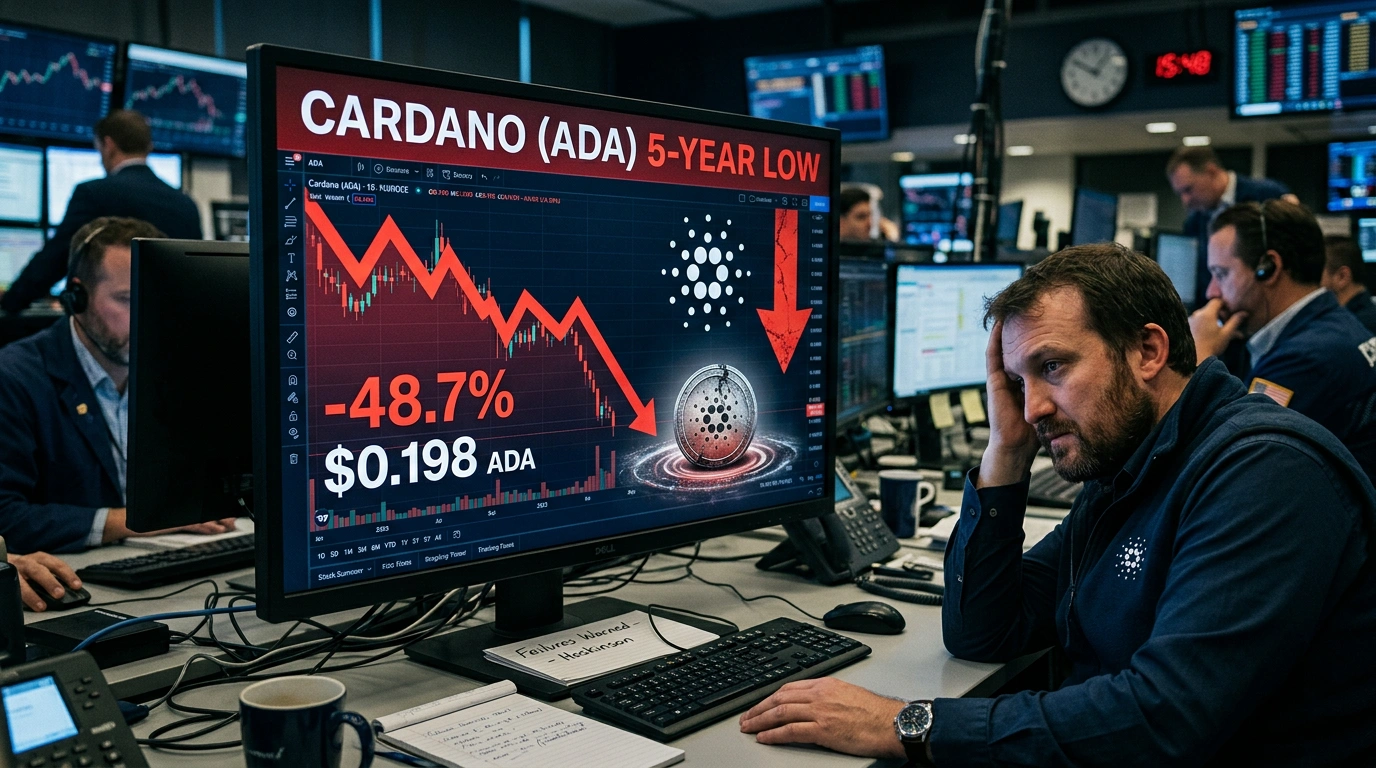
Cardano (ADA) fell below $0.20 on June 4 for the first time in more than five years. On the same day, network founder Charles Hoskinson published a candid YouTube monologue warning of a "wave of failures" in the Cardano crypto ecosystem. The pressure falls hardest on ADA holders and developers building on the network.
Where ADA Stands: The Drop Compared to the Broader Market
In 24 hours, ADA fell 7.95% and traded at $0.197. Bitcoin dropped 4.46% to $64,166 over the same period, while Ethereum fell 4.45% to $1,787. Cardano is losing significantly more than the market leaders.
The longer view is worse. ADA is down around 70% over the past year. From its all-time high of $3.09 set in 2021, the token has retreated more than 93%. Buyers who entered at the cycle peak now hold roughly 15 times fewer dollars than they put in.
At its 2021 peak, ADA ranked among the top five cryptocurrencies by market cap. Today it has slipped well out of the top 20 and continues to fall in the rankings. That signals more than a price drop: it points to declining interest from larger market participants.
Trading below $0.20 puts ADA back at prices last seen in early 2020, before the broader market recognized Cardano as a serious competitor. The network was positioning itself then as a research-based alternative to Ethereum and drawing millions of supporters. The return to those prices removes the premium investors paid for years on the strength of that thesis.
TapTools Shuts Down: What the Market Loses
The immediate trigger for Hoskinson's statement was the TapTools announcement. For four years, the platform gave Cardano traders and developers detailed on-chain analytics. The team has now announced it is shutting down.
TapTools was the de-facto standard for transaction analysis, DEX activity, and wallet tracking in the Cardano network. Traders used it to check liquidity pool volumes, monitor large wallets, and assess new projects. Without it, day-to-day work across the sphere gets harder.
The team explained the decision plainly: "Infrastructure costs are real. Development costs are real. Support costs are real. Operating a platform that serves the market at scale is expensive." The service could not reach profitability while the market stayed weak.
TapTools was not a marginal side project. It was one of the core analytics tools used daily by traders, project teams, and independent researchers. Its closure strips away a key information layer at the moment when the network needs new participants most.
Hoskinson: Candid Admission and Warning of More Failures
On YouTube, the Cardano founder spoke without his usual confidence. "I'm not exactly sure what my role or place is to resolve this," he said. That kind of admission is uncommon for a founder with a multi-billion-dollar ecosystem.
Hoskinson previously co-founded Ethereum before building Cardano through IOHK on peer-reviewed research. Earlier in 2026, he had warned that difficult market conditions would force closures. "There's going to be a wave of failures in the market," he said at the time. The TapTools shutdown confirmed that forecast.
He also raised the issue of the Cardano Foundation treasury. The community has consistently voted against spending it to support projects. Recently it declined to fund the annual Cardano Summit. "There doesn't seem to be a lot of community desire to spend the treasury to take these ventures to the next level," he said.
Hoskinson asked the community to stop blaming him personally for the network's problems. "It's not Charles Hoskinson driving them out. It's the economic reality driving them out," he said. The monologue raised the issues clearly but offered no concrete plan.
Risks for ADA Holders Right Now
The current situation around ADA creates several concrete market risks for token holders.
- More project closures. Hoskinson forecasts consolidation across Cardano's DeFi sector. Each shutdown pulls liquidity from the network and adds downward pressure on the token price.
- Developer outflow. Without new teams, transaction volumes stay low. Low activity limits the organic demand for ADA.
- Treasury pressure. The Cardano Foundation holds substantial ADA reserves. A large community vote to spend them could translate into selling pressure on the open market.
- Technical support levels. After breaking below $0.20, the next meaningful support zone in technical analysis sits near $0.15.
All four risks feed into each other: project closures accelerate developer outflow, outflow reduces network activity, and lower activity does not generate demand even at lower prices.
What to Watch For
ADA could stabilize if the wave of project closures stops and the community agrees to fund new initiatives from the market treasury. Both require time and a shift in sentiment that has not started yet.
After sharp drops in 2018 and 2019, ADA recovered alongside the broader market. But back then, the market was not facing mass closures from within. The current situation combines external market pressure with internal structural problems. That is a different risk profile compared to previous cycles.
The broader market offers no support right now. Bitcoin trades below $65,000. Ethereum is at a four-month low. In a general downturn, second-tier altcoins typically suffer more than the market leaders.
"We have the technology, we have the philosophy. We have no reason to lose," Hoskinson concluded. The market responds to liquidity and new capital, not philosophy. While both continue to shrink, the pressure on ADA continues.

Comments
Your email address will not be published. Required fields are marked *