


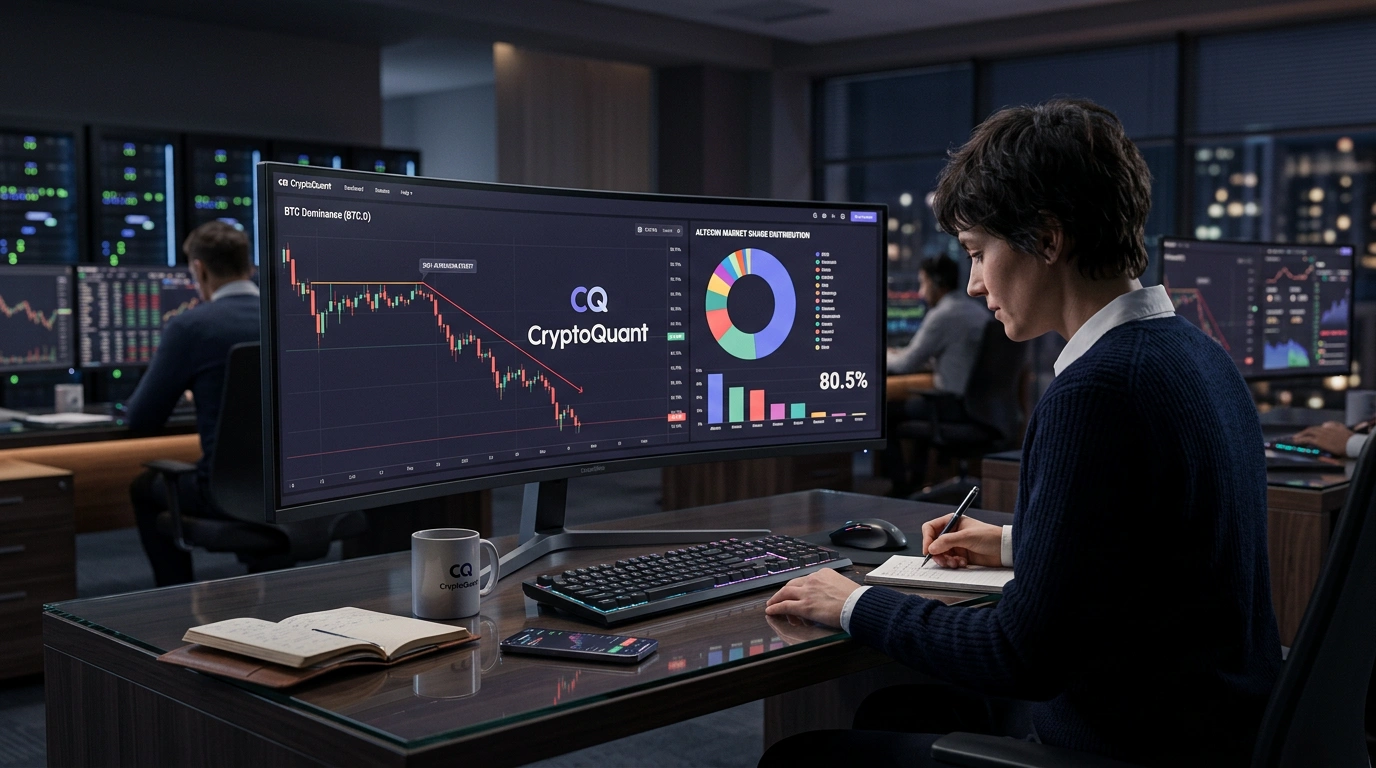
Traders are no longer rotating Bitcoin profits into altcoins the way they did in previous bull cycles. CryptoQuant data shows BTC-pair altcoin trading volume has collapsed to its weakest level since 2021. That raises serious doubts about whether a broad altseason can materialize any time soon.
Ki Young Ju, CEO of CryptoQuant, wrote on Saturday that the Bitcoin-to-altcoin rotation trend has "basically disappeared." Bitcoin dominance is holding above a key technical support, signaling the market may keep absorbing capital into BTC rather than spreading it across altcoins.
What CryptoQuant Data Shows on BTC-Pair Rotation
The CryptoQuant metric tracks aggregate trading volume of altcoins in BTC-denominated pairs on centralized exchanges. It excludes major assets such as Ethereum, XRP, BNB and Solana, focusing on mid- and lower-cap tokens where BTC rotation historically powered the biggest altcoin gains.
In 2017 and 2021, this metric surged sharply, fueling record altseasons. Right now it sits near post-2021 lows. Bitcoin is no longer the main liquidity source for altcoin speculation. "The era of alts pumping just because BTC pumps may be over," Young Ju wrote, citing CryptoQuant charts.
Market Concentration: Top 10 Hold 80.5% of Alt Capital
The non-Bitcoin, non-stablecoin crypto market is worth roughly $600 billion. But the distribution of that capital has narrowed substantially since 2021.
The top 10 non-stablecoin altcoins account for about $483 billion, or 80.5% of the total. In 2021, capital spread far more broadly across the market. Today liquidity concentrates in a short list of assets rather than flowing across the altcoin segment as a whole.
From 106 to 50 Large Altcoins: The Market Shrank in Half
In 2021, roughly 106 altcoins had market caps above $1 billion, according to a CoinMarketCap historical snapshot. As of June 2026, that number is down to about 50. The count more than halved in five years.
This backs up Young Ju's claim. Capital is not just rotating more slowly. It is concentrating into fewer and fewer projects. The market has not gone away, but it is built on far fewer large altcoins than it was in the last cycle.
Young Ju flagged the sectors where real interest is gathering: revenue-generating DeFi, stablecoins, tokenized real-world assets (RWA) and AI agents. He argues the next altcoin cycle will be less about rotating across the entire market and more about finding tokens with actual use cases and paying users.
Bitcoin Dominance: Reading the Technical Levels
Bitcoin's crypto market dominance (BTC.D) bounced from its 100-week exponential moving average and the lower trend line of an ascending channel. Both levels aligned at 58.75%. That confluence made it a meaningful technical support.
If momentum holds, BTC.D can push toward the upper channel line near 60%. A move there would mean Bitcoin is taking more market share from the rest of crypto. In practical terms, that delays any broad altcoin rally further.
Analyst Rekt Capital noted a bullish divergence on BTC.D: the metric makes lower lows while its RSI makes higher lows. That pattern often signals fading downside momentum and a potential bounce. Rekt Capital's read: "altseason is postponed."
That said, Rekt Capital also pointed out that BTC.D has already lost its macro uptrend. The current bounce may be a post-breakdown relief rally before further downside. If the bearish case plays out, BTC.D could drop toward its 200-week EMA at 57%, which would give altcoins more breathing room.
Outlook for Solana and the Broader Alt Market
If BTC.D climbs to 60%, Solana, Ethereum and other large altcoins continue to lose ground relative to Bitcoin in relative terms. For smaller altcoins the pressure is sharper: capital is concentrating in the top 10 and not flowing further down the market cap ladder.
The alternative path is BTC.D dropping to 57% (200-week EMA), freeing space for a wider altcoin recovery. Even then, Young Ju's warning holds: the recovery will not be uniform. Tokens with revenue and real users will benefit. Narrative-only projects likely will not.
Conclusion: A Structurally Different Market
BTC-pair altcoin volume at 2021 lows, the pool of large altcoins cut in half from 106 to 50, and the top 10 holding 80.5% of alt-market capital. Taken together, these are structural signals, not a temporary dip. BTC.D is holding above 58.75% and is technically positioned for a move toward 60%. A broad 2021-style altseason, where Bitcoin profits flow freely across hundreds of tokens, is on hold. The next cycle favors projects with defensible use cases in DeFi, RWA, stablecoins and AI.


Comments
Your email address will not be published. Required fields are marked *