


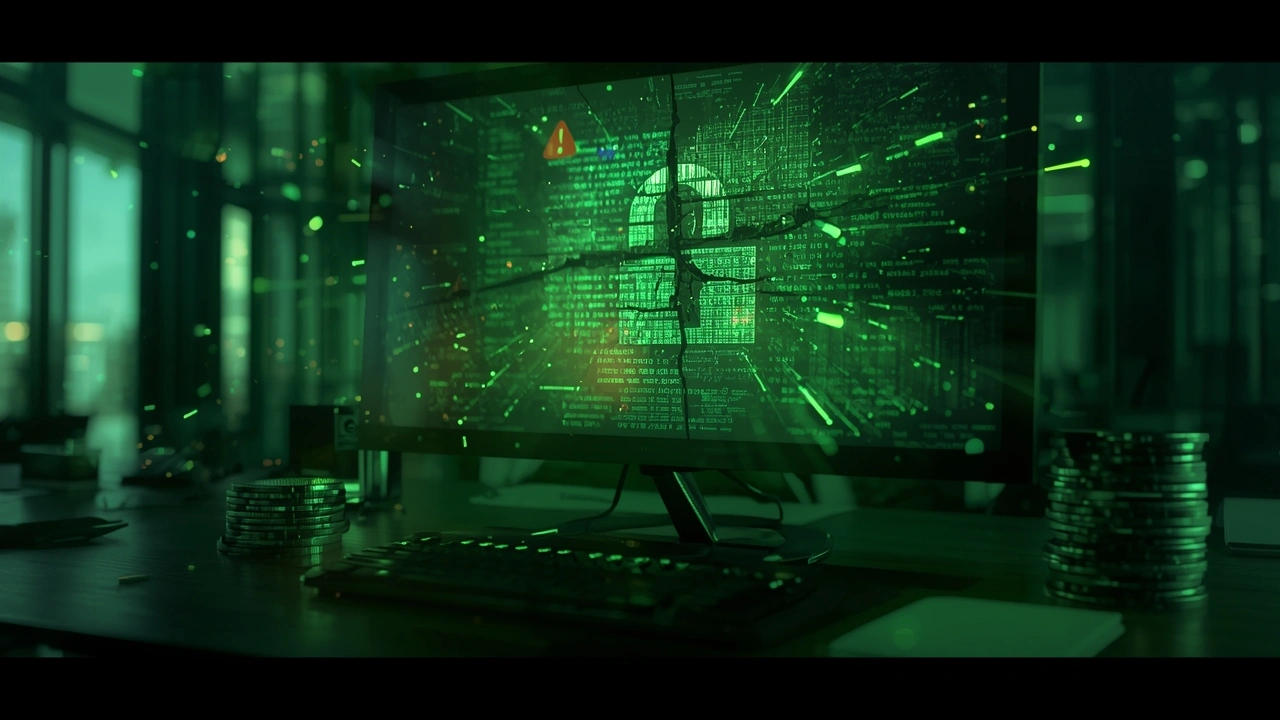
Chainalysis, the company whose reports law enforcement and exchanges use to trace stolen funds, has itself become a hacking target. It disclosed a cyber incident in which customer names and email addresses leaked. For the market it is an uncomfortable signal: the watchdog that tracks other people's thieves turned out to be vulnerable.
What exactly happened to Chainalysis?
On Friday the company published a blog post saying it had been attacked, like other platforms hit in recent weeks. According to Cointelegraph, user IDs, names and email addresses were exposed. Chainalysis calls this data non-sensitive.
The Block's headline frames it differently: the hacker used "offensive agentic techniques". That points to an attack where the work is done not by a person at a keyboard but by an AI agent that finds weak spots on its own and acts through a chain of steps. The company has not yet said how the intruder got in.
What did the hackers not get?
For Chainalysis customers the main question is whether anyone saw their cases. The company says no.
"Based on the investigation to date, we have found no evidence of unauthorized access to investigation content, authentication credentials, or session tokens."
Chainalysis, from the company blog post of October 30, 2026
That is a preliminary conclusion. The probe continues, and the phrase "to date" leaves room for revisions. The company brought in outside cybersecurity experts and is using large language models to review its own defenses.
Why is a leak of names and emails still risky?
Names and email addresses look minor until someone merges them into a database. A client list of a company that handles crypto crime investigations interests several groups at once.
- Phishing: a message "from Chainalysis" with the right recipient name looks convincing and is easier to fall for.
- The users of the service can be targeted too: exchanges, banks, government bodies.
- Knowing exactly who is a customer helps scammers pick targets for social engineering.
- For the company itself it is a reputation hit, since its product is trust in the data.
So the advice is simple: do not click links in emails about the "incident", and check the sender.
Is the incident linked to the Binance hack?
No, at least according to the company. It stressed separately that the incident has nothing to do with the recent theft at Binance, where attackers drained about $6.3 billion. The timing is odd: Chainalysis is exactly the firm helping trace where the stolen bitcoin moves.
There is no evidence of a connection between the two events, so there is no point in building theories. Just one observation: whoever hits both the exchange and the people who follow the money is clearly planning a long game.
What do the numbers say about the scale?
On Friday Chainalysis posted on X that hacks suspected of North Korean links made up almost 89% of reported crypto hack losses this year. In 2021 the share was 15%. That is a sixfold rise in five years.
For a user who keeps Bitcoin on an exchange, the takeaway is practical. The security of services we trust is not guaranteed, even for those whose job is security. Keep on an exchange only what you are ready to risk, turn on two-factor authentication and do not open messages demanding urgent action. We at Kurslog suggest treating every such message with suspicion, even when it looks perfect.



Comments
Your email address will not be published. Required fields are marked *