


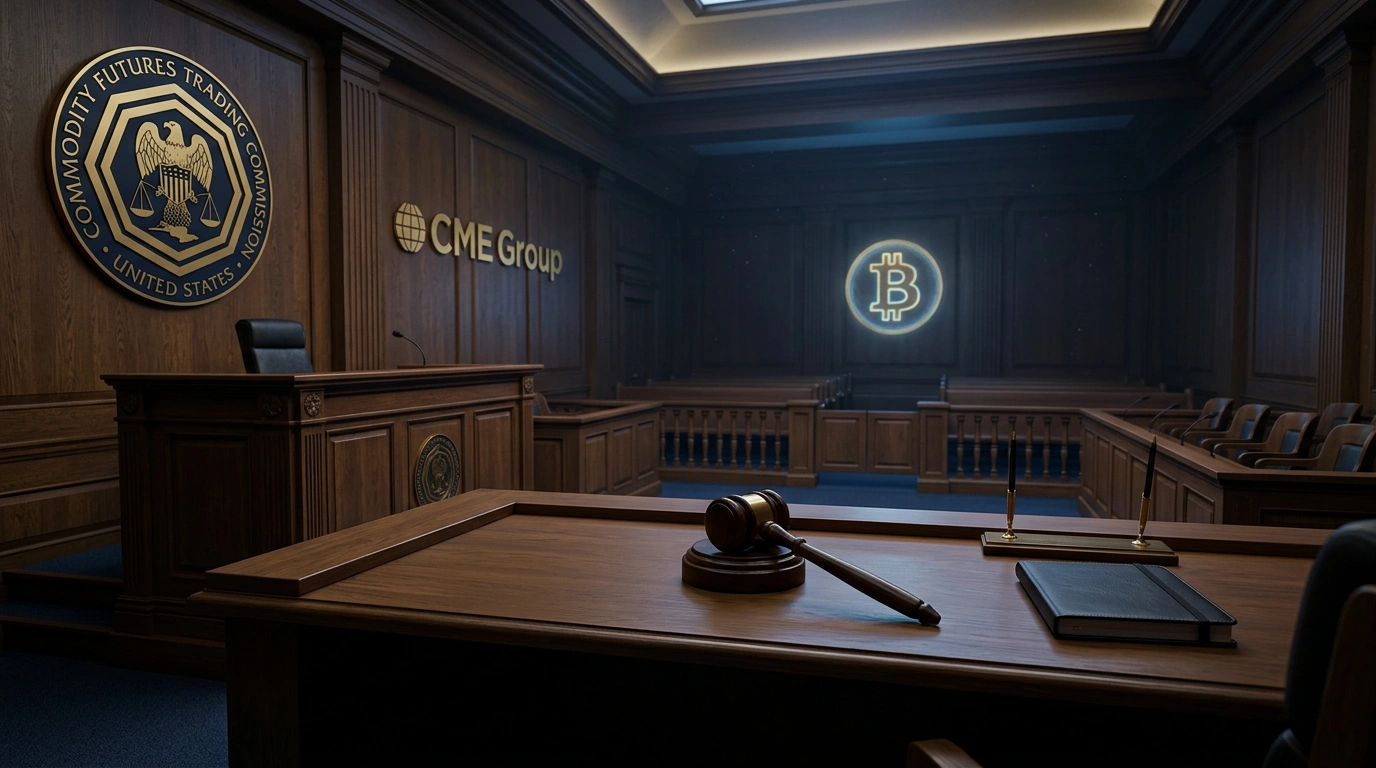
CME Group (the world's largest derivatives exchange operator) filed suit against the CFTC on Thursday, June 18. It is the first open courtroom clash between two central players in the U.S. derivatives market. At issue is the CFTC's May decision to approve Bitcoin perpetual futures for two American platforms.
Perpetual futures: what the product is and how it works
Perpetual futures (perps) are derivatives contracts with no expiration date. A standard futures contract ties to a specific month and rolls automatically at expiration. A perp stays open indefinitely. The trader closes it whenever they decide.
The price stays close to the spot market through a funding rate mechanism. Every eight hours, the side with the dominant position pays the other a small fee. When buyers outnumber sellers, buyers pay; when sellers dominate, the direction reverses. This keeps the perp price anchored to the real Bitcoin spot rate.
Perps became the most popular speculative instrument in crypto years ago, but only on offshore platforms. On Binance, Bybit, and OKX, daily Bitcoin perp volumes dwarf the spot market by multiples. Until May 2026, U.S. traders had no regulated access. Anyone who wanted to trade perps had to sign up on offshore venues with no American legal protection.
Their appeal comes down to two things. No monthly rollover means traders skip the cost of moving a position from one contract to the next. And deep liquidity on major platforms keeps spreads tight even for large trades. For short-term traders, that beats quarterly contracts by a wide margin.
Why did the CFTC approve perps in May?
CFTC Chair Michael Selig had a clear rationale. The Bitcoin perp market already existed outside U.S. oversight. Hundreds of thousands of Americans were trading on offshore platforms that owe no duty to U.S. law. Rather than ignore it, the regulator chose to bring the activity onshore.
In May the CFTC issued two approvals. Kalshi received a license to launch its own Bitcoin perpetual futures contract on a regulated U.S. venue. Coinbase received permission to connect American customers to offshore perps without registering a separate product. Both steps gave U.S. retail traders their first legal access to up to 50x leverage on Bitcoin.
CME CEO Terry Duffy saw those decisions differently. He drew a direct comparison to 2008 and put it bluntly on CNBC.
"The housing market has been supplanted by the speculation market, including predictions and everything else, and this could be a disaster waiting to happen."
Terry Duffy, CEO CME Group, CNBC Fast Money, June 2026
What exactly does CME challenge in the lawsuit?
The entire case turns on classification. CME argues that perps meet the definition of a swap under the 2010 Dodd-Frank Act, not a futures contract. That gap is not just terminology. Swaps must trade on a Swap Execution Facility (SEF) with different clearing, reporting, and licensing requirements. The current approval format, CME says, violates federal law.
CME also points to its exclusive licenses on key market benchmarks. Duffy contends that any new perp platform would have had to route through CME regardless. The regulator, in CME's view, bypassed that mechanism. The company also argues the CFTC cleared Kalshi's application far faster than standard review timelines.
The main claims in CME's lawsuit:
- Classification: perps are swaps under Dodd-Frank, not futures, and require a different regulatory regime
- Swaps must trade on a SEF with stricter clearing and reporting standards
- CME holds exclusive benchmark licenses that competing platforms should have used
- The CFTC reviewed Kalshi's application faster than standard procedural timelines
Duffy said CME spent eight months preparing the challenge with its board. "I've never shied away from a good battle, and I won't shy away from this one," he told CNBC.
Why is the CFTC holding firm?
A CFTC spokesperson called the CME suit "frivolous" and confirmed the agency would defend its decision in court. Chair Selig does not waver from his position. Perps already exist on the market, and pulling them under U.S. oversight beats leaving them in an unregulated offshore space. Kalshi and Coinbase continue operating normally, since the lawsuit does not automatically suspend their licenses.
The case was filed in U.S. district court. Regulatory disputes of this kind can take anywhere from several months to two or more years to resolve. Until a ruling comes down, the market stays as is. Potential new entrants who were eyeing perp launches may now wait on the sidelines.
The timing carries its own symbolism. Duffy filed the suit the same day CME announced his departure. He will hand the CEO role to Lynne Fitzpatrick in March 2027, the first woman to lead the company in its 175-year history. This lawsuit is shaping up to be the final major fight of Duffy's tenure. If CME wins, he exits having set the biggest regulatory precedent in crypto derivatives. If it loses, the market stays open for competitors.
The effect on Bitcoin holders and the market
For a typical Bitcoin holder, there is no immediate effect. But the verdict will determine how many regulated U.S. venues offer perps and under what rules. Derivatives markets consistently outpace spot in trading volumes. In perps, that gap is even wider.
If CME wins and courts reclassify perps as swaps, new market entrants will face higher registration barriers. For retail traders that likely means fewer platforms and a steeper entry threshold. If the CFTC prevails, the market will grow out from Kalshi and Coinbase, and more regulated venues will bring deeper liquidity and tighter price discovery for Bitcoin in the U.S.
The lawsuit itself signals something beyond any legal argument. The U.S. crypto derivatives market is entering a phase where the rules have not been settled yet. Who writes them will be decided in court.



Comments
Your email address will not be published. Required fields are marked *