


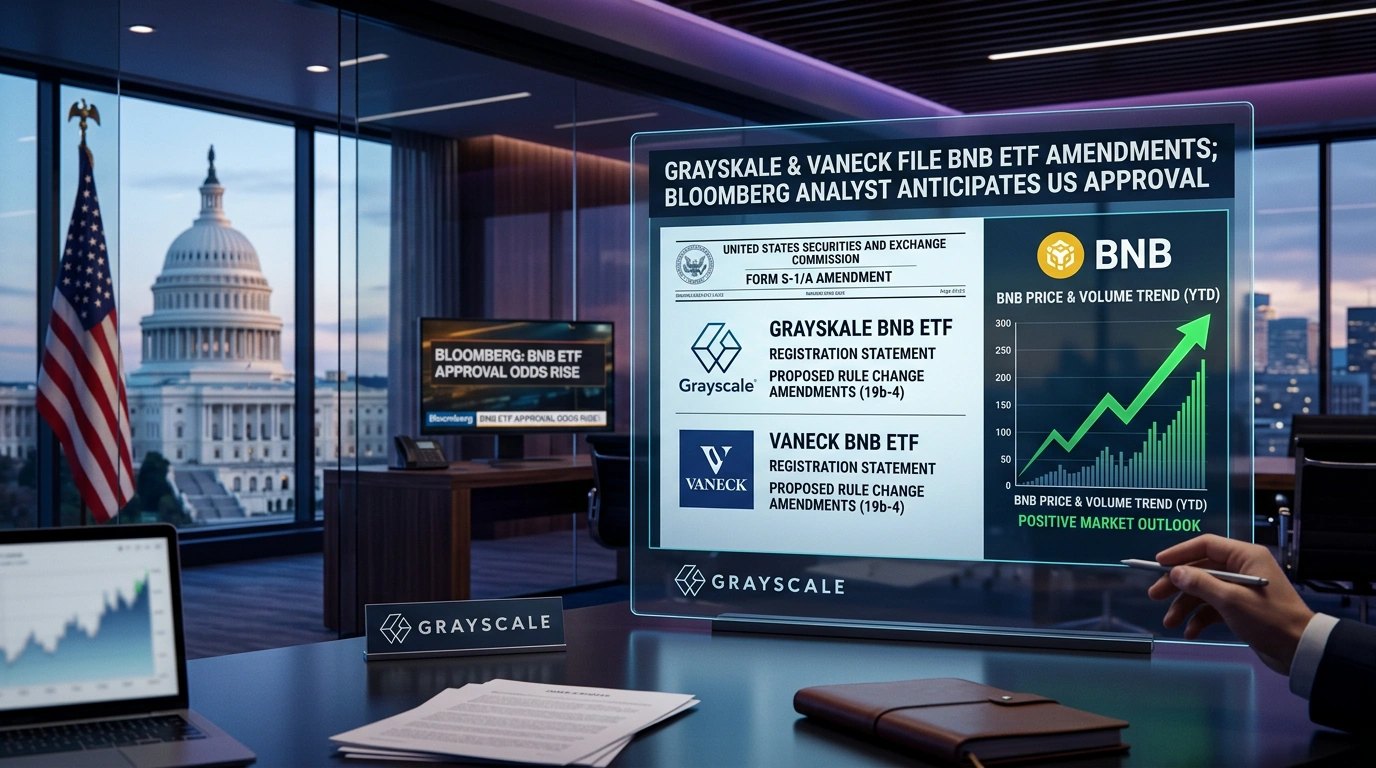
On Friday, May 16, Grayscale and VanEck both filed amendments to their spot BNB ETF registration statements with the SEC. Grayscale submitted its second amendment, VanEck its fifth in just over a year. Bloomberg ETF analyst James Seyffart commented the same day that BNB could realistically become the next cryptocurrency to receive spot ETF approval in the United States.
What was updated in the filings?
An S-1 is the primary registration document that ETF issuers must submit to the SEC before launching a fund. It covers fund structure, asset custody strategy, management fees, and a full list of investor risks. Each amendment typically means the regulator raised questions, and the issuer addressed them in a revised version returned for review.
Grayscale first filed for its BNB ETF (ticker GBNB) on January 23, 2026, making Friday's submission the second amendment. VanEck BNB ETF (ticker VBNB) has been in the process considerably longer: its first filing came in May 2025, and the company has now prepared five versions of the document. VanEck has proposed a 0.39% annual management fee for VBNB.
The fact that both issuers updated their filings on the same day is not coincidental. "Have to guess they are going off feedback from SEC and trying to launch in near future," wrote Seyffart. "Could be the next crypto asset to get a spot ETF in the US."
Why does BNB still lack a US ETF?
BNB ranks fourth globally by market capitalization at 7.4 billion. Yet it remains absent from the list of approved US spot altcoin ETFs, which already includes Solana, Litecoin, XRP, and Hyperliquid's HYPE. BNB has been passed over so far.
The reason is not BNB's reputation or technical characteristics. Before September 2025, the SEC reviewed each ETF application individually, requiring a fresh regulatory precedent for every new cryptocurrency. That approach slowed the process considerably. In the fall, the regulator introduced a generic listing standards framework for crypto assets, allowing any company to apply through a unified procedure.
BNB entered that new system later than some competitors. Solana and XRP completed initial approval cycles earlier or in parallel with the rule change. Grayscale filed for BNB only in January 2026. VanEck started slightly earlier but still under the new regulatory framework. The line exists. BNB is moving through it.
How did other altcoin ETFs perform at launch?
Since October 2025, the US ETF market has regularly added new crypto products. Reception has varied:
- Canary XRP ETF (XRPC): 45 million in net inflows on day one - a record for new altcoin ETFs
- Bitwise Solana Staking ETF (BSOL): 9.5 million on opening day
- 21Shares Hyperliquid ETF: just .2 million on debut day (May 2026)
The differences reflect institutional familiarity with each asset. XRP and Solana have been listed on major US exchanges for years and are well known to professional investors. Hyperliquid has a devoted DeFi following but limited recognition beyond that community. BNB's audience and liquidity profile put it closer to the first group: the token has been in the global top five by market cap for years and trades on every major exchange.
Are five amendments a sign of trouble?
In regulatory practice, amendment count is not a warning sign. It reflects the pace of dialogue between issuer and regulator: the SEC finds questions in the details, the issuer responds with an updated document. More active back-and-forth generally signals progress.
Bitcoin ETFs from BlackRock and Fidelity also went through multiple S-1 rounds before receiving approval in January 2024. Both funds subsequently attracted tens of billions of dollars. Nobody read the amendment count as a problem then.
Grayscale and VanEck are currently the only firms that have filed for a BNB ETF in the US. There is no third competitor in this race. If the SEC approves a BNB product, GBNB and VBNB will be first to market, giving them time to attract early institutional interest without pressure from rivals.
What does this mean for the market?
ETF approval does not guarantee an automatic price rally. The Hyperliquid example makes that clear: even a listed product can see weak first-day demand if the underlying asset lacks broad institutional recognition.
For established cryptocurrencies, however, ETF approval opens a new channel of capital. Pension funds, insurance companies, and standard brokerage accounts can invest through ETF wrappers where direct crypto custody is restricted or impractical. That is how Bitcoin attracted over $50 billion in new institutional capital after ETF approval in 2024. Ethereum followed with its own significant inflows.
As the fourth-largest crypto asset, BNB represents a logical next step in that progression. A SEC decision is expected within the coming months. The market is watching.



Comments
Your email address will not be published. Required fields are marked *