


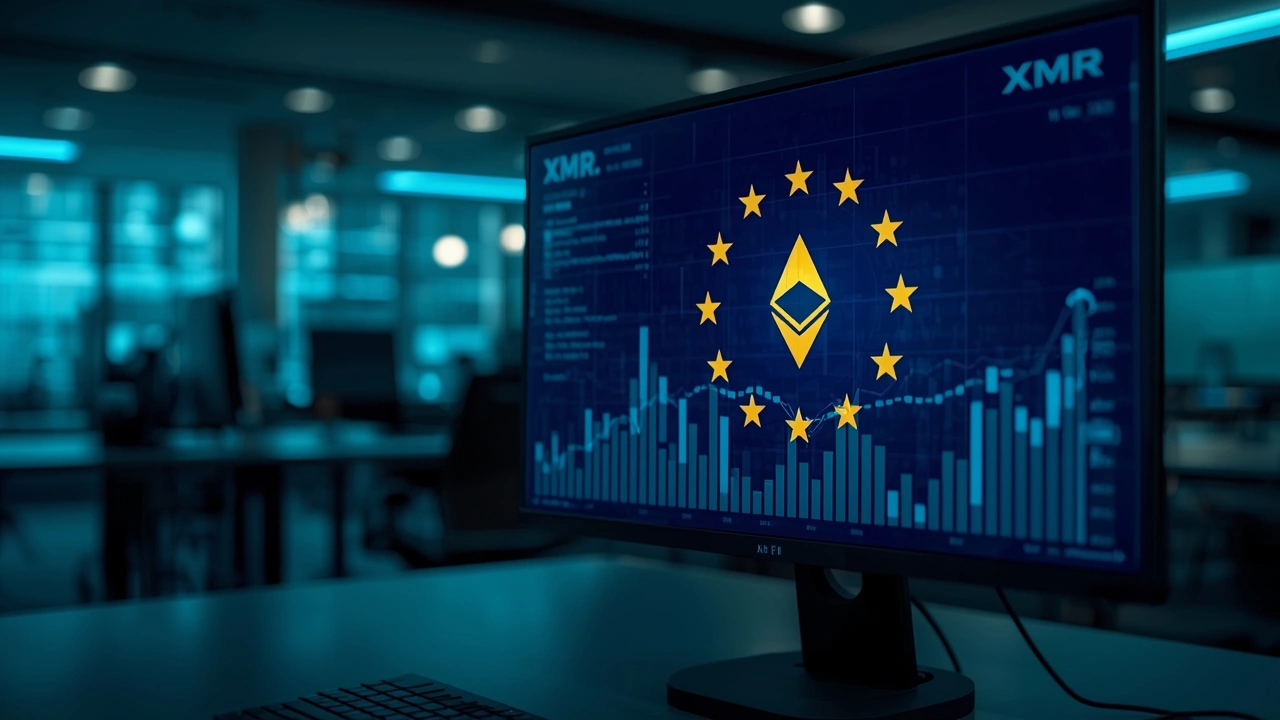
KuCoin announced it will remove Monero (XMR) from its markets on Nov. 30. It is the second major platform this month to drop the coin that hides transactions. XMR fell 10.5% in a day to $449.98.
According to Cointelegraph, the reason lies in Europe: from mid-2027, AML rules will bar regulated firms from handling "anonymity-enhancing coins".
XMR sits 28% below its Nov. 3 level
On Thursday evening UTC, Monero traded at $449.98. On Nov. 3 the price hovered near $625. That is a drop of roughly 28%, and on Thursday alone the coin shed another 10.5%.
CoinDesk called it XMR's biggest one-day slide in more than five months. So this is not ordinary noise: the selling is tied to specific exchange news.
Who has already switched Monero off
KuCoin has already suspended XMR deposits. Trading closes on Nov. 30, and withdrawals will stay open until Dec. 31. Earlier in November, MEXC suspended XMR spot trading and delisted its perpetual futures on the coin.
This is not the first such move. Binance delisted Monero back in 2024, and Kraken ended support for the European Economic Area the same year. The trend runs back to 2018, when Japan's FSA pressed exchanges to drop anonymity coins. South Korea and Dubai later took similar steps.
What Europe will restrict from July 10, 2027
From July 10, 2027, the EU's Anti-Money Laundering Regulation (AMLR) bars financial firms, including crypto service providers, from keeping anonymous accounts or accounts that obscure transactions through "anonymity-enhancing coins". It does not matter whether privacy is on by default or optional.
Individuals are not banned from anything. Holding such coins in a self-custody wallet remains legal. The limits hit exchanges and platforms that operate under a license.
Zcash: Grayscale's bet on optional privacy
Zcash launched in 2016 and lets users choose between transparent and shielded transactions. Monero, created in 2014, hides amounts and addresses by default. The difference matters, but the AMLR definition covers coins where privacy works "systematically or optionally", so Zcash may fall within the limits too.
Grayscale is not scared. Its spot ZEC ETF started trading on NYSE Arca on Aug. 25. On Sept. 24 the fund reached $1 billion in assets, and on Wednesday it held $406 million. That is about 59% below the peak.
- ZEC rose from $524 at the start of the year to $1,653 on Sept. 26.
- After the ETF launch, the price more than doubled in a month.
- Now: about $770, or roughly +50% year to date.
Will viewing keys save it
Grayscale research head Zach Pandl considers Zcash technically stronger. In his words, viewing keys let a holder show transactions to an auditor or regulator, which gives a person control over who sees their finances. Whether regulators accept that is an open question.
"For public blockchain technology to become a mainstream part of the financial system, it absolutely needs a privacy layer."
Zach Pandl, head of research at Grayscale, from an interview with Cointelegraph
Pandl also noted that artificial intelligence makes it easier to link pseudonymous addresses with off-chain data. Monero's ring signatures, in his view, may be vulnerable to such analytics. Monero developers are preparing an upgrade that would replace them with zero-knowledge proofs.
What is left in the end
For XMR, the next weeks will be set by the exit of exchange liquidity: trading on KuCoin closes on Nov. 30, withdrawals on Dec. 31. For Zcash, it is a test of whether a bet on optional privacy can survive inside EU rules.
The practical takeaway is simple. Anyone holding XMR on an exchange should move it to a personal wallet before Dec. 31. Whether the wave of delistings spreads to other platforms should become clear by spring, when exchanges begin preparing for July 2027.


Comments
Your email address will not be published. Required fields are marked *