


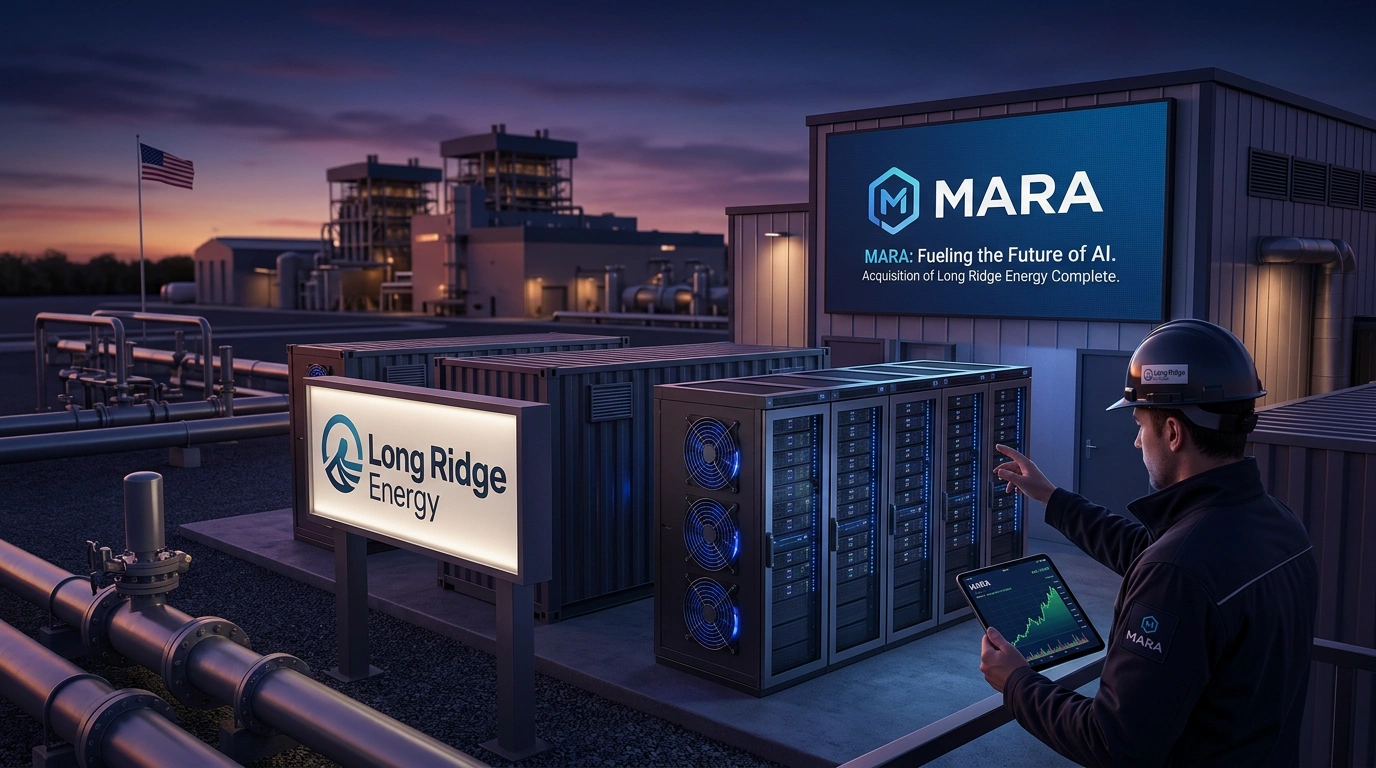
MARA Holdings agreed to acquire Long Ridge Energy & Power for approximately $1.5 billion, adding a 505-megawatt gas power plant and a co-located data center site in Ohio to its portfolio. Shares on Nasdaq jumped more than 12% after Thursday's announcement, extending a 55% monthly rally. Bitcoin miners are moving toward AI infrastructure faster than the market expected.
What MARA Acquired and What the Assets Include
The site sits on 1,600 acres in Hannibal, Ohio, and includes a combined-cycle gas plant with all-in operating costs below $15 per megawatt-hour, one of the lowest figures among industrial power sites in the US. A data center pad sits adjacent to the plant. The company received inquiries from AI and cloud tenants before the deal even closed.
The financial structure: MARA assumes roughly $785 million in debt backed by a bridge loan from Barclays. The site is expected to contribute about $144 million in annualized adjusted EBITDA. The deal is set to close in the second half of 2026, subject to regulatory approvals, with construction starting in the first half of 2027 and operations targeted for mid-2028.
Total site potential exceeds 1 gigawatt: 200 MW of existing capacity plus the ability to scale compute to 600 MW. That represents roughly a 65% increase in MARA's owned power capacity. In February 2026, the company also acquired a 64% stake in French computing infrastructure firm Exaion. The Ohio deal is the second major step in that same diversification strategy.
Beyond raw capacity, the site's geography matters. Access to water, fiber, and large land reserves makes Hannibal attractive for large-scale compute deployments. Locations that combine all four resources are increasingly rare in the US.
How the Deal Moved Shares and Investor Expectations
MARA shares rose more than 12% on Thursday. Over the past month, the stock is up roughly 55%, well ahead of Bitcoin, which is trading near $76,400 after the Federal Reserve held rates steady again. The market is rewarding strategic diversification more than hash rate growth.
The investor logic is straightforward. When BTC falls, mining margins compress and a company tied entirely to the crypto market takes losses. A data center with AI tenants nearby provides partial revenue stability. Owning cheap power generation reduces operating costs regardless of where the market trades.
Analysts point to one more factor: AI client inquiries arrived before the deal officially closed. If long-term leases get signed during 2026, MARA will have recurring revenue that does not depend on crypto prices. For institutional investors sensitive to BTC volatility, that meaningfully changes the risk profile.
Impact: The deal pushes MARA's potential capacity above 1 GW and adds $144 million in annual EBITDA. With generation costs below $15 per MWh, the company now holds one of the cheapest energy bases among publicly traded Bitcoin miners in the US.
Risks for the Mining Sector and the Bitcoin Network
Redirecting capacity from Bitcoin to AI carries specific risks. If several large miners cut hash rate simultaneously, the network temporarily becomes more exposed. The difficulty adjustment algorithm compensates within a few weeks as smaller miners fill the gap, but the window for attack formally widens during the transition.
A harder problem sits inside MARA itself. Running a gas plant, a data center, and a Bitcoin farm at the same time means three separate regulatory regimes and three different client bases. The $785 million debt load increases sensitivity to any construction delays or cost overruns. The Ohio site is at least two years from generating revenue.
The systemic pressure is also growing. Both industries, crypto mining and AI compute, are competing for the same cheap power in the US. Those who locked in contracts early pay less and get better sites. Those who wait may find few affordable options left by 2027.
Competitors Are Taking the Same Route
MARA is not alone. In January 2026, CleanSpark signed a deal for 447 acres in Texas for a 300-MW AI-focused data center. In March, Core Scientific secured a $500 million loan from Morgan Stanley for data center expansion. HIVE Digital Technologies announced a $75 million raise for GPU purchases.
CoreWeave tells its own story. The company started as a Bitcoin miner, was among the first to pivot to GPU compute, and in April 2026 signed a multi-year agreement with Anthropic to support Claude workloads. Its market valuation now far exceeds any traditional Bitcoin miner.
One pattern connects all these deals: cheap or owned electricity became the key asset, not hardware. Sites that mined coins a year ago now attract cloud provider inquiries. Whoever locked in cheap power first is in a strong position regardless of what workloads they choose to run.
What Comes Next for MARA and the Mining Industry
MARA currently holds more than 47,600 BTC. At current prices that is over $3.6 billion. Share performance will continue to track Bitcoin, at minimum until the Ohio site launches operations in mid-2028. The original business model has not gone away.
But the shape of future earnings is changing. If AI tenants sign long-term leases in 2026 or 2027, the share of revenue outside crypto markets will grow. Institutional investors who avoid heavy BTC exposure will see a more predictable income profile from MARA compared to pure-play mining companies.
The direction for the sector is clear: Bitcoin miners are becoming energy and compute providers. MARA's deal sends a firm signal to the market. Companies that fail to secure enough capacity before 2027-2028 risk being left with an outdated model in a market that has already moved on.
Comments
Your email address will not be published. Required fields are marked *