


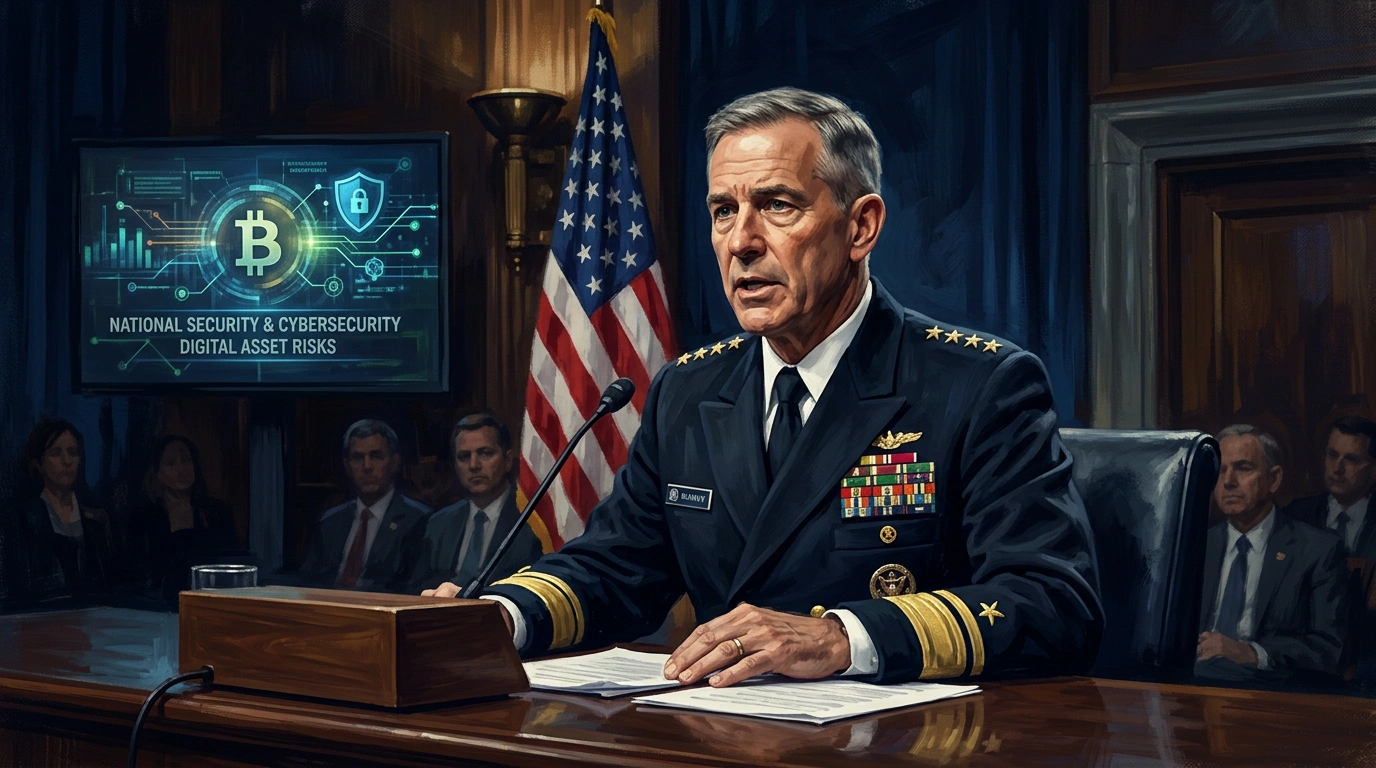
US Navy Admiral Samuel Paparo publicly called Bitcoin "a valuable computer science tool" and an instrument of power projection at a Senate Armed Services Committee hearing on Tuesday, April 21. He argued that proof-of-work technology imposes costs on attackers trying to compromise the network and has "really important computer science applications for cybersecurity."
What the admiral actually said
Senator Tommy Tuberville asked how the US and Congress can lead on Bitcoin competition with China, noting that China's top monetary think tank now views Bitcoin as a strategic asset. Paparo responded directly. "It is a valuable computer science tool, as a power projection. Outside of the economic formulation of it, it has got really important computer science applications for cybersecurity," he said.
He went further. "Bitcoin is a reality. It is a peer-to-peer zero-trust transfer of value. Anything that supports all instruments of national power for the United States of America is to the good," he added.
China, Bitcoin, and a Senate hearing about the Indo-Pacific
Tuberville's question put the Bitcoin competition with China on the record. The US holds the largest Bitcoin reserves among nation-states and controls the largest share of global hashrate. The vulnerability is on the hardware side: American miners rely on ASIC equipment made primarily by Chinese manufacturers. In a technology rivalry of this scale, that dependence is a supply chain risk few in Washington have addressed publicly.
This is not the first argument of its kind
In December 2023, US Space Force officer Jason Lowery published a thesis arguing that proof-of-work networks could defend the US against cyber threats. He said Bitcoin can secure "all forms of data, messages or command signals," not just financial transfers. That thesis stayed in a narrow academic circle. Paparo saying something similar in a Senate hearing is a different thing entirely.
The underlying argument is this: attacking a PoW network requires enormous computing resources. That makes large-scale cyberattacks expensive. The country with the most hashrate has a built-in advantage - defending costs less, attacking costs more.
Why this goes beyond the usual Bitcoin debate
Until now, the official US conversation about Bitcoin has mostly stayed in financial territory: the strategic reserve, spot ETFs, exchange regulation. Paparo's statement is the first time a sitting four-star admiral has directly connected Bitcoin to national defense before the Senate, without qualifications.
If this view gains traction in Congress, the next logical push would be support for domestic Bitcoin mining and local ASIC manufacturing. As long as American miners source their chips from Chinese producers, that vulnerability stays open.



Comments
Your email address will not be published. Required fields are marked *