


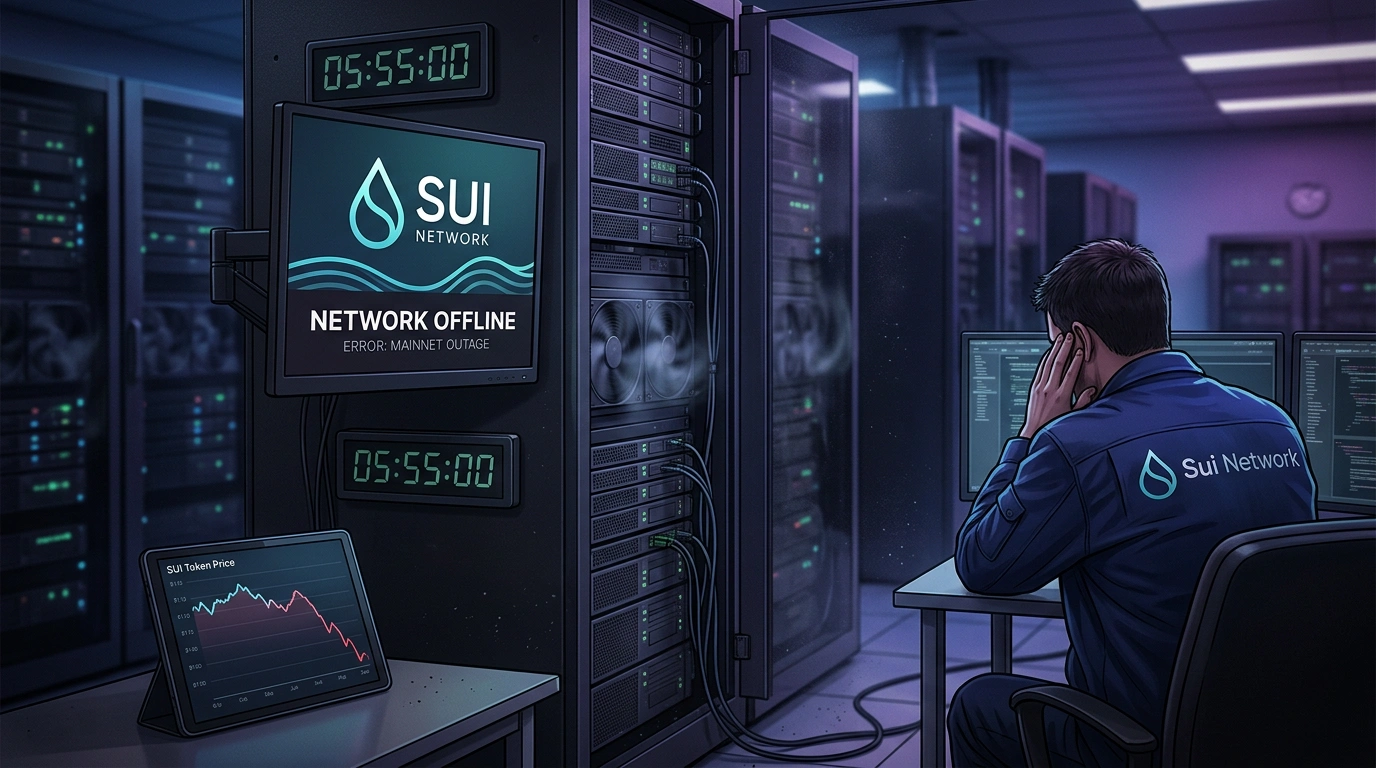
On Thursday evening, the Sui network went offline for nearly six hours after a bug slipped into a routine update. Transactions stopped processing, 137 protocols on the blockchain became unreachable, and the SUI token dropped 6.6%. For a network that markets itself as a payment blockchain built for financial institutions, this was the third serious outage in 18 months.
What exactly happened during the outage?
The problem started with version 1.72. Mysten Labs, the team behind Sui, shipped a planned update. Bundled with it was a bug in the module responsible for calculating gas fees. When updated nodes tried to process transactions, they hit an error that caused them to crash out entirely.
Sui confirmed the outage in an official post on X, attributing it to "a crash bug in the gas charging logic introduced by the 1.72 release." Earlier, the team had described a "network stall" and warned that transactions might pause until a fix rolled out. Recovery required building a hotfix, getting validators to install it, and waiting for a critical mass of nodes to restart with the patched code. After the network came back online, the team promised a detailed public incident review.
"A halt due to a crash bug in the gas charging logic introduced by the 1.72 release. A full incident review will be shared in the coming days."
- Sui Network, official post on X, May 29, 2026
How does a gas logic bug take down an entire blockchain?
Gas in a blockchain is the fee paid for processing transactions. Every operation, whether a token transfer or a smart contract call, consumes a set amount of gas, and the sender pays that amount to validators. The fee size depends on the complexity of the operation and current network load.
The gas charging module checks every transaction before it gets included in a block. If this module returns a bad result or crashes, the node cannot form the block. Sui uses BFT consensus, where all nodes must follow the same processing rules. When that rule breaks at the code level, the entire network stops, not just one node.
In BFT-based systems, unlike classic proof-of-work, a block is formed through a 2/3 validator vote. That speeds up transaction finality, but it also means a shared code bug stops everyone at once, with no isolated node continuing to run.
Here is the standard transaction path that the bug interrupted.
- Gas check: the node confirms the sender has enough funds to cover the fee.
- The transaction enters the mempool and waits in queue for the next block.
- Validators vote on a set of transactions and collectively sign the block.
- The bug in version 1.72 broke the first or second step, so blocks simply never formed.
Three outages in 18 months
November 2024: all network validators entered a crash-restart loop. The downtime lasted around 2.5 hours. Then came January 2026 with a similar failure, where the network was down for more than six hours. Now May 2026, and the pattern repeated.
SUI responded with a sell-off. During the outage the token dropped to $0.90, down 6.6% from the day's opening price. At the start of May the coin was trading at $1.41, lifted by a streak of good news. A Nasdaq-listed company had staked a large portion of the supply, and developers announced upcoming zero-fee stablecoin transfers and private transaction features. After the network came back, the price recovered to around $0.93.
What was paused for six hours?
At the time of the incident, 137 protocols were running on Sui with a combined TVL of $542 million, according to DefiLlama. For nearly six hours, no operation in those protocols executed. Decentralized exchanges went dark, lending positions sat unserviced, and staking transactions did not go through.
The exact financial loss is hard to calculate. Validators missed all fee revenue during the window. Traders with open positions could neither close their trades nor add collateral. Liquidation calls in lending protocols went unprocessed, which on a volatile day stacks up risk. Arbitrageurs tracking price gaps between Sui and other networks were shut out of the market for the full duration.
Ethereum, with all its technical trade-offs, has not suffered a full network halt since 2023. Solana went through several high-profile outages in 2021 and 2022 and spent years rebuilding developer trust. Sui, which launched its mainnet in May 2023, is now navigating a similar reputational challenge.
What comes next for Sui?
Mysten Labs has promised a full postmortem report. It should answer how the bug made it into version 1.72, why testing did not catch it, and what process changes the team will put in place to prevent a repeat.
The roadmap itself has not changed. Adeniyi Abiodun, co-founder of Mysten Labs, confirmed at Consensus 2026 that zero-fee stablecoin transfers and private transaction features are coming soon. Sui continues to target enterprise and financial applications, and after three years of mainnet operation it has accumulated $542M in TVL across 137 protocols.
Three serious outages in 18 months is not a coincidence. Enterprise clients picking a blockchain for critical payment infrastructure weigh uptime alongside throughput and fees. The upcoming postmortem will show whether the Mysten Labs team has identified the root cause and built a more reliable testing pipeline around network updates.


Comments
Your email address will not be published. Required fields are marked *