


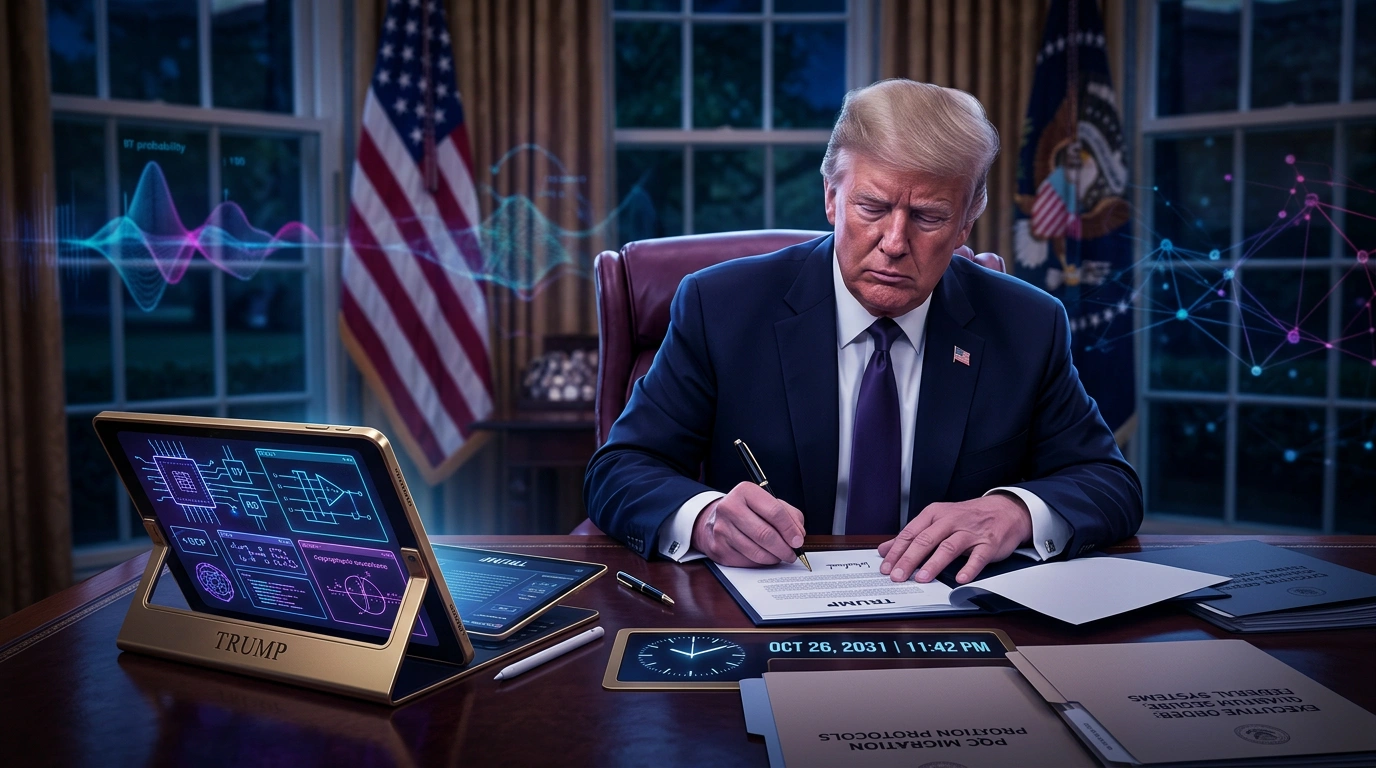
US President Donald Trump signed two executive orders on quantum technologies on June 23. One targets the development of quantum computers at a national scale. The other sets a firm deadline: all federal systems and high-value assets must migrate to post-quantum cryptography by the end of 2031. For the crypto market, this is a signal that is hard to dismiss.
What do the two orders actually say?
The first order launches the QC-ADDS program (Quantum Computer for Application Development and Discovery Science), aimed at building an application-scale quantum computer. All federal agencies have 180 days to update the National Quantum Strategy to support commercialization and industry partnerships. Agencies are also required to assess the implications of growing commercial quantum capabilities, including for the migration to new cryptographic standards.
The second order places the Office of Management and Budget (OMB) and the National Cyber Director in charge of a nationwide transition to post-quantum cryptography. All federal high-value assets and critical systems must complete the migration by December 31, 2031. The orders establish a "cohesive, whole-of-government approach" to quantum deployment and commercialization.
"We're going to be investing in American quantum leadership like never before to stay ahead of the pack."
- Donald Trump, US President, statement at the signing of executive orders, June 23, 2026
Why is current cryptography at risk?
Bitcoin, Ethereum, and most blockchains rely on ECDSA (Elliptic Curve Digital Signature Algorithm). It is built on the discrete logarithm problem for elliptic curves. For classical computers, this problem is practically unsolvable. Shor's algorithm, published in 1994, can theoretically solve it in polynomial time, meaning it could crack a private key from a public one far faster than any classical computer could manage over billions of years.
The exposure goes beyond wallets. ECDSA underpins transaction signatures, multi-signature schemes, and in some networks even governance mechanisms. No quantum machine of the required scale exists yet. But researchers warned as early as 2025 that, under favorable conditions, such a computer could arrive by 2030.
Why is the US moving now?
The context is in the orders themselves: in March 2026, China released its "Five-Year Plan" naming scaled quantum computer investment a top priority. The plan also covers an integrated quantum communication network spanning ground and space systems. The US-China quantum race has entered an open phase.
Washington, reading the orders, wants to avoid repeating the 5G situation, where falling behind China proved costly and catching up proved slow. Agencies are tasked with analyzing how growing commercial quantum capabilities will affect the timeline for cryptographic migration in the private sector.
- First national deadline: before 2031, the US had no binding date for transitioning to quantum-resistant cryptography
- NIST standardized three PQC algorithms in 2024; now the government is required to deploy them
- Private-sector companies are not directly covered, but federal contracts will require compliance with new standards
- QC-ADDS will give academic and commercial science access to federal-level quantum computing resources
Ethereum and Solana are moving forward, Bitcoin is still debating
The picture across major blockchains is uneven. Solana and the Ethereum Foundation already have active post-quantum roadmaps. Ethereum is testing algorithms such as SPHINCS+, and Algorand announced plans to achieve "broad quantum resilience" by 2027.
Bitcoin is a different story. The community has not reached agreement on protecting vulnerable addresses. These are addresses where the public key is already visible to the entire network, and they face the highest risk once a capable quantum computer exists. Some developers say there is no urgency. Others argue that acting now, while the threat is still theoretical, is the only sensible path.
What lies ahead for the crypto market?
Trump's orders do not require private blockchains to do anything directly. But they set the pace. As federal systems shift to NIST PQC standards, compatibility with those standards will become a practical requirement for any system interacting with government infrastructure. For banks, stablecoin issuers, and tokenized asset platforms, that relevance is already direct.
Less than five years remain until 2031. For Bitcoin, where even minor technical changes take years of discussion through the BIP process, that horizon is closer than it might seem.



Comments
Your email address will not be published. Required fields are marked *