


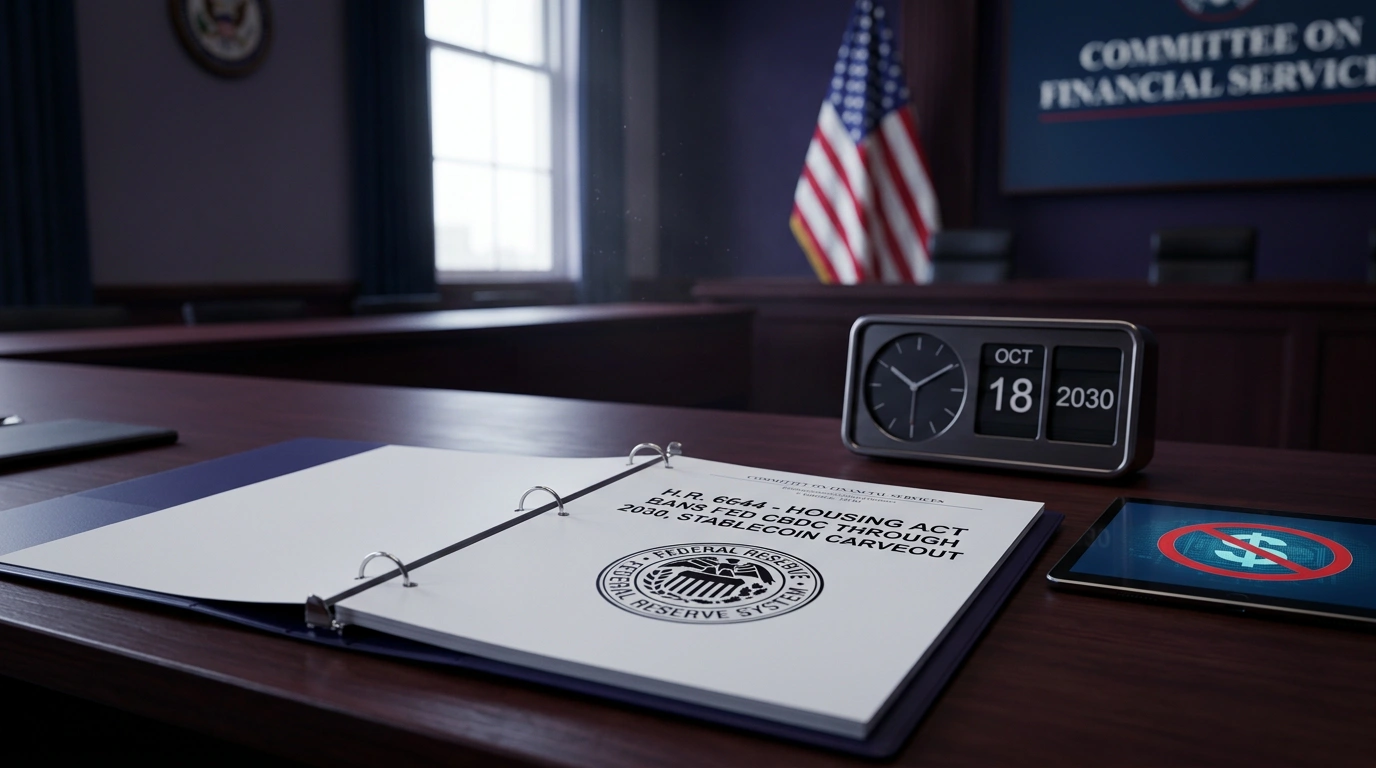
The leaders of the Senate Banking Committee and the House Financial Services Committee released updated text Tuesday for H.R. 6644, known as the 21st Century ROAD to Housing Act. Tucked into the sweeping housing package is a provision barring the Federal Reserve from issuing a digital dollar through December 31, 2030. The Senate passed a prior version in March 89-10; the House cleared its amended text in May 396-13.
Elizabeth Warren called the bill "the biggest housing bill in more than 30 years." With chambers now aligned on the text, the legislation heads back to the Senate floor for a final vote before going to the president.
What the CBDC Ban Says and What It Exempts
The language is direct: the Fed "may not issue or create a central bank digital currency" or any substantially similar asset through December 31, 2030. The ban covers any form of government-issued digital dollar, not just a literal "digital dollar" in a narrow legal sense. Workaround instruments with similar features also fall under the prohibition.
One carveout stands out: the restriction does not apply to open, permissionless private dollar assets that preserve "the privacy protections of United States coins and physical currency." That language directly covers stablecoins such as USDT and USDC. Private crypto infrastructure is explicitly outside the ban. The distinction matters for the market: Washington is blocking a state-issued digital dollar while leaving private alternatives untouched.
Who Signed the Deal and What Compromises Got It Done
Four committee leaders put their names to the updated text, two from each party. On the Senate side: Banking Committee Chair Tim Scott (R-SC) and Ranking Member Elizabeth Warren (D-MA). On the House side: Financial Services Chair French Hill (R-AR) and Ranking Member Maxine Waters (D-CA). That bipartisan, bicameral authorship shows genuine cross-aisle support rather than a narrow party-line push.
To close the gap between chambers, the Senate accepted a three-year sunset on a disaster-recovery block grant program and adopted nine community banking bills and restrictions on institutional homebuyers that the House had backed. Hill said he looked forward to President Trump signing the bill. Waters said the text includes more than 50 housing and banking provisions Democrats fought to secure. A months-long negotiation ended with both sides making concrete concessions.
How the Anti-CBDC Clause Ended Up in a Housing Bill
House Republicans pushed to include the CBDC ban as a rider on the broader housing legislation. Attaching provisions to must-pass bills is a standard legislative tactic, but the 89-10 Senate vote shows more than procedural maneuvering. That margin far exceeds the 60-vote threshold to end debate, pointing to genuine bipartisan agreement. The CBDC ban drew support across party lines, not only from crypto-friendly Republicans.
Some conservatives want to go further. Rep. Anna Paulina Luna (R-FL) argues that "CBDCs are bad for everyone" and wants the ban made permanent rather than capped at 2030. Treasury Secretary Scott Bessent recently reinforced the White House position, saying a digital dollar is "off the table." The current text stops at a temporary moratorium, leaving the 2031 decision to the next Congress.
Outlook for the Crypto Regulatory Picture
H.R. 6644 reinforces a two-track approach in Washington: regulate private stablecoins through the separate GENIUS Act (also moving through Congress) and block a government-issued competitor in parallel. For Bitcoin and broader crypto assets, this removes a specific systemic risk. A state-backed dollar asset competing with private crypto in the US market is off the table for at least four years.
Analysts estimate the stablecoin market topped $200 billion in market cap in 2026. Federal legislation that explicitly frames stablecoins as privacy-preserving cash equivalents raises their regulatory standing. Stablecoin issuers now have a concrete legislative definition to reference when working with banks and payment networks, an advantage that was absent before this text was released.
Next Steps: Senate Floor Vote and the Path to Trump's Signature
The agreed text now returns to the Senate for a vote on the bicameral compromise version. The 89-10 tally from March provides a comfortable margin for passage. Once the Senate votes, the bill goes to the president. Hill explicitly said he expects Trump to sign it into law.
The practical effect is clear: any Federal Reserve effort to develop or pilot a digital dollar through December 2030 would violate federal statute. For the market, that translates to four years of legal certainty. The stablecoin industry gets room to grow without competing against a government-backed issuance program. When 2031 arrives, the question comes back to Congress with a clearer picture of how private digital dollars actually performed in the intervening years.


Comments
Your email address will not be published. Required fields are marked *