


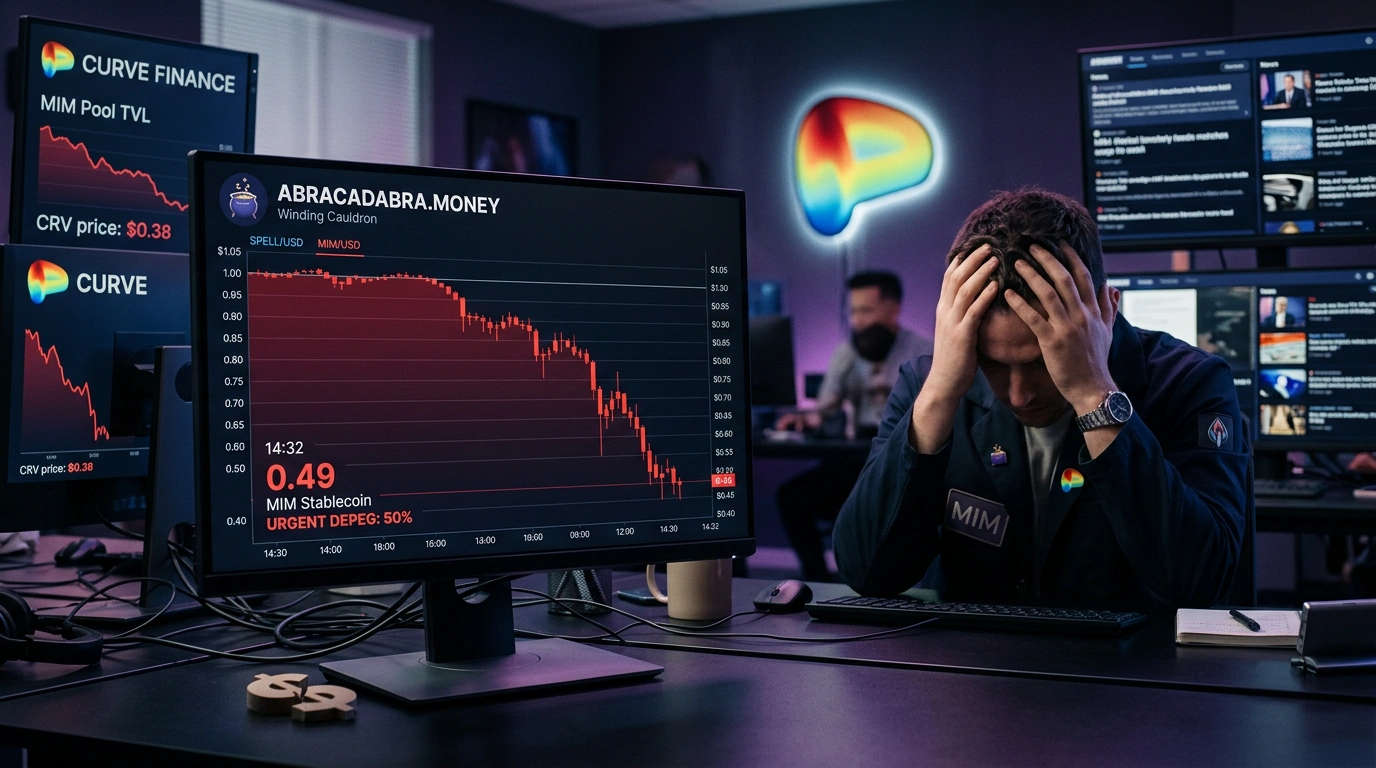
DeFi lending platform Abracadabra has declared emergency measures after its Magic Internet Money (MIM) stablecoin dropped to $0.49. That is half its $1 target price. About $104 million in MIM remains in circulation, and the team acknowledged the situation calls for immediate action.
What is MIM and how is it minted?
Magic Internet Money launched in May 2021 on the Abracadabra platform, a multichain DeFi lending protocol. Unlike USDT or USDC, MIM is not backed by real dollars in a bank account. It gets minted through a collateral lending mechanism tied to yield-bearing tokens.
Here is how the system works.
- Collateral deposit: a user deposits yield-bearing tokens (such as Convex Finance or Yearn vault tokens) into Cauldrons, Abracadabra's specialized lending pools.
- The protocol assesses the collateral value and issues a MIM loan. The borrowing limit typically caps at 90% of the deposited asset's value.
- The minted MIM can be used for trading or added to liquidity pools on DEX platforms.
- To retrieve the collateral, the borrower repays the debt in MIM. Returned tokens are automatically burned, shrinking the total circulating supply.
- The $1 peg holds through arbitrage: when MIM trades below a dollar, there is an incentive to buy it cheap and repay debt at a discount, contracting supply.
Why Curve Finance liquidity matters so much
Curve Finance, a decentralized exchange built for low-slippage stablecoin swaps, is the primary venue for MIM liquidity. When traders want to buy or sell MIM, they do it mostly through Curve pools. Deep liquidity there keeps the price close to $1.
The trouble started with a shift in DeFi incentive strategies in late May. Several liquidity providers pulled out of MIM's Curve pools, thinning the buffer considerably. In that kind of market, even a moderate MIM sell-off can push the price far from its target.
This differs from centralized stablecoins. USDT and USDC hold dollar reserves and do not depend on DEX pool sentiment. MIM relies entirely on third-party liquidity providers, and those providers can exit any time.
How the depeg unfolded since mid-June
The first warning signs appeared in mid-June, when MIM slipped from $1 to $0.74. The market treated it as a temporary glitch that could be fixed with targeted intervention. On June 15, the team injected $100,000 into a key Curve pool to restore balance after an unexpected withdrawal of liquidity.
MIM briefly recovered to $0.89, but the rebound did not hold. On June 25, selling pressure intensified as broader crypto markets fell: Bitcoin dipped below $60,000 the same day. MIM broke through $0.49, the deepest deviation from its peg in the token's five-year history.
Rate hikes and the arbitrage bet
Abracadabra announced gradual interest rate hikes across all Cauldrons, including deprecated markets no longer in active use. Higher borrowing costs give debtors a stronger reason to repay. Every repayment burns MIM, reduces supply, and applies upward price pressure.
"The current depeg creates a natural incentive for borrowers to repay debt at a discount, accelerating supply contraction and strengthening the path back to the peg. Our priority is simple: restore confidence, improve market structure, and return MIM to a healthy and liquid peg."
- Abracadabra team, statement dated June 25, 2026
The protocol is also counting on self-correction through arbitrage. Anyone who borrowed in MIM can now repay at $0.49 instead of $1 and reclaim their collateral at a discount. That incentive is already in play, but how fast it works depends on how many borrowers act quickly.
What this reveals about DeFi stablecoins
The MIM situation follows a familiar pattern: a crypto-collateralized stablecoin that looks overcollateralized on paper turns fragile in a bear market. This is another major incident following the UST (Terra) collapse in 2022. The shared problem is that these assets depend on external liquidity, which tends to vanish exactly when it is needed most.
Abracadabra is not the first DeFi protocol to face this, and likely not the last. Investors holding similar assets should treat liquidity risk as a separate category in their analysis. It is not about algorithm reliability. It is about whether liquidity providers stay in the pool when a crisis hits.
MIM holders now face a choice: sell at a 50% loss or wait for the peg to recover, which could take weeks. Trading volume in MIM surged over the past 24 hours as panic selling kicked in. The situation remains fluid.


Comments
Your email address will not be published. Required fields are marked *