


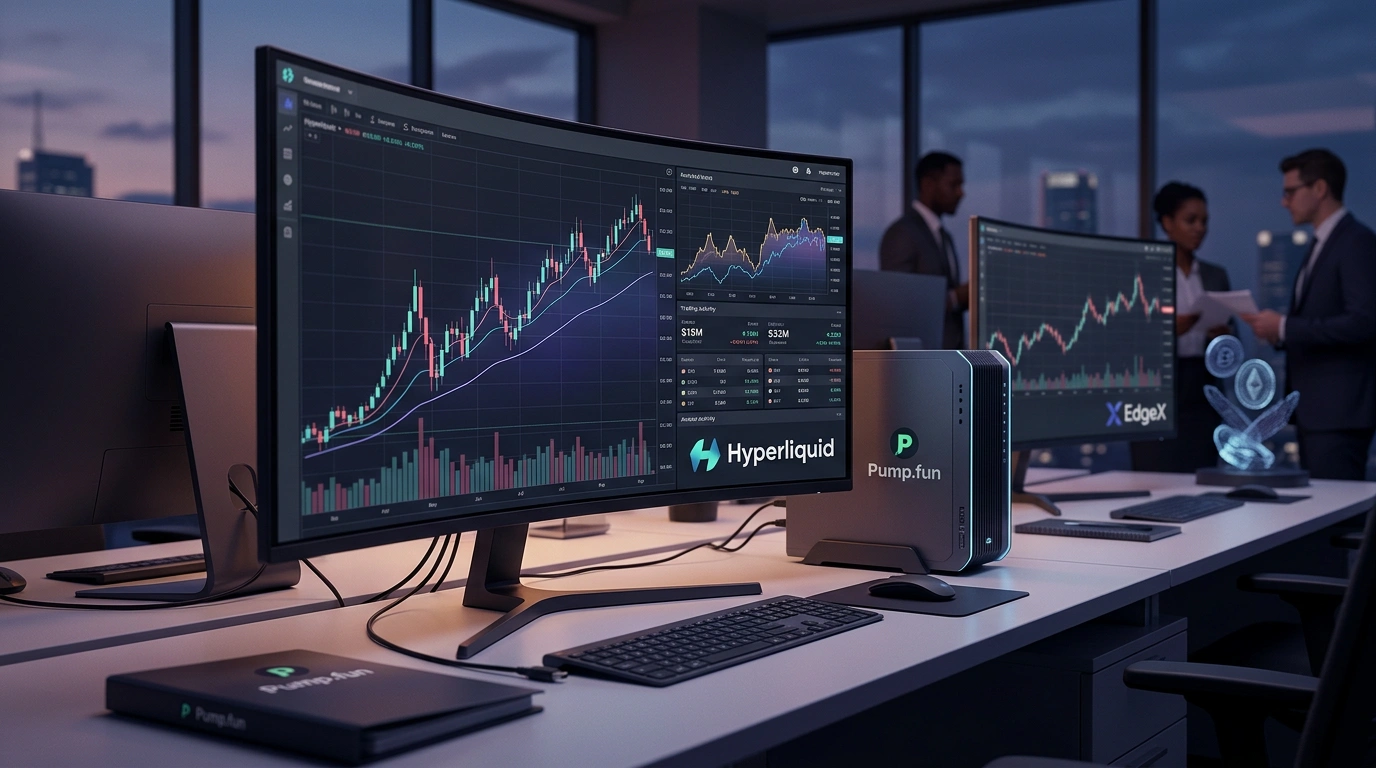
Three DeFi protocols paid token holders a combined $96.3 million in 30 days. Hyperliquid, EdgeX and Pump.fun topped the distribution rankings, outpacing established projects by 10 to 15 times. DefiLlama data for May 2026 shows a clear shift: the market has changed how it measures DeFi success.
Compared to an equivalent 30-day window a year ago, the three protocols have grown their distributions by multiples. But the mechanics behind each differ sharply - one shares pure revenue, another draws on reserves. That difference matters for any long-term token holder.
Hyperliquid: $50.95M with zero spent on incentives
Hyperliquid generated $50.95 million in revenue over 30 days and passed the full amount to token holders. Nothing went to liquidity mining or incentive programs. This approach is rare in DeFi: most protocols redirect a portion to the treasury or use it to attract liquidity providers.
Annualized, the protocol generates $945.87 million for holders. The foundation is a dominant position in the perpetual DEX market. Hyperliquid controls more than 70% of volume among perp platforms, which produces consistent trading fees. When volume is stable, distributions are stable. That separates organic revenue from models that pay holders by spending reserves.
The protocol launched in 2024 but already exceeds projects with five-plus years of history by this metric. For context: over the same 30-day window, Uniswap returned $3.29 million to holders, 15.5 times less than Hyperliquid.
EdgeX and Pump.fun: two different approaches, one result
Pump.fun returned $22.09 million to holders out of $38.81 million in total revenue. That is 57% of earnings distributed, with the remainder kept for operational needs. Distributions have been consistent, not tied to token listing events or marketing campaigns. Annualized, the platform generates $481.15 million for holders, per DefiLlama.
The EdgeX picture is different. Holders received $23.26 million, yet the protocol's own revenue came to only $8.26 million. The gap was covered by reserves or alternative sources, though the platform gave no breakdown. Annualized, this amounts to $236.42 million. Paying out three times more than earned is only sustainable with fast revenue growth - otherwise the reserves eventually run out.
Established protocols lag far behind: Uniswap and Chainlink
Uniswap, the largest decentralized spot exchange, returned $3.29 million to holders in 30 days across 44 blockchains. Its structure routes most trading fees to liquidity providers rather than token holders. The tokenomics of Uniswap are built around attracting liquidity, not distributing dividends.
Chainlink paid $4.63 million to holders. Aerodrome, the main DEX on Base built on Ethereum, returned $3.53 million. PancakeSwap earned $3.94 million but spent $905,000 on incentives, leaving $2.48 million for holders. Funds spent on attracting new participants directly reduce the pool available for current token holders.
The gap between younger leaders and market veterans on this metric turned out larger than the market anticipated. It is not a question of scale: Uniswap processes more trades. The question is what share of those trades reaches token holders.
From TPS to earnings: what the market actually wants
Robbie Klages, co-founder of crypto media outlet The Rollup, put it directly: "Nobody cares that your chain does 10x the TPS anymore. The market is 'show me the money right now.' Treat it like a business not a network growth thesis." This view has circulated through crypto circles since early 2026 and keeps gaining traction.
Protocols without real cash flows risk being priced like pre-revenue startups in a high-rate environment. Betting on a narrative without numbers behind it no longer works. After FTX, after the Terra/Luna collapse and several rounds of tight monetary policy, capital demands accountability.
The metric "revenue to holders" is gradually replacing TVL and active wallet counts as the main indicator of protocol health. Those who adapt first will have the advantage in the next institutional cycle.
Andre Cronje: DeFi in 2026 looks like real financial infrastructure
Yearn.Finance founder Andre Cronje assessed the state of DeFi with concrete figures rather than marketing language. The stablecoin market reached $320 billion, with Tether and Circle holding most of that. Decentralized spot exchanges process over $160 billion per month. Perpetual DEX platforms handle $540 billion monthly.
Active loans in Aave, Morpho and Maple Finance exceeded $28 billion. Real-world assets are increasingly used as collateral in onchain protocols. "DeFi is no longer just competing for APY. It is becoming the backend for the onchain economy," Cronje wrote on X.
This scale explains why the revenue model is gaining attention. A protocol that handles $540 billion in monthly volume and shares collected fees with token holders no longer needs a narrative. The numbers make the case.
The trend holds, but open questions remain
May 2026 data confirmed it: three young protocols beat market veterans on holder distributions. If Hyperliquid and Pump.fun maintain this pace, their annualized holder returns will be comparable to some traditional yield instruments. A $945.87 million annual figure for a single protocol puts DeFi well outside niche territory.
The EdgeX case still needs watching. Paying out three times more than you earn works only with rapid revenue growth. One month of data does not give a full picture: whether these numbers hold over six to twelve months is a question analysts are keeping open.


Comments
Your email address will not be published. Required fields are marked *