


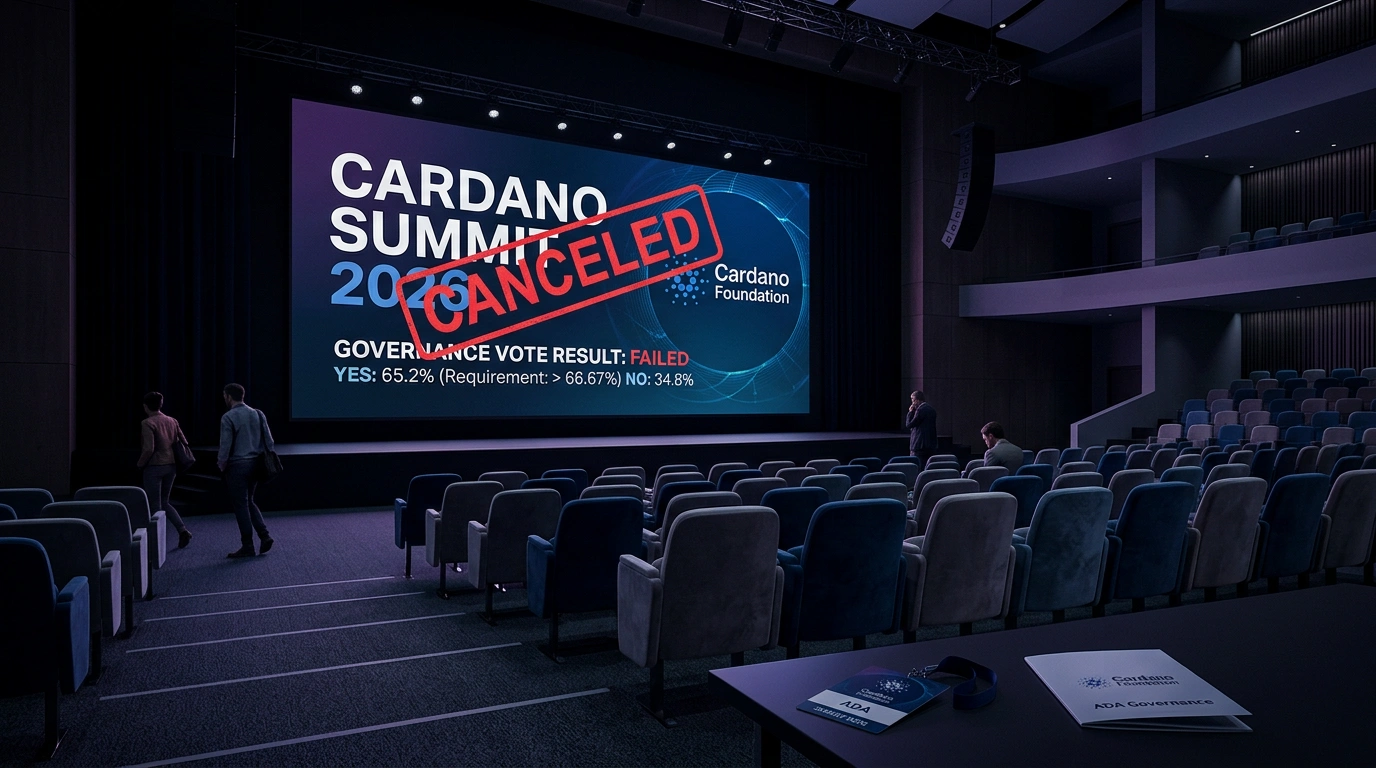
Cardano Foundation canceled its annual Cardano Summit 2026 conference after the community rejected a funding proposal. The vote ended at 65.2% in favor, falling short of the 66.67% threshold required for approval. This marks the second consecutive funding failure in two months.
"Governance requires not only participation, but also a commitment to accept collective decisions. The Cardano community has spoken and we respect the outcome."
- Cardano Foundation, posted on X, May 30, 2026
The Conference Was Canceled After the Second Failed Vote
The Cardano Summit 2026 was scheduled for October 5-6 in Singapore. For months, the Foundation sought funding from the network's community treasury. In May it submitted a first proposal asking for roughly 14 million Cardano (ADA) tokens to cover conference costs. Only 10% of Delegated Representatives (DReps) voted in favor. The proposal failed by a wide margin.
The foundation revised its ask. The second proposal requested 7.8 million ADA worth roughly $1.84 million. Voting closed on May 29. The tally came in at 135 in favor, 61 against, and 24 abstaining. The 65.2% approval rate missed the required 66.67% threshold by less than two percentage points.
With the vote failing, the Foundation officially canceled Cardano Summit 2026. It is the foundation's most visible governance loss in recent memory.
The Role of DReps and the Origins of the Conflict
DReps are Delegated Representatives: individuals or organizations that ADA holders can assign their voting power to. They make binding decisions on treasury spending, new initiatives, and protocol changes. The DRep system is a core part of Cardano's Voltaire governance era, designed to hand control of the network to its community.
The tension between the Foundation and a bloc of DReps has been building for months. The opposition argues that the Foundation already has its own funding sources and should cover its own events without drawing from the shared treasury. Support for that position has grown among DReps who believe community funds belong in direct protocol development, not industry events.
Cardano founder Charles Hoskinson has traded public criticism with the opposition on several occasions. The dispute became one of the most watched governance conflicts in the Cardano ecosystem in 2026.
EMURGO and the TOKEN2049 Alternative
Despite the Summit cancellation, the Cardano ecosystem will still have a presence in Singapore this fall. EMURGO, the investment and commercial arm of the Cardano blockchain, ran its own proposal in parallel and won DRep approval to represent the environment at TOKEN2049. The contrast with the Foundation's outcome shows that the community is willing to fund commercial initiatives when they are clearly scoped.
TOKEN2049 is one of the largest annual crypto conferences in the world. The event takes place in Singapore on October 7-8, just two days after the canceled Summit was set to begin. EMURGO will have an official booth representing the sphere.
Hoskinson is already looking at expanding that presence. He said he is gauging community interest in a larger booth and an embedded MiniSummit within the main TOKEN2049 event. No format has been confirmed yet, but the active search for alternatives shows the Cardano founder is not ready to cede the conference circuit for the rest of 2026.
Cardano by the Numbers: Why the Vote Went This Way
Network data helps explain why the spending-control argument found enough support to block the proposal. Cardano's market cap sits at $8.8 billion. But total value locked in the protocol is under $129 million, ranking the chain 28th among blockchains by that measure. The network trails leading DeFi chains by a wide margin in on-chain activity.
The comparison with 2022 is striking. The network generated $8.35 million in fees that year. So far in 2026, the figure has not reached $360,000. At that activity level, a $1.84 million conference expense drawn from community funds looked disproportionate to a significant share of DReps.
The Foundation has not announced alternative plans for its own annual event. How TOKEN2049 and a possible MiniSummit play out will serve as the first test of a new model for Cardano ecosystem representation at major industry gatherings. The failed vote will likely push the Foundation to rethink how it approaches conference funding going forward.
Comments
Your email address will not be published. Required fields are marked *