


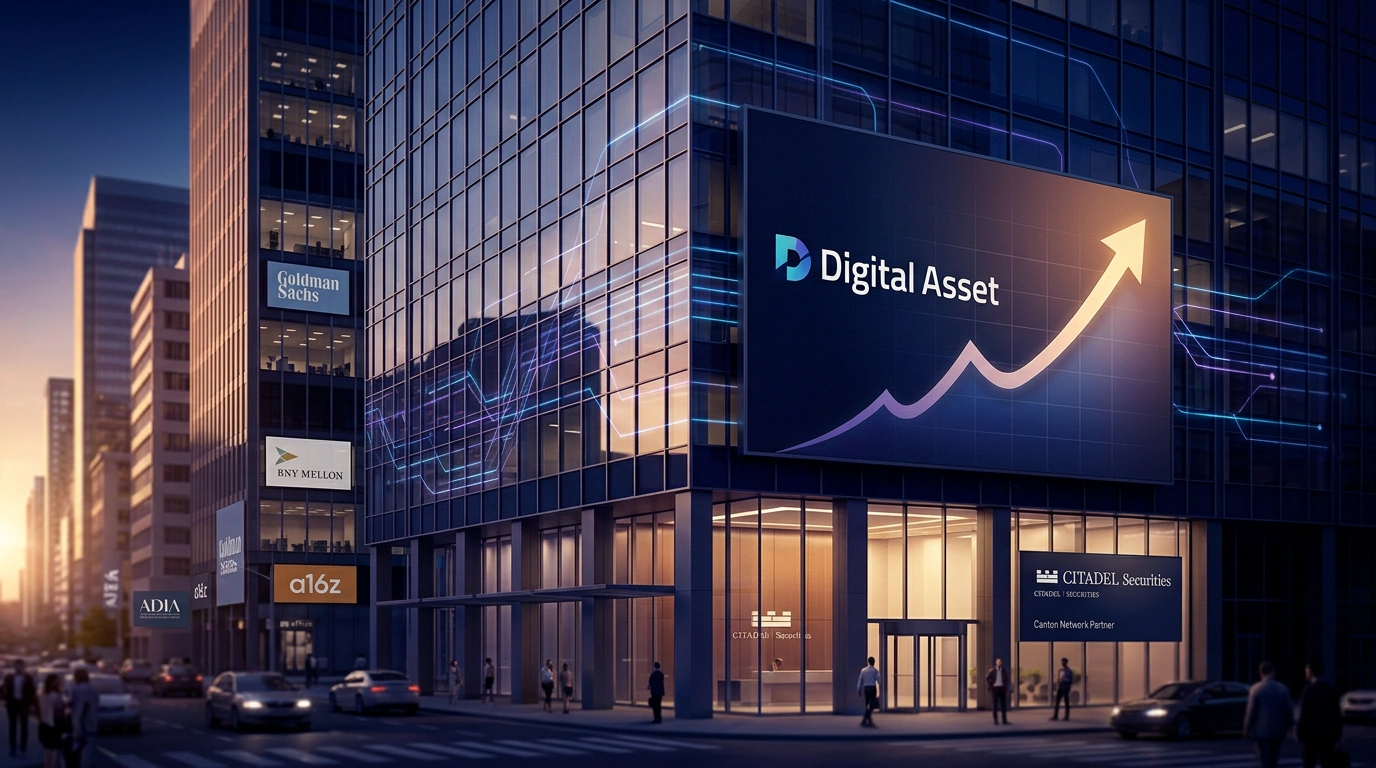
Digital Asset Holdings raised $355 million in a round led by Andreessen Horowitz (a16z), valuing the company at roughly $2 billion. Bloomberg reported the deal closed on June 11, 2026. It is the largest fundraise in the company's history.
The capital will go toward scaling Canton Network, a permissioned blockchain for banks and financial institutions. Goldman Sachs, BNY Mellon, BNP Paribas, and several other major institutions are already running pilots. With this funding, Digital Asset has the resources to convert those pilots into full commercial deployments.
Round structure: a five-member syndicate
a16z crypto contributed $100 million as the lead investor. The remaining $255 million was split among 7RIDGE, the Abu Dhabi Investment Authority (ADIA), Citadel Securities, and Optiver.
ADIA's presence sets this syndicate apart from typical crypto venture deals. The UAE sovereign wealth fund manages over $900 billion in assets and rarely backs early-stage crypto companies. Its entry into Digital Asset's cap table signals that Canton Network is viewed as regulatory-grade financial infrastructure, not an experimental platform.
Citadel Securities and Optiver returned for a second time, having already participated in the June 2025 round worth $135 million. Repeat participation at a higher valuation shows they are satisfied with the company's progress over the past year.
Canton Network: why banks need a private blockchain
Canton Network allows financial institutions to tokenize traditional securities and settle transactions on-chain without exposing commercially sensitive data to other network participants. That is the core difference from open public networks, where transactions are visible to any observer.
Public blockchains like Ethereum proved that assets can be tokenized and settlements automated through smart contracts. But regulated institutions need something more: guarantees that no third party can alter an issuer's books without its consent. Canton fills that gap for banks and custodians.
The network is built on DAML, a smart contract language developed by Digital Asset itself. DAML encodes legal terms of agreements into executable code, cutting settlement times and reducing the need for intermediaries. CEO Yuval Rooz told Cointelegraph that Canton was designed for regulated finance from day one and that no third party can change an issuer's books and records without its consent.
"We can accelerate strategic partnerships and help major financial institutions move mission-critical infrastructure onchain faster."
- Yuval Rooz, CEO of Digital Asset, comment to Cointelegraph, June 11, 2026
Six banks in the pilot: Goldman Sachs to Deutsche Borse
The pilot lineup spans three major financial centers. Goldman Sachs, BNY Mellon, and Standard Chartered represent US and UK capital markets. BNP Paribas and Societe Generale bring French regulatory context. Deutsche Borse covers exchange and clearing infrastructure.
Most of these institutions are not just clients. Goldman Sachs first invested in Digital Asset back in 2021. BNY Mellon participated in the December 2025 round. They are simultaneously technology buyers and shareholders, which reduces the risk of switching providers mid-deployment.
Pilots covered securities settlement and tokenization of debt instruments. Banks have not disclosed specific operational details. Still, the scale and composition of participants across multiple quarters tells more than any press release about exploring the technology.
Three years, $660 million: how Wall Street funded Digital Asset
This round is the fourth major fundraise in three years. Total investment in Digital Asset has now exceeded $660 million:
- 2021: more than $120 million from JPMorgan, Citi, Deutsche Borse, Goldman Sachs, IBM, Samsung, Salesforce, and other institutional investors.
- June 2025: $135 million from DRW Venture Capital, Tradeweb, Citadel Securities, IMC, Optiver, Goldman Sachs, and Virtu Financial.
- December 2025: $50 million from BNY Mellon, Nasdaq, S&P Global, and iCapital.
- June 2026: $355 million led by a16z crypto, with ADIA, 7RIDGE, Citadel Securities, and Optiver.
Goldman Sachs appears in two of the four rounds, five years apart. That is a consistent strategic commitment from one of the world's largest banks, not a one-time bet on a market trend.
Canton vs. competitors: the fight for an industry standard
Digital Asset is not alone in this space. JPMorgan is pushing its own network, Kinexys, rebranded from Onyx in 2024. R3 maintains Corda, used by around 400 financial firms globally. SWIFT is running its own tokenization pilots with central banks through BIS Project Agora.
The total tokenized real-world assets market exceeded $51 billion in early 2026. Tokenized securities are still under 10% of that figure. But the segment is growing faster than the broader market. BCG and ADDX project the total could reach $16 trillion by 2030.
The main risk for Digital Asset is not technical. Closed networks face a classic interoperability problem: without a common standard, institutions end up locked into one vendor's platform. The winner here will be whoever attracts enough banks to create a true network effect. The $355 million round gives Digital Asset the time and resources to secure that position before competitors lock in their own coalitions.



Comments
Your email address will not be published. Required fields are marked *