


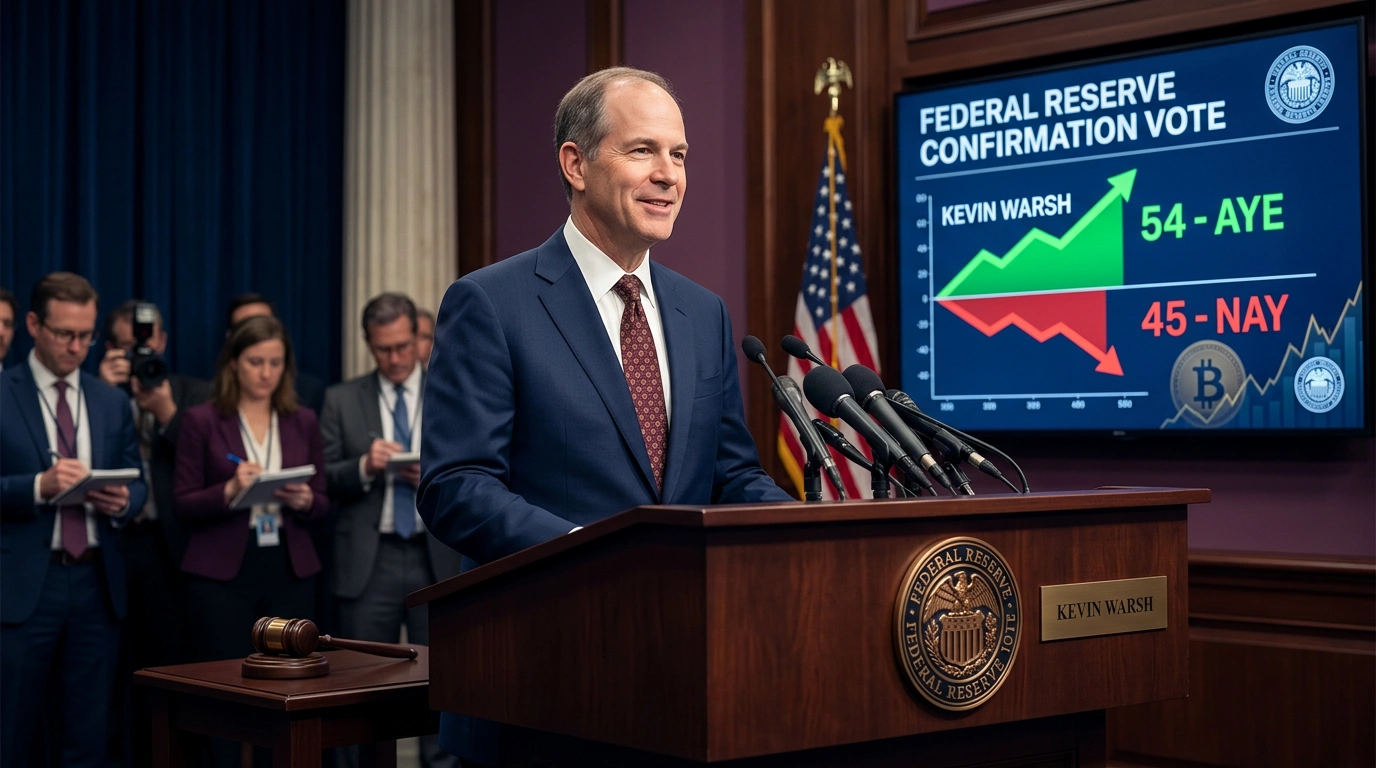
The US Senate confirmed Kevin Warsh as the new Federal Reserve chair on May 13, 2026, in a 54-45 vote that split largely along party lines. Jerome Powell steps down on May 15 after eight years at the helm. Warsh becomes the first person in the Fed's 112-year history to assume the role with publicly declared crypto holdings and an on-record endorsement of Bitcoin as a policy tool.
Markets took the news in stride. Bitcoin hovered around $79,500 with no sharp reaction following the vote. The real question for crypto is not the immediate price move but the long-term regulatory posture a Warsh-led Fed will adopt.
Two Votes Over Two Days
The confirmation required separate sessions. On Tuesday, May 12, the Senate approved Warsh as a Federal Reserve governor by 51-45, granting him a 14-year term on the Board of Governors. The next day, a 54-45 vote confirmed him as chair for a four-year term.
Democrats raised two central concerns: the Federal Reserve's independence from White House pressure and the recently closed DOJ investigation into Powell, which ended without charges. Trump had repeatedly called on Powell to cut rates and at times suggested firing him. Senator John Fetterman was the only Democrat to cross party lines in both votes.
Powell does not leave the Fed entirely. His term as a Board governor runs through 2028, so he retains a vote at FOMC meetings. For at least two years, two distinct approaches to monetary policy will share the same decision table.
Crypto in Warsh's Disclosure: Bitcoin, Solana, Polymarket
Warsh's financial disclosures list investments in Solana and the prediction market Polymarket. At his Senate Banking Committee hearing, he stated that digital assets are "already part of the fabric of our financial services industry." In a 2025 interview, he called Bitcoin "an important asset that can help inform policymakers."
His view of the broader market is not uniformly positive. He has described some crypto projects as fraudulent and worthless. In his framing, Bitcoin occupies a different category from most of the altcoin market. Pro-crypto Senator Cynthia Lummis wrote on X that "digital asset holders finally have a Fed leader ready to engage." CFTC Chair Brian Selig, who has defended prediction markets against state-level lawsuits in 2026, also congratulated Warsh and said he looks forward to working together.
"Kevin Warsh is the first Fed Chair to endorse Bitcoin and describe it as a useful signal for policymakers, reflecting a shift in institutional legitimacy for crypto. While he's known as an inflation hawk, his stated belief that rates can move lower as a result of AI-driven productivity gains provides a plausible path to more accommodative liquidity conditions for crypto assets."
- Juan Leon, Senior Investment Strategist at Bitwise, comment to Decrypt, May 13, 2026
Key Figures at Confirmation
CPI at 3.85% and the Rate Dilemma
April CPI came in at 3.85% year-over-year, the highest reading since May 2023 and nearly twice the Fed's 2% target. That gap is the central quantitative argument against rate cuts in the coming quarters.
Warsh built his "hawk" reputation during his earlier Fed tenure from 2006 to 2011, when he consistently pushed back against loose monetary policy. The current picture is more complex: White House pressure for quick rate cuts runs directly against an inflation print that sits at double the target. Middle East tensions in 2026 pushed oil prices higher, adding an energy component to CPI that monetary tools cannot address directly.
Warsh has not ruled out cuts. He ties that scenario to AI-driven productivity gains lowering inflation over time. That effect does not yet show up in any 2026 data release, which is exactly why futures markets are pricing nothing in. The first FOMC meeting under Warsh's leadership will be the first real test of where he actually stands.
CLARITY Act: A Regulatory Convergence
The confirmation landed in the same week as a separate crypto-regulation milestone. On May 13, the Senate Banking Committee released updated text for the Digital Asset Market Clarity Act. The bill includes a compromise on stablecoin yield, which had been a sticking point between the banking industry and crypto stakeholders for months.
A markup hearing followed on May 14, which could advance the bill to a full Senate vote. This is the closest the US has come to a baseline regulatory structure for digital assets in years.
The Fed has direct influence over how banks hold assets on their balance sheets. If CLARITY passes, a Warsh-led Fed will have meaningful say over how commercial banks implement new crypto-related permissions. The pairing of Warsh at the Fed and Selig at the CFTC represents a more crypto-friendly regulatory configuration than the US has seen before.
What Comes Next
Warsh takes over with CPI at 3.85%, a futures market pricing in zero cuts, and a crypto sector that expects more than his predecessors delivered. The 54-45 confirmation shows purely partisan support, meaning any unconventional move in monetary policy or digital asset regulation will face immediate institutional resistance.
Bitcoin's flat reaction after the vote reflects a realistic read: the policy shift, if it comes, will take quarters to materialise. If CLARITY clears the Senate and the Fed simultaneously eases bank custody requirements for crypto, the combination would be a meaningful tailwind for the market. Both scenarios play out over months, not days. For Q2 and Q3 2026, CPI prints and FOMC decisions carry more weight than the stated sympathies of the incoming chair.


Comments
Your email address will not be published. Required fields are marked *