


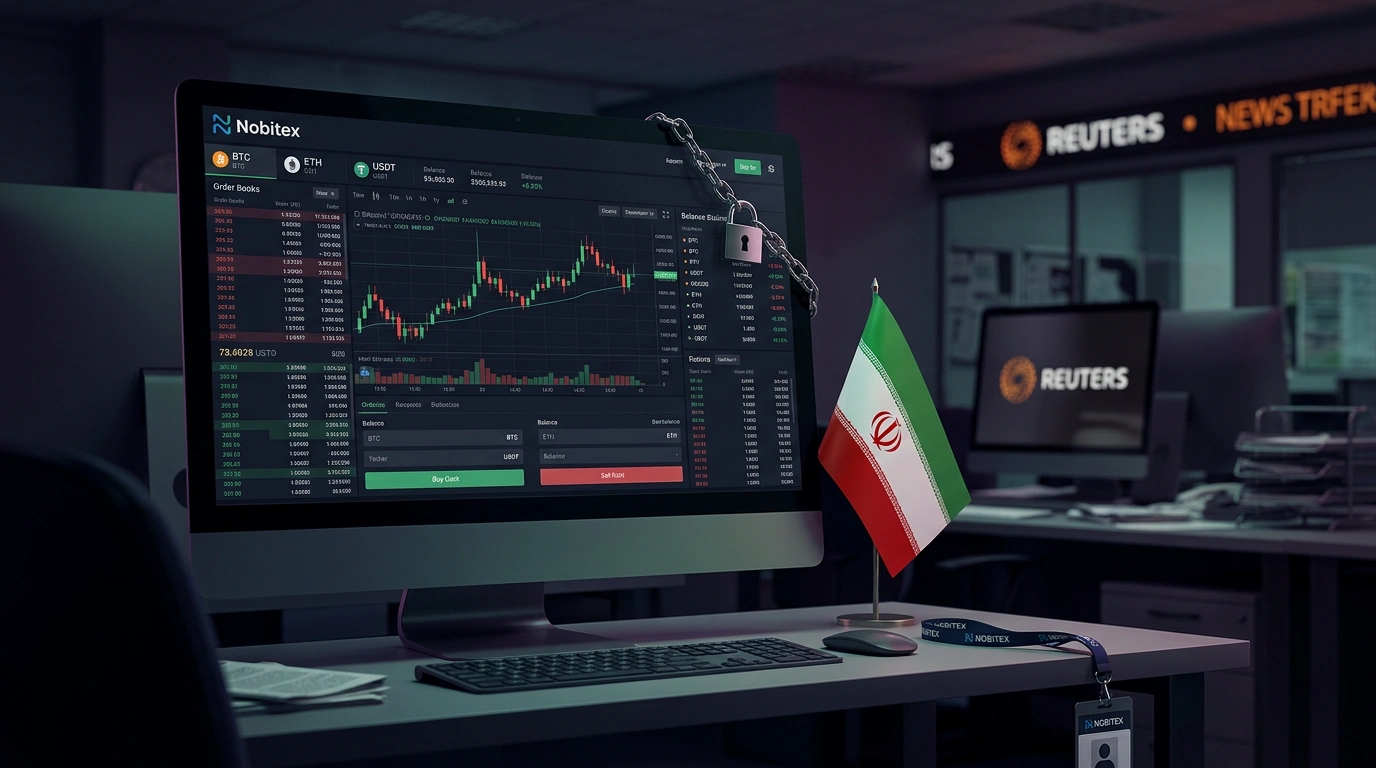
Reuters published the results of a major investigation: Nobitex, Iran's largest crypto exchange with over 11 million clients, was founded by brothers from one of the Islamic Republic's most powerful families. The founders, Ali and Mohammad Kharrazi, operated for years under the alias "Aghamir," concealing their real surname in corporate records and filings. The Kharrazi family has direct ties to Supreme Leader Ali Khamenei and his likely successor, Mojtaba.
The Kharrazi Family and Ties to Regime Leadership
The Kharrazi brothers' grandfather served on the Assembly of Experts, the body that appoints Iran's supreme leader. He also personally tutored Mojtaba Khamenei, Ali Khamenei's son. The brothers' father, Ayatollah Bagher Kharrazi, founded an Iranian political movement named Hezbollah and helped staff the Islamic Revolutionary Guard Corps in the wake of the 1979 revolution.
In all corporate registries and professional life, the brothers appeared exclusively under the "Aghamir" surname. That name appeared in business filings, declarations, and credential records throughout their careers. Reuters traced their real identity through corporate records and archival material. The connection between Nobitex's founders and the Kharrazi family had not previously been confirmed publicly.
Nobitex launched in 2014 and grew to become Iran's dominant crypto platform over a decade. It accounts for the majority of all Bitcoin and crypto trading in the country, serving over 11 million registered users as of 2026.
The Exchange Through Internet Blackouts and Armed Conflict
Nobitex kept operating through the armed conflict between the US, Israel, and Iran - including a period when Iran was completely cut off from the global internet. Analysts told Reuters that more than $100 million in transactions passed through the platform during that time. A significant share of those funds moved abroad.
Blockchain data reveals a link between the platform and state structures. Wallets connected to Iran's central bank sent hundreds of millions of dollars to Nobitex in 2025. Reuters assessed this as part of a broader strategy to move government funds past international financial restrictions. Nobitex denied any government affiliation and described suspicious transactions as a small fraction of its total volume.
From $22M to $366M: Three Independent Estimates
Three analytics companies ran separate checks and produced very different estimates of suspicious flows through Nobitex:
- Elliptic identified roughly $366 million in potentially suspicious transactions
- Chainalysis recorded $68 million in direct transfers from sanctioned wallets
- Crystal Intelligence found $22 million in direct transfers from sanctioned addresses
The gap comes down to methodology. Chainalysis and Crystal Intelligence count only direct transfers from wallets on official sanctions lists. Elliptic additionally counts transactions routed through intermediate addresses linked to sanctioned entities. Each company reaches a different number - none claims to capture the full picture of fund flows.
The case of Iranian businessman Babak Zanjani added more weight to the findings. During his 2025 court proceedings, Zanjani publicly revealed wallet addresses. Analysts traced another $20 million in state funds moving through Nobitex via those addresses.
"Illegal transactions represent only a tiny fraction of the platform's total activity. Nobitex has no government affiliation."
- Nobitex official position, as reported in the Reuters investigation
US Actions and Operation Economic Fury
The US moved against Iranian crypto assets before the investigation was published. Under Operation Economic Fury, American authorities seized roughly $500 million in cryptocurrency linked to Iran. Tether froze $344 million in USDT at the request of relevant authorities. By scale, this ranks among the largest compliance operations in the crypto industry.
Nobitex continues to operate. The Reuters investigation questions the independence of a platform whose founders spent years concealing their ties to the regime. Analysts, regulators, and legal bodies across multiple countries are now working toward an answer.


Comments
Your email address will not be published. Required fields are marked *