


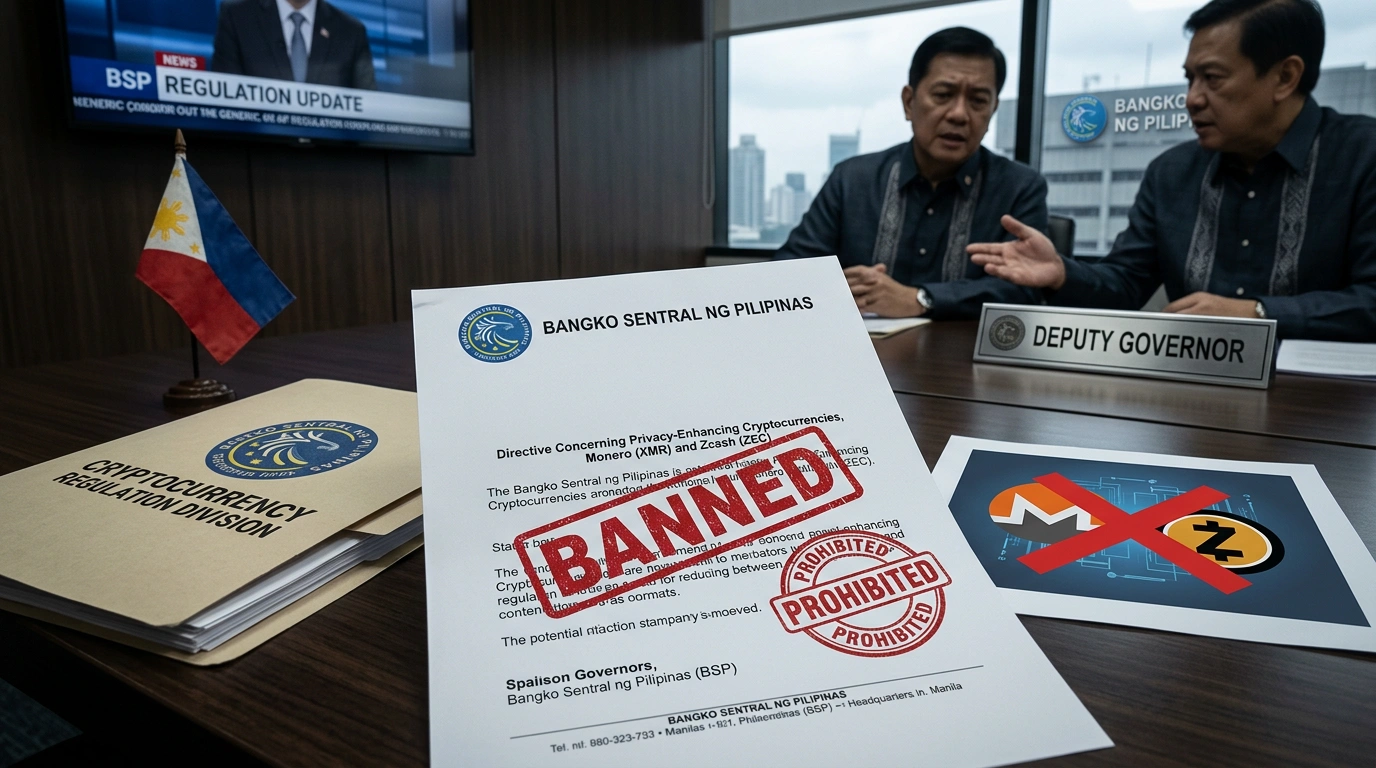
The Bangko Sentral ng Pilipinas (BSP) has ordered all licensed virtual asset service providers to implement strict due diligence before listing any digital asset. The memorandum was signed by Deputy Governor Lyn Javier. Privacy coins faced an outright ban: Monero and Zcash can no longer be offered on compliant Philippine exchanges.
The Philippines ranks 9th globally in the Chainalysis 2025 Global Crypto Adoption Index. The APAC region grew 69% year-over-year to lead grassroots adoption worldwide. For a market moving at that pace, the BSP's new framework is a structural shift, not a minor adjustment.
What the BSP Memo Requires
Every VASP must establish a thorough due diligence and accreditation process before offering any token to customers. The BSP framed the goal as "promoting financial stability and protecting the financial welfare of customers by ensuring that virtual asset services are provided in a safe, sound, and consumer-centric manner."
The rule covers more than new listings. Assets already on a platform face ongoing monitoring, and VASPs must define thresholds that trigger trading halts or delistings. Grounds include loss of liquidity, issuer insolvency, involvement in a scam or scandal, de-pegging, material security breaches, and misleading disclosures. The list is not exhaustive.
Privacy coins face a separate and stricter rule. BSP classified Monero, Zcash, and similar assets as "anonymity-enhancing virtual assets" and prohibited their listing outright. The memo sets no transition period for platforms already supporting them.
Two Regulators, One Jurisdiction
Philippine crypto firms answer to two independent bodies. The BSP licenses them as Virtual Asset Service Providers (VASPs) for payment and transaction rails. The Securities and Exchange Commission (SEC) oversees the same firms on the securities side through the Crypto-Asset Service Provider (CASP) framework.
If a token offered on a platform carries securities characteristics, the VASP must satisfy SEC's CASP Rules on top of BSP requirements. Before Memorandum Circular No. 5 in 2025, many platforms registered with one regulator and skirted the other. Now both are tightening in parallel, and that gap is closing.
Until 2024, many platforms registered with just one of the two bodies and avoided the other. The BSP focused on payment flows; the SEC monitored token offerings. The new listing memo is the first instance of the central bank reaching beyond the payment rail to set conditions on the assets that licensed platforms can offer at all.
A Year of Tightening: From Circular 5 to Ten Blocked Platforms
June 2025 brought SEC Memorandum Circular No. 5. It required crypto-asset service providers to register locally, hold $1.8 million (PHP 100 million) in paid-up capital, store customer data within the Philippines, and report to the Anti-Money Laundering Council.
By August, the SEC had blocked access to 10 offshore platforms. The list included OKX, Bybit, Kraken, and KuCoin. Several of those are among the world's largest exchanges by trading volume. Luis Buenaventura, President of the Blockchain Council of the Philippines, called it "a competitive advantage for licensed players," as compliant local platforms gained de-facto protection from global rivals.
Separately, lawmakers are advancing Senate Bill 1330, which would put the national budget on-chain. The bill grew out of mass protests over roughly $9.2 billion in flagged public works spending. Blockchain in the Philippines is now framed as a tool for fiscal accountability, not just a payment layer.
Binance and the BlockShoals 90-Day Deadline
The most prominent attempt to re-enter the market belongs to Binance. In November 2025, local firm BlockShoals Technologies Inc. received initial SEC clearance through the StratBox regulatory sandbox. The arrangement was meant to give Binance a path back through a locally registered partner.
The BSP pushed back. Neither Binance nor BlockShoals holds a VASP license from the central bank, and sandbox participation "doesn't substitute for central bank licensing." The SEC reclassified Binance from "global VASP" to "global crypto-asset service provider" and gave BlockShoals 90 days to integrate with a licensed domestic VASP before onboarding any users.
The BlockShoals play reflects a broader pattern among global exchanges after the 2025 blockings. A direct entry without a local license is off the table, but a partnership with a locally registered entity lets a global exchange keep a foothold while waiting for the regulatory picture to clarify. How long the BSP will accept that model is unclear.
The situation is still open. Binance has a technical path through BlockShoals, but no client operations are possible without a BSP VASP license. The new memo's stricter listing conditions raise the bar for market entry further.
Industry Backs Standards, Splits on Privacy
Alden Yburan, head of crypto at GCash, called the new listing rules "long overdue." He described them as "the minimum bar any responsible platform should already be applying before listing an asset to retail users," adding that stronger standards lead to better products.
On the privacy coin ban, his view is more divided. He acknowledged that Monero and Zcash "exist for legitimate reasons" and that privacy is "a foundational value in crypto." At the same time, he pointed out that the Philippines is remittance-heavy. Positioning the crypto space as trusted financial infrastructure while letting anonymity-enhancing assets flow freely does not work.
GCash is one of the country's largest platforms for domestic and international remittances. Yburan's position reflects the real friction between crypto privacy and AML compliance. Regulators globally are choosing the latter.
Privacy coin bans have been building globally. Japan's FSA pushed exchanges to delist Monero and Zcash back in 2018. South Korea followed in 2021. The Philippines joins that group, with one difference: the ban comes through a central bank memorandum rather than informal regulatory guidance, giving it a firmer legal footing.
The dual BSP-SEC framework looks more developed than most neighboring markets. The question is not whether oversight will tighten, but how fast. The Philippines' 9th-place ranking in Chainalysis 2025 points to deep retail demand. That demand will set the boundary between consumer protection and market restriction in the next cycle.
Comments
Your email address will not be published. Required fields are marked *