


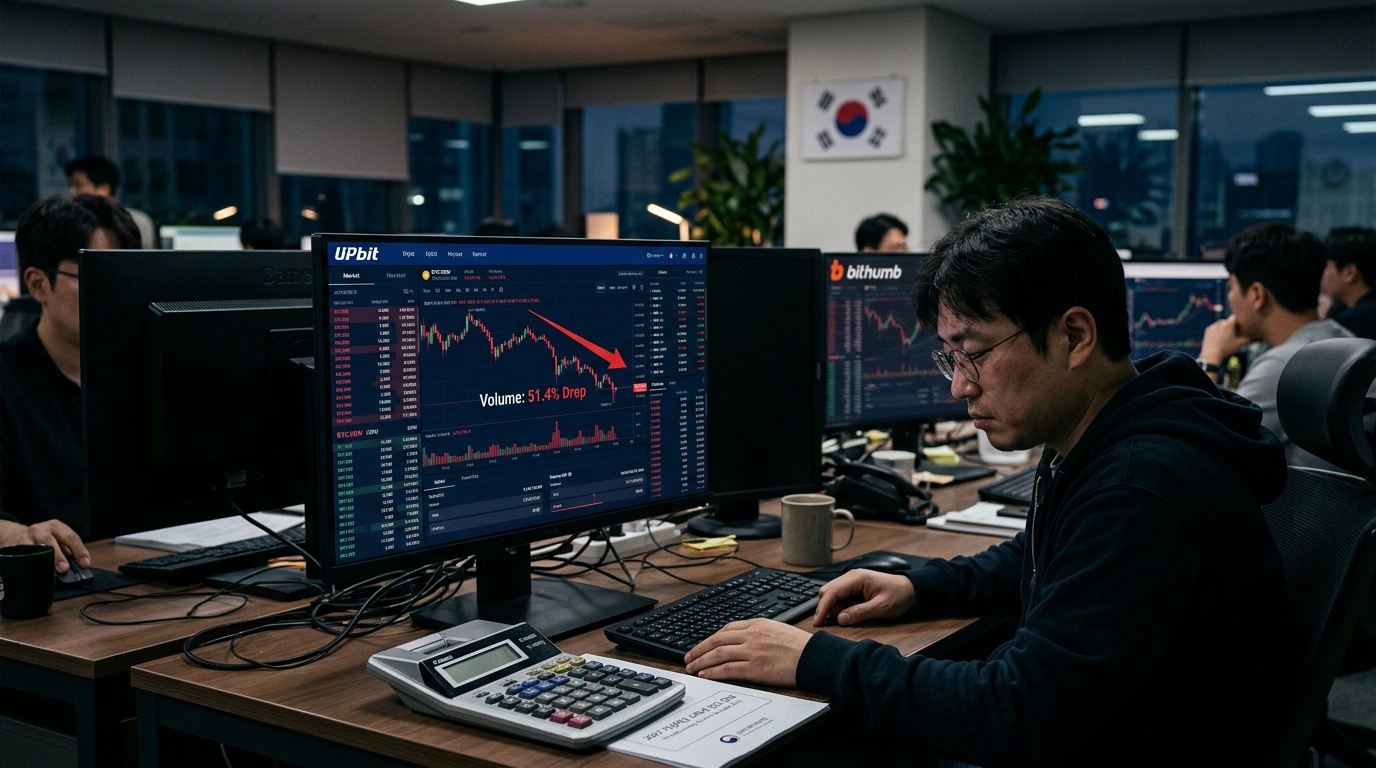
In just over a year, the value of crypto assets held by South Korean investors fell by half. In December 2024, the country's five largest exchanges processed over $11.6 billion in daily trading volume. By February 2026, that figure dropped to $3 billion. The reasons go beyond a simple price correction.
How Much Did the Market Shrink?
According to the Bank of Korea, the total value of crypto held by South Korean citizens reached 60.6 trillion won, or $41.4 billion, by the end of February 2026. Back in January 2025, the figure stood at 121.8 trillion won, or $83.3 billion. The gap over 13 months came to nearly $42 billion.
The decline hit several metrics at once. Won deposits at the five major platforms, Upbit, Bithumb, Korbit, Coinone, and Gopax, fell from 10.7 trillion to 7.8 trillion won. Free capital ready for new purchases is shrinking. The data was submitted by the Bank of Korea at the request of lawmaker Cha Gyu-geun of the Rebuilding Korea Party.
Context matters. In previous years, South Korea ranked among the most active retail crypto markets globally. The so-called "kimchi premium", the gap between Bitcoin prices on Korean platforms versus the global market, once reached 20%. That gap reflected extraordinary domestic demand. Those days appear to be over.
Where Is the Capital Going?
A large share moved to stock markets. The drop in crypto prices coincided with a rise in Korean equities, and part of the retail investor base shifted its focus. Stock indices KOSPI and KOSDAQ posted solid gains during this period, driven by a technology rally across Asia.
Korean retail investors are known for chasing risk assets. This same audience helped drive the crypto bull run in 2020-2022. When technology stocks began offering better returns, they switched. Fast and in large numbers.
Stablecoins initially bucked the trend. Holdings in USDT and other stablecoins climbed to $597 million in December 2024. Some investors did not exit crypto entirely but parked funds in less volatile assets while waiting for a better entry. By February 2026, however, even those holdings had fallen to $41 million. The patience ran out.
What Will the New AML Rules Change?
Updated anti-money laundering rules are set to take effect in South Korea in August 2026. The regulator plans to automatically flag as suspicious any transaction above 10 million won passing through foreign exchanges or private wallets. That threshold equals roughly $6,800.
- Trigger threshold: over 10 million won through foreign platforms or private wallets
- Transactions get flagged automatically, without prior review by an operator
- DAXA calculated the number of such reports could rise 85 times (from 63,000 to 5.4 million per year)
- That volume is nearly impossible to process manually. Compliance costs for exchanges will jump sharply
- Some traders may shift to Binance and other offshore platforms
For an active trader, a $6,800 threshold covers almost any meaningful transaction. Not large sums or institutional money, but a normal retail operation. At that level, hundreds of thousands of ordinary users would automatically appear on "suspicious" lists.
Industry body DAXA pushed back against the proposal, calling the threshold disproportionate. An 85-fold rise in suspicious transaction reports would make full compliance practically unworkable, the group argued. DAXA also warned that the volume may force exchanges to pass data to authorities without proper review, which runs counter to what the law is trying to achieve. Financial regulators, for now, are holding their position.
What Does the 22% Crypto Tax Mean?
South Korea's Ministry of Finance confirmed this week that a 22% tax on crypto gains will take effect on January 1, 2027. Debate over this tax has dragged on for years. This week officials stated for the first time that the date will not change.
Most developed markets apply lower rates. In the US, profits from selling crypto assets are taxed at rates ranging from 0% to 20%, depending on how long the asset was held and the investor's income level. Japan goes higher, with rates reaching up to 55%, though its broader tax structure and exemptions differ substantially. South Korea's 22% sits near the top of the range for markets where crypto is already regulated.
The combination of a 22% tax and stricter AML requirements may push active traders toward alternatives. Tight conditions tend to accelerate migration to offshore platforms, and South Korean regulators are aware of this dynamic. The question is whether they will adjust how the rules get implemented before August 2026.
Will Capital Return to Crypto?
A global market rally could reignite interest in Korean platforms. But even if prices recover, the new regulatory framework adds friction for local investors. It does not matter how much an asset gains if trading it is costly and complex.
New AML rules will raise operating costs for exchanges and make active trading harder. The coming 22% tax reshapes the economics of each trade. Together, these two factors create an environment where an active retail trader faces constant pressure from the regulator.
Even as crypto prices climb, Korean platforms may grow steadily less competitive compared to offshore options. South Korea is one of the most regulation-sensitive retail crypto markets in the world. If the rules become too burdensome, activity simply moves where they do not apply. The question is not whether the crypto market returns. The question is where it comes back.

Comments
Your email address will not be published. Required fields are marked *