


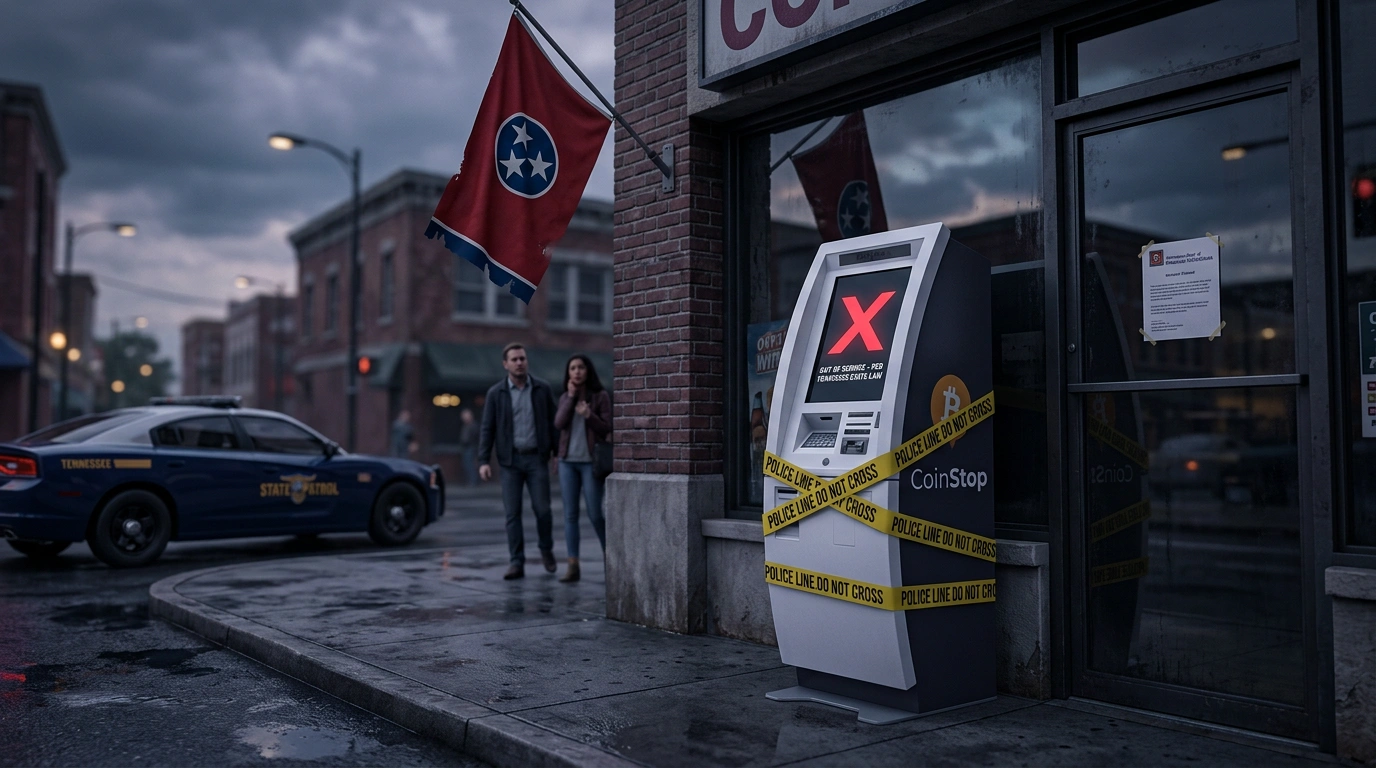
Tennessee became the second US state to make operating a Bitcoin ATM a criminal offense. The law is signed, and 651 machines across the state, most of them clustered around Nashville, now face a hard choice: removal or criminal charges. For operators, the cost calculation has already started.
Criminal Charges Instead of Fines: What the Law Does to Operators
The two-page bill, introduced in February 2026, classifies owning or operating a Bitcoin ATM as a Class A misdemeanor. In Tennessee, Class A misdemeanors sit alongside simple drug possession and domestic assault. Maximum penalty runs up to 11 months in jail or a $2,500 fine per machine. The law took effect without notable pushback from major tech companies.
There are no transition periods. An operator caught running a machine after the law takes effect faces criminal prosecution. This is a sharp departure from the administrative-fine approach used by most other states, where violations carried no criminal record. The industry received a hard signal with no soft landing built in.
One machine costs between $5,000 and $15,000. Removal, transport to another state, and reinstallation add several thousand more. A company running 20 machines in Tennessee faces direct losses of $100,000 to $300,000 in hardware alone, before accounting for lost commission revenue.
651 Machines in Nashville and the Scale of the Market Hit
Tennessee hosts 651 Bitcoin ATMs according to Coin ATM Radar. Most sit in Nashville, where foot traffic from tourists and business visitors is highest. The rest are scattered across gas stations, tobacco shops, and liquor stores in smaller cities and suburbs.
Bitcoin Depot, the largest public ATM operator in the US, runs thousands of machines across multiple states. Tennessee represents a small fraction of its business. Smaller regional operators who built their revenue around Nashville are in a harder spot. Some of them staked their entire operation on a few dozen machines in specific city locations.
The ATM business model runs on commissions of 10 to 20 percent per transaction. Those margins cover rent, maintenance, and compliance costs. With Tennessee removed from the accessible market, some operators will rethink the economics of maintaining machine clusters in states where regulatory pressure is rising.
Indiana and Tennessee Form a Map of Criminal Bans
Indiana was the first state to criminalize Bitcoin ATMs. Tennessee followed months later. Two laws in one measurement period form a trend, not a coincidence. Both reference the same FBI statistics on elder fraud and both classify violations as Class A misdemeanors.
Most states previously relied on operator registration and customer ID requirements. Criminal liability for the mere presence of a machine is a different category of pressure entirely. The National ATM Council has signaled it will challenge these laws in court, but litigation takes years, and operators must either stop running machines or accept the criminal risk in the meantime.
If the first year of Indiana's law produces a measurable drop in fraud complaints, the case for similar action in other states becomes very hard to argue against. Texas, Florida, and California, which have the highest ATM concentrations in the country, are already drawing legislative attention. Some operators are now quietly relocating inventory to jurisdictions with friendlier rules.
Why the Push Happened and Who Is Driving It
The core argument for these bans is not legal theory but a dollar figure. The FBI's 2025 report shows Americans over 60 lost $257 million to crypto ATM fraud. That is a 58 percent increase from 2024 and a number that exceeds the annual law enforcement budgets of several mid-sized states.
Americans under 30 lost $6.6 million from the same schemes. A difference of roughly 40 times explains why that age bracket became the focal point of legislative debates. Older voters show up at the polls. State legislators hear them. One high-profile fraud case in a retirement-heavy district can shift an entire caucus.
Operators spent years arguing their machines are neutral infrastructure and that fraud happens through social engineering, not technology. That argument no longer holds in Tennessee. The law points directly to the fact that victims who send money through an ATM have almost no path to recovery. The irreversibility of the transaction, not the hardware, became the deciding factor.
Where Buyers Go and What This Means for the Industry
The Bitcoin ATM customer base is specific. Most of these users want to buy crypto with cash and skip identity checks. Some are unbanked; others simply distrust online platforms. Moving them to centralized crypto exchanges or peer-to-peer platforms is not automatic. Both options require registration, identity documents, and typically a bank account.
For Bitcoin as an asset, ATM transaction volumes are a rounding error at the global level. A state-level ban will not move the price. But retail accessibility for cash buyers is narrowing.
If four or five large states follow Indiana and Tennessee, the US crypto ATM market will effectively cease to exist as a mainstream channel. That means industry consolidation around large operators with multi-state reach, asset writedowns for smaller companies, and a full rethink of the business model for everyone who bet on cash-based crypto sales.



Comments
Your email address will not be published. Required fields are marked *