


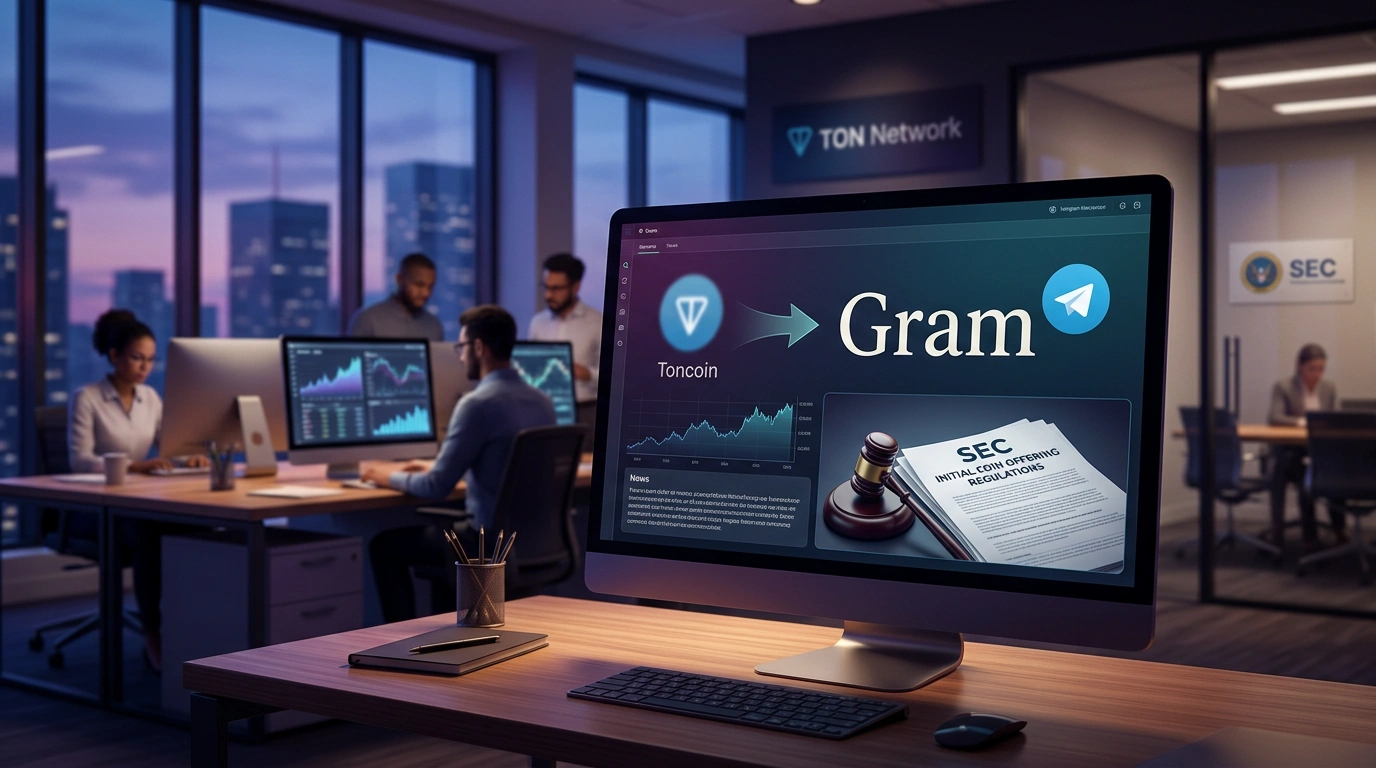
The Open Network (TON) announced it will rename Toncoin to Gram. The name is not new: the token was called Gram in the project's first whitepaper back in 2018, before the SEC blocked Telegram's $1.7 billion ICO. Telegram founder Pavel Durov wrote that the network is "returning to our roots and starting a new chapter."
Where did the name Gram come from, and why was it dropped?
In 2018, Telegram was building a cryptocurrency called Gram. It was meant to be a payment token inside one of the world's largest messaging apps, and large venture funds from the US and Asia backed the idea. The team raised $1.7 billion through SAFE agreements (Simple Agreement for Future Tokens) before any public sale. That contract structure later became the core of the SEC case. The regulator ruled those agreements were equivalent to selling unregistered securities.
In 2020, the SEC sued and won a court order blocking distribution. Telegram settled, paid $18.5 million in penalties, and refunded all round participants. The name Gram became legally toxic. Any project using that name would have drawn immediate regulatory scrutiny, regardless of its connection to Telegram.
A group of independent developers who already had access to the network code launched it on their own and rebranded it. The network became The Open Network and the token became Toncoin. Telegram had no official role, though it gradually built TON features into the messaging app, including a crypto wallet, a payments bot, and mini-app support. Despite the formal separation, Telegram functioned as the network's main promoter throughout those years.
Why did Telegram return to TON now?
In May 2026, the picture changed sharply. Telegram officially took over as the network's primary developer and became its largest validator, effectively sidelining the independent TON Foundation. The shift was made possible by a significant loosening of the US regulatory climate through 2025-2026. A new administration changed the SEC's tone toward crypto projects, and Congress advanced several legislative efforts, including the GENIUS Act stablecoin bill. The legal risk that had kept Telegram at arm's length for years dropped considerably.
Durov launched the "Make TON Great Again" roadmap with four sequential steps. The Gram rebrand is the fourth stage.
- A Catchain upgrade in April 2026 sped up block processing through a new consensus mechanism
- Transaction fees were cut across the network for all participants
- Telegram officially replaced TON Foundation as the main development authority
- The Gram rebrand (the current, fourth stage)
The team said the rename opens the path to the next step. No details on a fifth stage have been released. The destination is already clear: a Web3 super app for Telegram's billion users, with Gram as the native settlement token.
What happens to balances, and is any action needed?
TON Foundation opened a governance vote immediately after the announcement. Holders of 1.8 million tokens voted in favor, representing roughly 80% of all votes cast. The full transition is expected to take about three weeks. Voting on TON runs through smart contracts, where each participant confirms their position by temporarily locking a portion of their tokens. Once the process ends, the locked funds return to the owner automatically.
Holders of Toncoin do not need to take any action. The team confirmed there will be no swap, migration, bridge, or conversion. All balances, addresses, contracts, and positions remain exactly as they are. Only the public name and ticker will change. Wallets and exchange accounts will update automatically once the transition completes, without any steps from holders.
How did the market react?
The token jumped 15% after Durov's post, rising from around $1.95 to $2.25. By the following morning it had pulled back to $2.07. Toncoin still sits 75% below its June 2024 all-time high of $8.25. That 2024 peak came from real product integration of the TON wallet and payments bot inside Telegram, not from a name change.
For symbolic announcements, this reaction is standard. An initial jump on the news, then a cooling off. A rebrand alone does not change what the network produces. For a sustained move, what matters far more is actual product delivery. If Telegram builds a real settlement layer through Gram inside the super app, that would be the genuine driver, not the rename itself.
What the return to Gram means in practice
Technically, the rebrand changes nothing about how the network operates. But for positioning it is a meaningful step. Gram reads like a payment token, not a technical asset sitting on a secondary chain. Telegram's plan is to turn the messaging app into a platform for payments, mini-apps, and AI agents for a billion users. Gram is meant to be the native settlement token inside that super-app environment. The name change signals that Telegram is treating this project as its own product, not as a side experiment by the broader community.
The rename closes a loop that opened in 2018. Back then, the SEC blocked Gram and Telegram walked away. Now, under a very different regulatory climate, the project is reclaiming the original name with Telegram directly behind it rather than kept at a formal distance.
Comments
Your email address will not be published. Required fields are marked *