


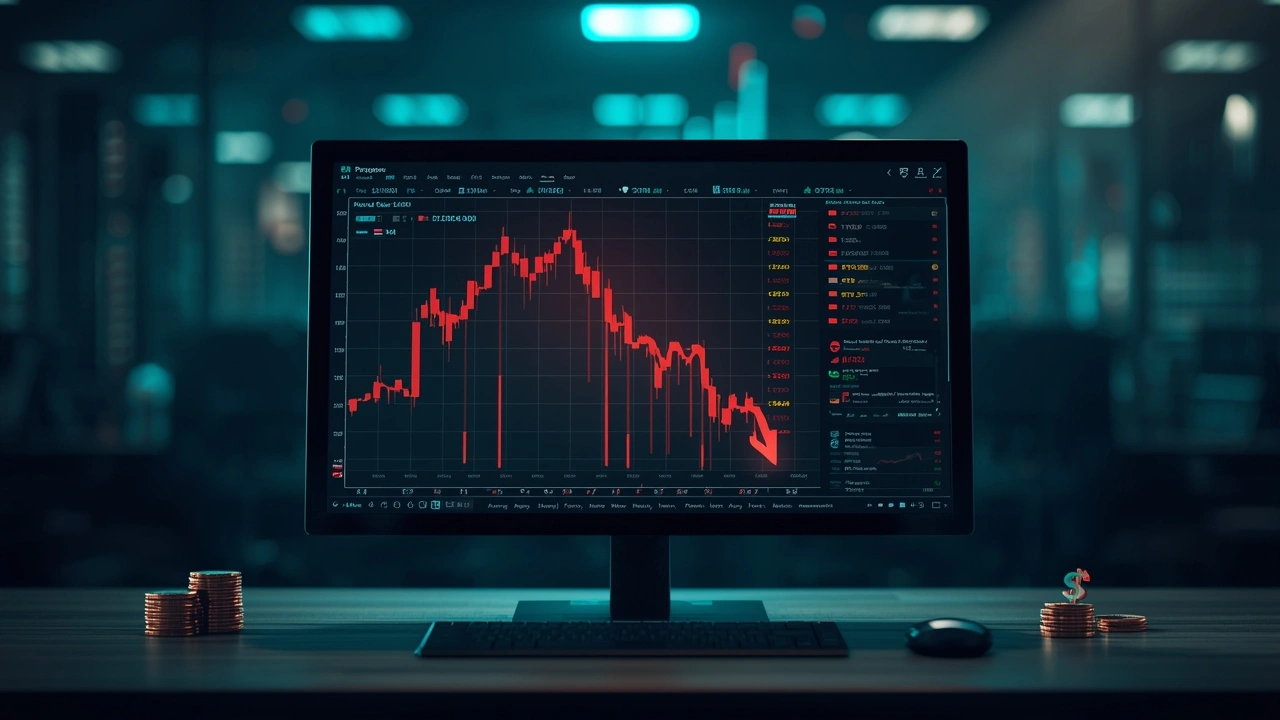
The WLFI token of World Liberty Financial, the project tied to the Trump family, lost between 50% and 59% of its value in a day and hit a record low. The hit spilled over to the project's USD1 stablecoin, which briefly dropped to $0.96, according to market aggregators. For WLFI holders this is one of the harshest days in the token's history, and for the stablecoin market it is one more reminder that a coin holds the dollar only as long as people believe in it.
What the numbers show for the day
According to CoinGecko, WLFI traded near $0.0196 on the morning of November 28. That is down 52% over 24 hours, 56% over a week and 62% over a month. Outlets quote different drops, from 50% to 59%, because they measure from different moments. The token peaked in early September 2025 near $0.33, so it has lost roughly 94% from the top.
Turnover is just as telling. Trading reached almost $540 million against a market cap of about $620 million, meaning nearly the whole value of the token changed hands in one day. That is a classic panic picture. Holders are leaving, not accumulating. Liquidations, per media reports, were only $10-15 million, which is small for a move like this. It looks like spot selling started the avalanche, not borrowed money.
The ether sale from the project wallet
Some outlets link the crash to a World Liberty wallet selling ether. We found no official explanation from the team at the time of writing, and we do not name a sale size because the available material has none. The mechanism itself is clear. When a project converts part of its reserves into other assets, the market reads it as a need for liquidity, not routine treasury management.
It weighs more because WLFI had already fallen over 70% from its yearly high in early November, when the team talked about buying back tokens. The size and timing of that buyback stayed vague. Now a sale of assets has come on top, and the signals pull apart, since a buyback supports the price and a sale pushes on it.
USD1 and the price of a dollar coin
According to bloomingbit and BigGo Finance, USD1 traded near $0.96 at the peak of the panic. By the morning, CoinGecko showed it back at $0.9978, down 0.2% on the day. The deviation was short, and it looks like thin liquidity on some venues caused it, not a reserve problem.
The difference between the two assets is basic. WLFI floats freely, while USD1 is supposed to hold the dollar through reserves and redemption. Yet a buyer sees one brand on both. That is why days like this damage the issuer's reputation more than the rate itself. If you hold and exchange USDT through exchangers, it is a good moment to check how far the exchange price drifts from par and who stands behind the reserves.
Bitcoin, Ethereum and the risks around it
The market is weak this morning too. According to CoinGecko, Bitcoin trades near $59,250 (down 3.8% on the day) and Ethereum near $1,650 (down 4.2%). In such conditions altcoins with a political or narrative story lose liquidity first, since few buyers came for the news, and many holders want out.
The episode leaves a few observations for the market:
- Tokens whose price rests on the reputation of one family or brand react more sharply to a signal of asset sales than ordinary altcoins.
- If the ether sale is confirmed, it adds pressure on ETH, though the size of that pressure is still unknown.
- A stablecoin tied to a governance token carries a higher risk premium than a coin with a simple structure.
- While the team stays silent, any promises about a buyback or an unlock will be met with distrust.
What WLFI holders can expect
The next few days will show whether the team confirms the ether sale and whether it brings back the buyback. Until then the market sees a token with no visible floor. We are watching USD1 and stablecoin rates at exchangers: if the gap to par starts to widen, that will be a more serious signal than the fall of WLFI itself.



Comments
Your email address will not be published. Required fields are marked *