


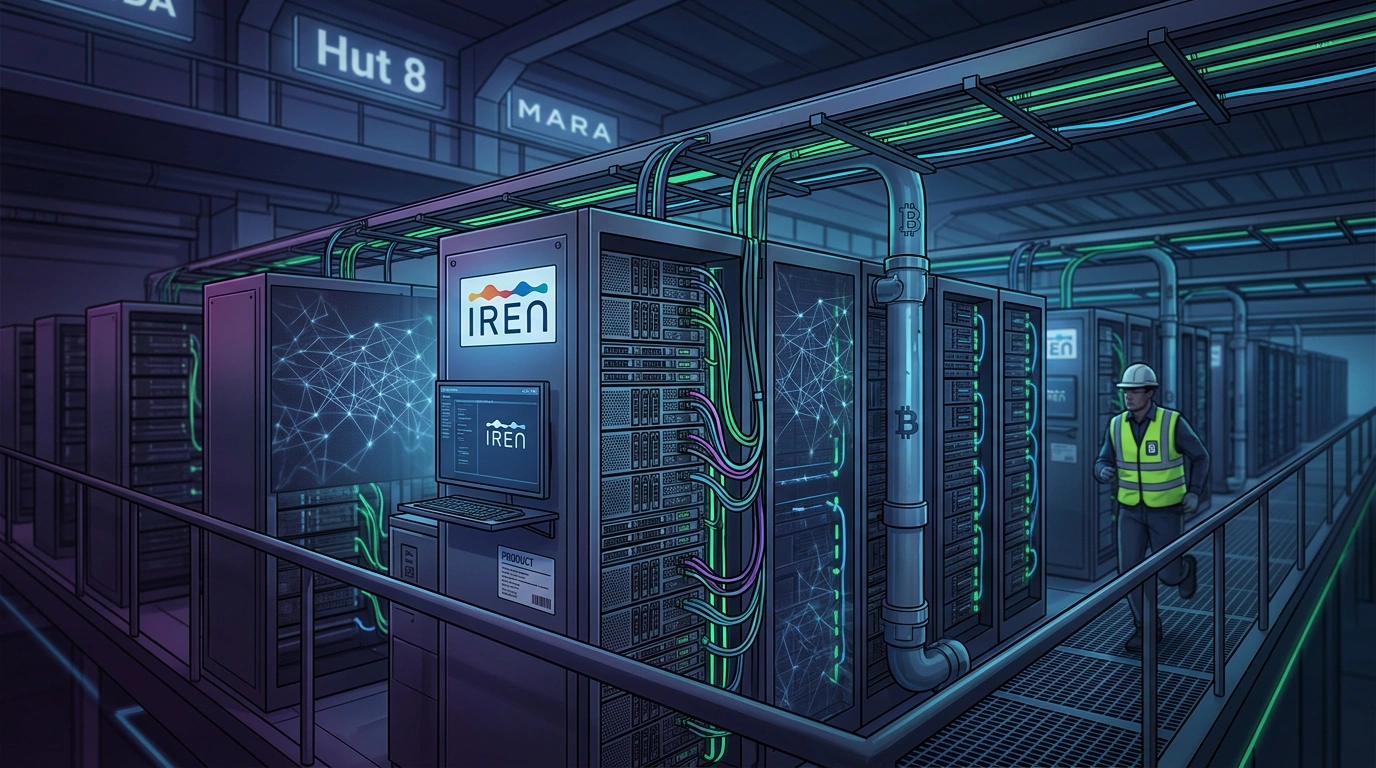
Bitcoin miners have become critical suppliers of AI infrastructure. Bernstein analysts published a research note on May 19, 2026, showing that publicly traded companies mining Bitcoin control more than 27 gigawatts of planned power capacity and have announced AI-related deals worth over $90 billion with hyperscalers, neocloud providers, and chipmakers.
This shift follows two converging trends. The April 2024 halving compressed Bitcoin mining margins and pushed companies to find new revenue streams. At the same time, AI power demand grew so fast that big tech firms ran short not of servers but of electricity and ready-built industrial sites. Miners who spent years securing cheap power contracts and substation access found themselves holding exactly what the market needs most.
27 GW and $90 Billion: What Bernstein Found
Bernstein analysts Gautam Chhugani, Mahika Sapra, Sanskar Chindalia, and Harsh Misra estimate that publicly traded miners have already contracted 3.7 gigawatts with hyperscalers, neocloud providers, and chipmakers. The total planned power portfolio across the sector exceeds 27 GW.
For scale: a single large AI model-training data center requires between 0.5 and 1 GW. The 3.7 GW already under contract could theoretically serve dozens of such facilities. Most deals involve the largest buyers: Amazon Web Services, Google, Microsoft, and fast-growing neocloud operators building out AI compute at speed.
The analysts explain the miners' advantage: they are not offering empty warehouses. They bring fully developed sites with cooling, grid connections, and completed permitting already in place. These sites take years to build. No newcomer can replicate that quickly. This is why large tech companies prefer signing long-term agreements with miners rather than waiting for new sites.
50 Months to Connect: Why Power Scarcity Is the Real Moat
The deeper argument in the Bernstein note is not how much has been signed but how hard it is to add new capacity. The median waiting time to connect 1 GW to the US grid exceeds 50 months, according to the analysts. That number explains why miners have become irreplaceable for the AI industry.
Even in Texas, where the regulatory environment is considered friendly for large power consumers, utilities have moved to a batch review process for new applications. Bernstein quotes the analysts directly: "The median waiting time to secure a GW of power is nothing less than approximately 50 months across states, and even in politically friendly states such as Texas, the utility is following a batch review process to navigate the interconnect queue." New applicants wait years. Companies that secured industrial power contracts and substation access in 2019-2023 stand three to four years ahead of any competitor starting fresh today.
Fifty months is more than four years. During that window, the AI market may completely reshape itself. Whoever already holds grid connections will collect rental income regardless of what happens in the Bitcoin market.
That is the strategic asset Bernstein describes in the note: not hardware, not coins, but power agreements signed years in advance.
The 2024 Halving That Pushed Miners Toward AI
Before April 2024, most publicly traded miners focused entirely on Bitcoin production. The halving cut block rewards from 6.25 to 3.125 BTC and compressed margins industry-wide. For companies with higher operating costs, this was the first real pressure to diversify.
Bernstein notes that several major players have already shifted their business model from pure Bitcoin production toward building AI data centers and high-performance computing facilities. Three recent examples: IREN signed a $3.4 billion agreement with Nvidia, Hut 8 announced a $9.8 billion AI deal, and MARA acquired Long Ridge Energy for $1.5 billion. All three were announced between April and May 2026.
Each deal rests on the same underlying asset: a connected industrial site with guaranteed power capacity. Infrastructure that was previously used only for ASIC farms is now becoming the foundation for GPU clusters and cloud compute services. The difference between the two business models comes down to who rents the site: the Bitcoin protocol or Amazon.
Risks the Analysts Do Not Ignore
Shifting from mining to AI infrastructure requires significant capital spending. Retrofitting a site for GPU data center standards costs far more than running ASIC farms: higher cooling density, stricter power reliability requirements, and extensive redundancy. Companies without adequate financing risk missing the window.
There is also an operational gap. Bitcoin miners built their business around a simple model: buy ASICs, connect to power, sell coins. AI infrastructure requires different expertise entirely.
- GPU cluster management: different temperature and reliability requirements than ASIC operations
- Enterprise SLAs: hyperscalers require uptime guarantees that do not exist in mining contracts
- New talent: data center engineers, not just Bitcoin operators
- Capital gap: $90 billion in agreements does not equal $90 billion in cash flow today
The $90 billion figure reflects signed agreements, not current revenue. Converting contracts into functioning data centers will take years and require additional financing along the way.
What These Numbers Mean for Bitcoin's Price
For Bitcoin markets, the practical takeaway from the Bernstein note is counterintuitive. Large miners that have successfully diversified into AI become less dependent on BTC price movements. A company earning steady cash flow from AI contracts does not need to sell Bitcoin for dollars to cover operating costs when markets pull back.
This structurally reduces forced selling pressure during BTC downturns and may support a higher price floor during corrections. While analysts debate whether BTC falls to $65,000 or $70,000, large miners are methodically converting coin exposure into megawatt contracts.
Bernstein releases sector reports regularly. This one stands out for its specificity: 27 GW, $90 billion, 50 months. Those three numbers explain why publicly traded Bitcoin miners have gained 85% since the start of 2026 while BTC itself has not recovered its February levels. The difference is that miners sold kilowatts, not coins.
Comments
Your email address will not be published. Required fields are marked *