


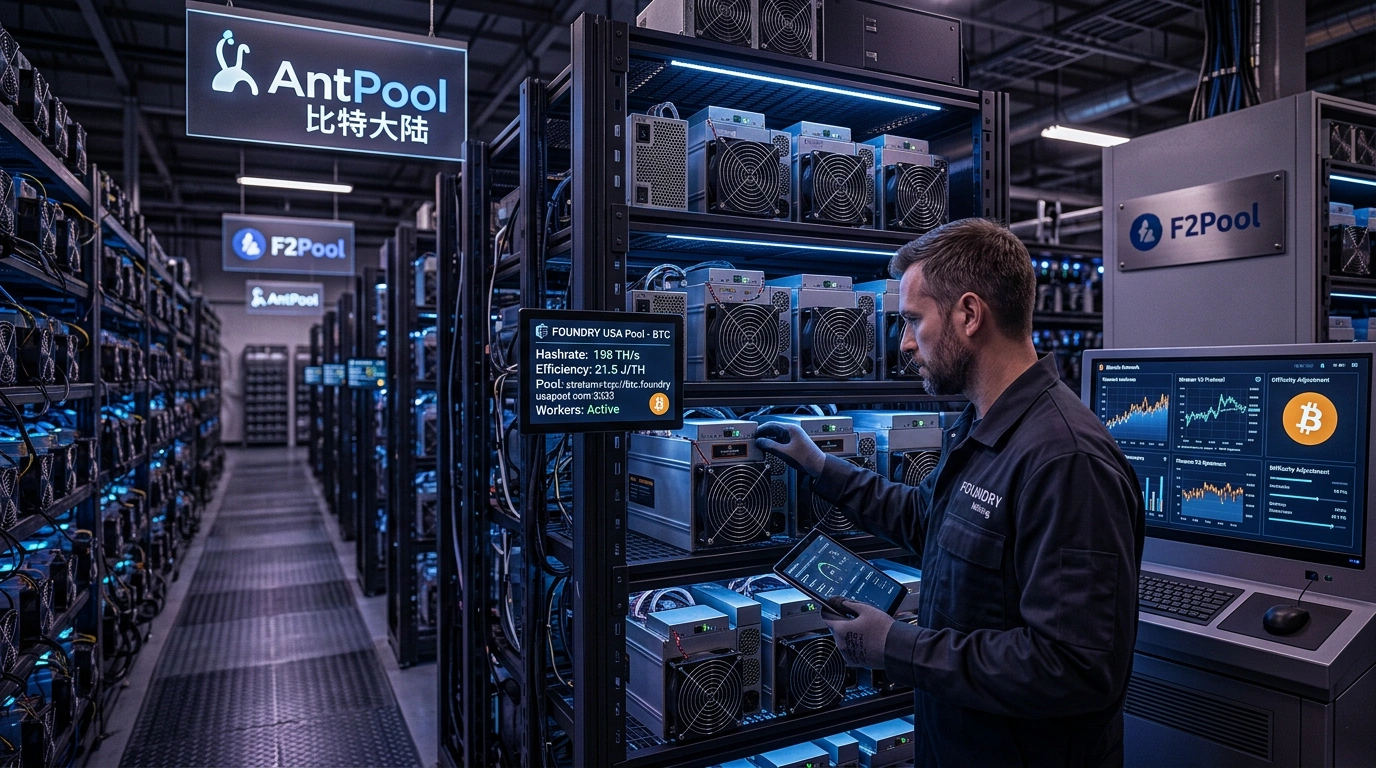
Seven major Bitcoin mining pools joined the Stratum V2 working group to build a shared open-source communication protocol between pools and miners. AntPool, Block Inc, F2Pool, Foundry, MARA Foundation, SpiderPool, and DMND all signed on. Together they represent a substantial portion of the global Bitcoin network hashrate.
Stratum V2 is a next-generation protocol designed to replace Stratum V1, which pools have used since 2012. The update cuts the time between finding a block and distributing work to miners, and it lets individual miners choose which transactions to include in their block template rather than accepting whatever the pool operator decides.
Participants and Their Hashrate Shares
Foundry is the largest Bitcoin mining pool in the world. According to Hashrate Index data, the company controls approximately 30% of the global network hashrate. AntPool, owned by Bitmain, holds 17.7%. Those two participants alone account for more than 47% of all Bitcoin mining compute power.
F2Pool and Block Inc, the company led by Jack Dorsey, are also significant players in the market. MARA Foundation is the non-profit arm of Marathon Digital Holdings, one of the largest publicly traded Bitcoin miners. SpiderPool and DMND round out the geographic reach of the consortium.
What Stratum V2 Changes
Under the old Stratum V1 model, pools send miners a pre-built block template with no input from the miner on which transactions to include. Stratum V2 changes that. Miners can build their own transaction set within parameters set by the pool. This reduces the network's dependence on a handful of large operators when it comes to what goes into each block.
The technical gain is also measurable in latency. As the Stratum V2 announcement put it, in Bitcoin mining "a millisecond can determine whether a miner wins a block or loses to a competitor." Cutting the time between block discovery and work distribution directly affects how profitable a pool can be at scale.
Mining Economics Under Pressure
The announcement comes as mining profitability is under serious strain. The next Bitcoin difficulty adjustment is set for May 15, 2026 at 5:58 PM UTC. According to CoinWarz, difficulty will rise from 132.47 T to 135.64 T, an increase of roughly 2.4%. For miners, that means more compute per block with no change in reward.
Hashprice, the key profitability metric measuring revenue per unit of mining power, has dropped to $36-38 per petahash-second per day. CoinShares estimates that up to 20% of Bitcoin miners are currently operating at breakeven or a loss. At those levels, operators face real pressure to sell Bitcoin for dollars before covering full operating costs.
Decentralization vs Concentration: The Industry Paradox
Stratum V2 is built to decentralize transaction selection. But the same list of working group members shows the opposite trend in raw hashrate: Foundry and AntPool together control more than half the network. That concentration has drawn criticism from parts of the Bitcoin community long before the Stratum V2 announcement.
- Transaction choice: Stratum V2 gives individual miners the right to build their own block template, which reduces how much influence large pools have over what gets included in each block.
- Total hashrate decentralization is a separate question. Pooling under a shared protocol does not reduce the concentration of actual computing power among a few operators.
- Regulatory exposure: several governments are already considering rules that target mining pools directly. A single open standard makes monitoring easier, but it could also make targeted policy intervention more straightforward.
A Protocol That Could Reshape the Mining Industry
Seven major pools joining Stratum V2 moves the protocol from an open-source proposal toward something that looks like an actual industry standard. If the rest of the market follows, the update could cut latency, improve individual miner returns, and reduce censorship risk at the pool level. The months ahead will show whether additional large participants sign on and whether Stratum V2 can establish itself across the industry before the next wave of difficulty increases squeezes margins further.


Comments
Your email address will not be published. Required fields are marked *