


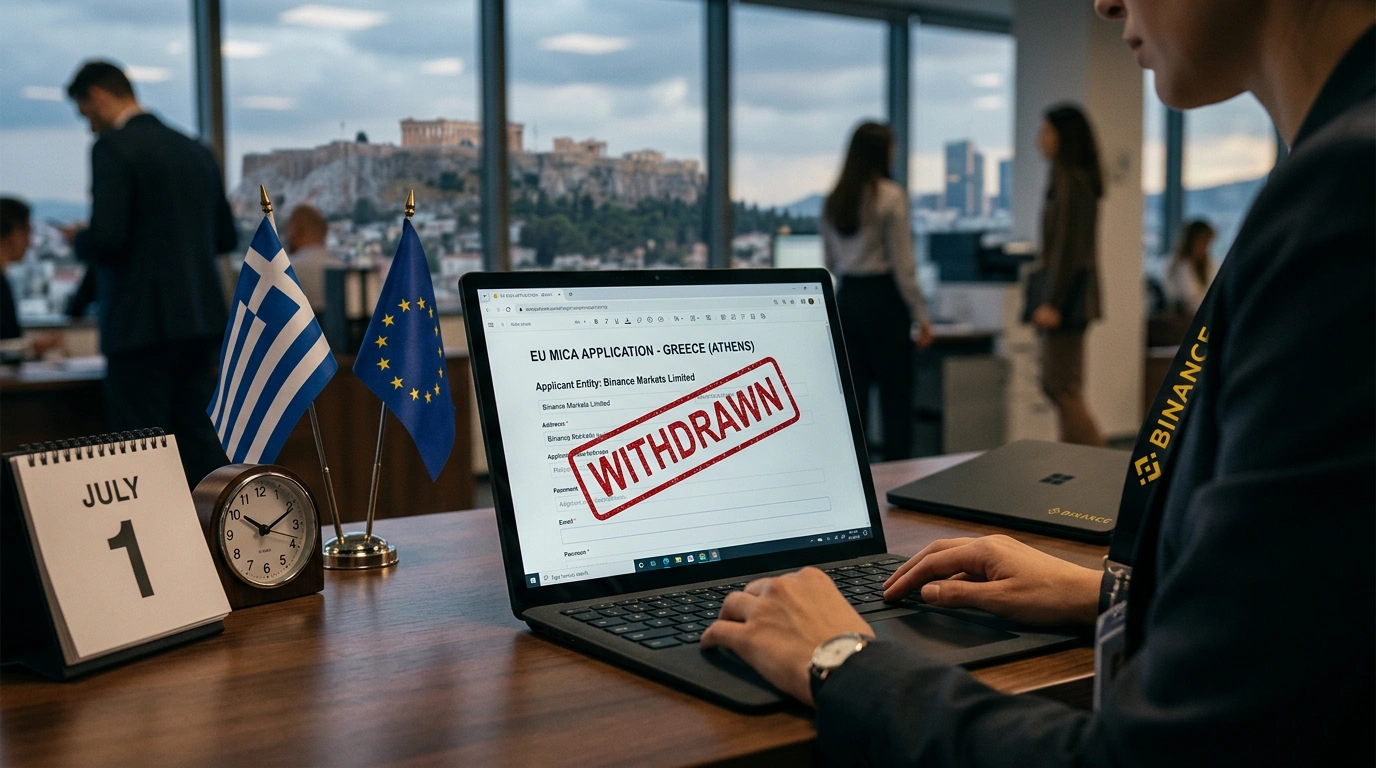
Binance officially withdrew its CASP license application from the Hellenic Capital Market Commission (HCMC) on June 24, 2026. Less than a week remains before the MiCA transitional period ends. No new EU jurisdiction has been announced. In its statement, the company confirmed that "some users may be impacted" and promised to notify affected clients directly.
According to CryptoQuant, Binance controls 18.5% of euro-denominated spot trading volume in the European Union, ranking second behind Kraken at 43.3%. Daily volume on EUR pairs runs $100-250 million, reaching about $600 million on peak days. CryptoQuant analyst Maartunn calculated that these figures account for roughly 1% of Binance's total global spot volume.
From Denying the Reuters Report to Withdrawing in 8 Days
Binance had been negotiating EU registration for several months, holding talks with Ireland, Latvia, and Greece. It filed a formal application only in Greece. Gillian Lynch, Binance's head of Europe and the United Kingdom, told Reuters that filing in multiple countries simultaneously was never part of the plan, and discussions with the other two regulators never progressed beyond consultations.
On June 16, Reuters reported that Greece was preparing to reject the application. Binance denied that the same day, saying HCMC had assessed the documents as compliant and the process was moving toward authorization. Eight days later, the company withdrew the application. On June 23, ESMA (the European Securities and Markets Authority) published a statement requiring unlicensed platforms to begin winding down before July 1.
The U.S. Settlement That Followed Binance Across Three EU Countries
In November 2023, Binance settled cases with the U.S. Department of Justice for $4.3 billion. Founder and then-CEO Changpeng Zhao personally agreed to a $50 million fine and served four months in prison. The company admitted to AML violations and serving Iranian clients in breach of sanctions.
MiCA allows regulators to reject CASP applications when there are substantiated concerns about a firm's AML compliance. For Binance, the U.S. settlement carried reputational weight in each of the three conversations. Regulators also pointed to the holding company's opaque international structure and what they described as a "risk-taking culture." Bybit and Crypto.com, which had no equivalent precedent, secured CASP authorizations by spring.
18.5% of the EU Market, but Only 1% of Global Volume
Binance ranks second in the EU market and processes up to $600 million on peak days. In the context of its global business, though, these volumes account for about 1%. The direct financial impact on the company is limited. The reputational and regulatory fallout is harder to quantify.
What EU Users Could Face After July 1
ESMA is demanding that unlicensed platforms begin winding down "immediately." Binance has not disclosed which specific features will be restricted, only stating that "all user funds remain safe and secure." Based on standard MiCA procedures, the following scenarios are likely:
- New registrations: suspension of onboarding EU residents until a license is obtained in a new jurisdiction
- Additional verification or partial trading restrictions for existing EU accounts
- Suspension of new deposits from EU clients in specific member states
- Gradual wind-down of certain services while negotiations about a new jurisdiction continue
Different EU member states apply different buffer periods for platforms in the licensing process. If Binance files a new application quickly, some EU states allow continued operations for 6-12 more months. Without naming a new jurisdiction, though, that option stays theoretical.
Licensed Competitors Gained a Strategic Edge
WhiteBIT received CASP authorization in Austria 12 days before the deadline. Bybit and Crypto.com completed EU licensing by spring. For these platforms, the Binance situation is a real opportunity: some EU traders may shift to licensed competitors in the first weeks of July.
The Binance case also carries a broader structural implication. MiCA-authorized exchanges are becoming de facto gatekeepers for token listings in the EU. Projects seeking EU liquidity will concentrate on licensed venues. Major assets like Bitcoin or Ethereum are barely affected, but smaller tokens face direct dependence on listing decisions made by MiCA-licensed platforms.
When Binance Will Name a New Jurisdiction
The company said it will announce a new EU jurisdiction "when ready." No dates were given. Getting a license within a week is not realistic: regulatory procedures take months. The most likely sequence: Binance names a new country within days, then goes through standard licensing, during which EU users operate under escalating restrictions.
The Binance situation served as a real-world stress test for MiCA: the world's largest crypto exchange by volume could not complete EU licensing because of its AML track record. With EU volumes at roughly 1% of global business, the direct financial blow is limited. Long-term access to the EU market and regulatory standing, however, carry far more weight than current EUR pair volumes.



Comments
Your email address will not be published. Required fields are marked *