


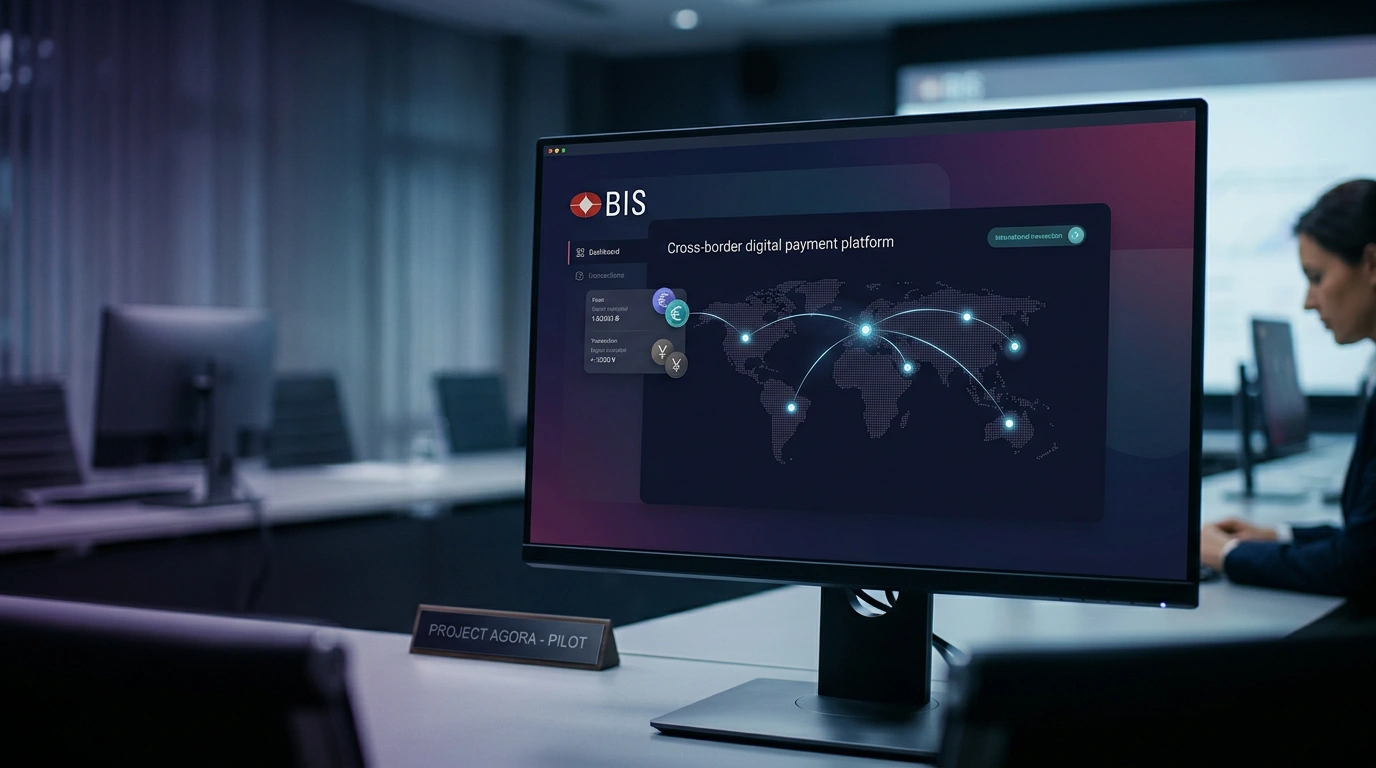
The Bank for International Settlements (BIS) published a report Wednesday on Project Agora, a two-year experiment in tokenized wholesale payments. The prototype, built with seven central banks and over 40 regulated institutions, settled cross-border transactions in seconds once funds were locked. The project now moves to real-value testing.
Why Do Cross-Border Payments Still Take Days?
An international payment today travels through a chain of correspondent banks. Each one keeps its own ledger, verifies the transaction independently, and passes it along. That takes one to five business days from send to receipt. No party knows the exact transfer status in real time.
AML checks, sanctions screening, and fraud verification run in sequence. Each step waits for the previous one to finish. That is where most delays pile up, along with false positives that need manual review. Cross-border payments reached $195 trillion in 2024. FXC Intelligence projects growth to $320 trillion by 2032. The infrastructure built last century was not designed for that volume.
How Does the Two-Layer Architecture Work?
The system runs on two levels. At the first, each participating central bank maintains its own ledger of tokenized central bank reserves. At the second, a shared unifying ledger holds tokenized commercial bank deposits. Both ledgers operate through a single integrated platform.
- Atomic settlement: all balance updates happen simultaneously or not at all. Partial execution is excluded by design.
- AML screening, sanctions checks, and fraud detection run in parallel rather than in sequence. This cuts false-positive rates and reduces manual workload.
- The platform operates around the clock. Mismatched business hours across jurisdictions no longer delay settlement.
- All parties to a transaction see real-time payment status. Non-participating entities do not.
"The prototype also enhances transparency. All parties to a transaction have access to real-time payment status, while maintaining privacy from non-participating entities."
- BIS Project Agora report, May 2026
The BIS says the design preserves the "two-tier banking system" and "singleness of money." That sets Project Agora apart from private stablecoins like USDT, which bypass the banking layer entirely. According to the BIS, this architecture better protects financial stability.
Who Is Involved, and Why Does the Breadth Matter?
The seven central banks are the Banque de France on behalf of the Eurosystem, the Bank of Japan, the Bank of Korea, the Bank of Mexico, the Swiss National Bank, the Federal Reserve Bank of New York through its NY Advancement Center, and the Bank of England. That covers the dollar, euro, pound, yen, Korean won, and Mexican peso. Testing across that many different legal and regulatory frameworks at once is rare for this type of project.
Over 40 commercial banks and financial institutions joined as partners alongside the BIS and the Institute of International Finance. That makes this one of the broadest consortiums assembled to test tokenized payment rails. Most earlier initiatives stayed within two or three jurisdictions and a handful of participants.
What Still Needs Work?
The report is direct about the gaps. Liquidity saving mechanisms need further development: the platform has not yet shown how it handles a sharp spike in transaction volume. Cybersecurity is another open question. A centralized platform linking several major central banks is a high-value target.
Governance frameworks covering settlement finality, data governance, and risk allocation between participants are still being defined. The BIS gave no timeline for moving from testing to full deployment. The immediate next step is real-value transactions in specific currencies with actual participants.
What This Signals for Global Finance
While Ethereum and competing blockchains chase tokenization in the retail segment, major central banks are building a parallel track. Project Agora shows that regulators are ready to bring distributed ledger technology into wholesale banking as an upgrade to its core, not a replacement. Those are two very different propositions with very different regulatory standing.
For the stablecoin market, the report carries weight. The BIS explicitly sets its model against private digital assets and argues that tokenized central bank reserves protect stability better. That position gives regulators across multiple countries a ready-made argument as they write new stablecoin rules.



Comments
Your email address will not be published. Required fields are marked *