


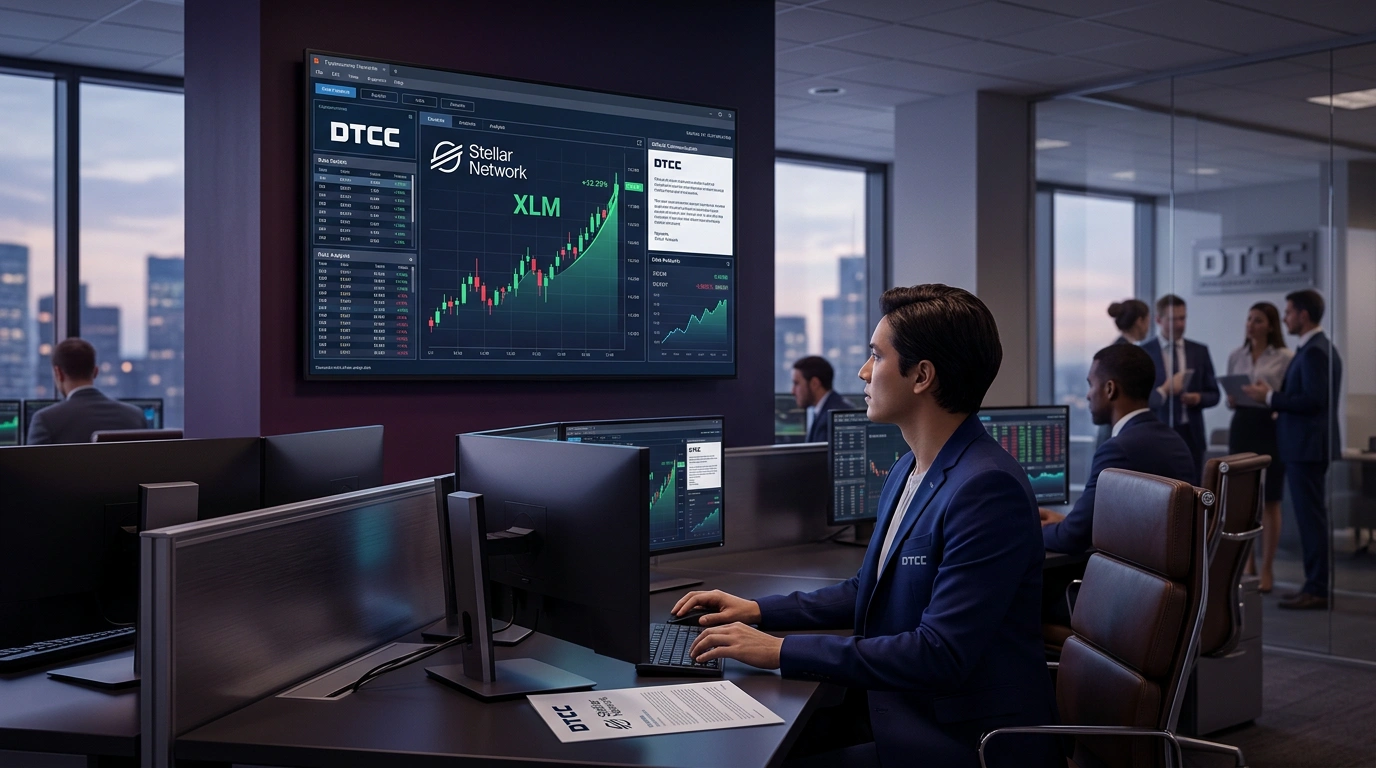
Stellar's XLM token gained more than 51% this week, reaching its highest price since January 2026. The catalyst was a press release from DTCC, the corporation that clears and settles $10 to $12 trillion in securities every day, announcing plans to integrate its tokenized securities platform with the Stellar network. The broader crypto market fell about 5% over the same period.
What is DTCC and why does it matter?
The Depository Trust and Clearing Corporation, known as DTCC, sits at the center of US financial market infrastructure. It processes clearing and settlement for stocks, bonds, and derivatives totaling $10 to $12 trillion daily. Most trades executed on the NYSE and Nasdaq are closed through this corporation.
DTCC has already run a pilot project with tokenized assets. The new Stellar Network partnership extends that work: DTCC's tokenized securities will be issued, managed through corporate actions, and settled directly on the Stellar public blockchain. Target launch is the first half of 2027.
For the crypto market this is a different kind of signal than another startup pilot. DTCC is regulated federal infrastructure, and when it selects a specific blockchain for live operations, that choice carries real weight.
How will the integration work?
DTCC follows a multi-chain strategy. Stellar will become one of the blockchains used for tokenized real-world asset issuance. The corporation plans to cover several functions:
- Token issuance: a security receives a digital twin on the Stellar blockchain.
- Corporate actions (dividends, splits, shareholder votes) get automated through smart contracts.
- Settlement between market participants moves beyond the traditional T+2 cycle.
- Existing DTCC systems remain connected throughout.
Why did XLM spike so fast?
The price moved immediately after the DTCC press release. But 51% in a week is more than a standard reaction to good news. According to CoinGlass data, since May 28 the market recorded $12.41 million in forced short closures against $6.82 million in long liquidations, matching the pattern of a short squeeze.
Open interest nearly doubled over the same period and reached $292.11 million. Traders were not closing positions. They were adding new ones with borrowed capital while the price was already climbing. The OI-weighted funding rate fell to -0.027%, its lowest level since April. A negative rate means short traders were paying long traders to keep positions open despite the rising price. Forced buying from the bears added extra upward pressure.
Will the sharp pullback repeat?
There are reasons for caution. Two previous XLM rallies ended with steep corrections. In November 2024, following Trump's presidential election win, XLM surged roughly 640% and then lost 68.6% from the local peak. In July 2025, PayPal's stablecoin launch on Stellar and excitement around Protocol 23 produced a ~140% rally, after which XLM/USD corrected 73.8%.
A similar pattern played out for XRP. Each Ripple partnership with banks or regulators triggered a sharp rally followed by a corrective pullback. The current setup adds complexity because open interest jumped sharply and the funding rate stayed negative even through the rally. The crowd of shorts did not disappear.
That said, the current rally differs from those earlier cases. The excitement around PayPal and Protocol 23 rested on community enthusiasm. DTCC is a regulated federal institution that chose a blockchain for live operations. Whether that difference makes this rally more durable will become clear in the weeks ahead.
What to watch next
The key date is the first half of 2027, when DTCC plans to move into full production. Until then, the market will track XLM trading volumes and positioning from large players. Bitcoin and the broader market remained under pressure this week: ETF outflows stretched to nine consecutive days and totaled $2.84 billion. XLM moved against that trend. But that same fact raises the entry risk. If the broader market fails to turn around, even a strong catalyst may not hold the price at these levels.

Comments
Your email address will not be published. Required fields are marked *