


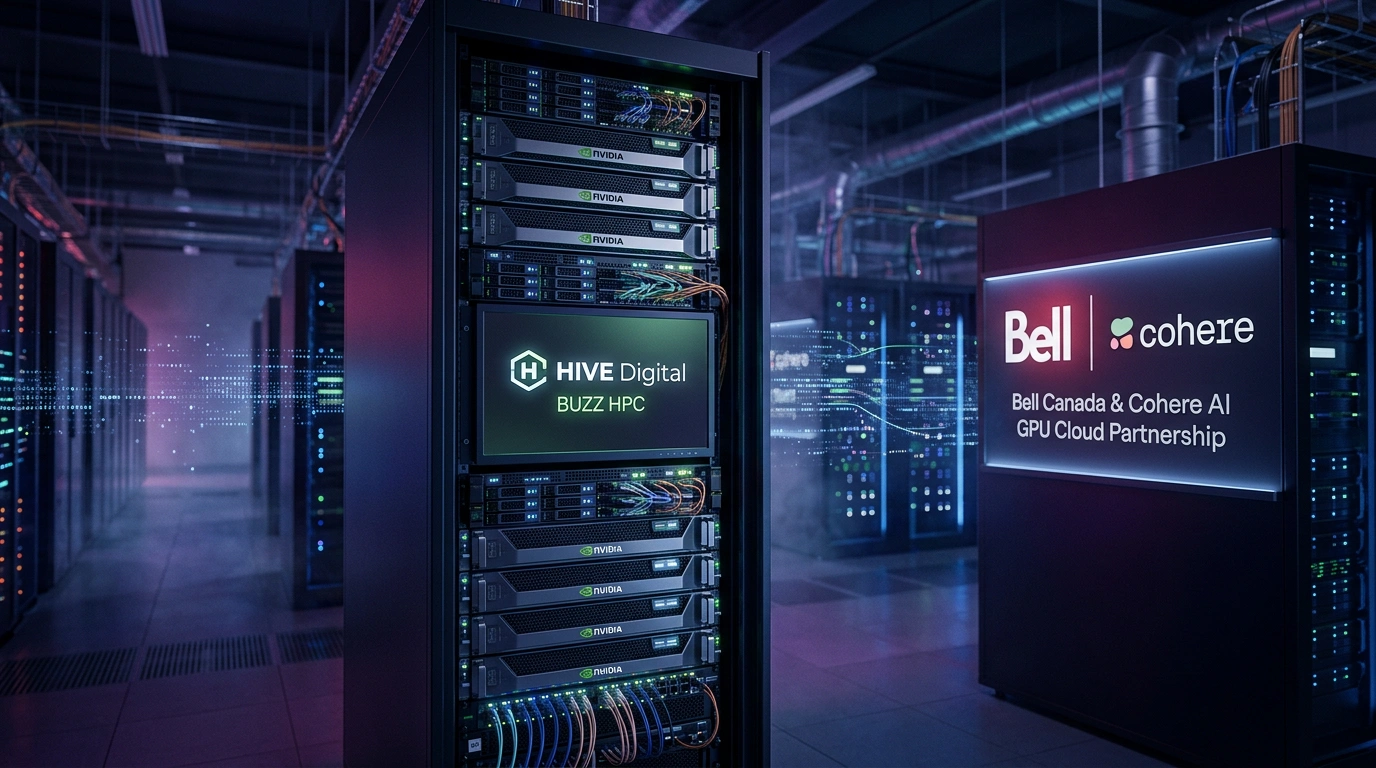
Canadian Bitcoin miner HIVE Digital Technologies, through its subsidiary BUZZ HPC, has signed a three-year GPU cloud contract with Bell AI Fabric worth approximately $220 million. The deal serves AI startup Cohere, which provides enterprise and government AI solutions across Canada. HIVE expects the agreement to generate around $70 million in annual recurring revenue, pushing its total contracted HPC revenue above $100 million ARR.
The announcement came on the same day industry publications tallied the results of Bitcoin's latest mining difficulty drop. The network adjusted down 10.09% on June 14, one of the largest single-round corrections in its 17-year history. These two data points together show where the mining sector is heading. Mining margins are shrinking, and AI infrastructure is filling the gap.
2,304 NVIDIA Grace Blackwell chips at Bell Canada's British Columbia facility
Under the contract, BUZZ HPC will deploy 2,304 NVIDIA Grace Blackwell GPUs at a Bell Canada data center in British Columbia. The hardware will support Cohere's AI models for enterprise and government customers across Canada. The contract runs for three years, with revenue beginning after the cluster enters service.
Grace Blackwell is Nvidia's latest GPU generation, designed specifically for large language model workloads. The chip integrates CPU and GPU in a single package, reducing latency in AI processing tasks. Deploying 2,304 of these chips in a single project puts BUZZ HPC in the same tier as major enterprise-grade HPC providers.
For Cohere, the contract reduces dependence on public clouds like AWS, Azure, and Google Cloud. The company is expanding its base of enterprise and government clients in Canada, and dedicated GPU capacity through Bell Canada strengthens that position.
HIVE's Bitcoin treasury dropped threefold in one quarter
The strategic shift is showing up in the company's financials. HIVE's Bitcoin holdings fell to 150 BTC from 481 BTC the previous quarter. Resources freed from mining are flowing into HPC: the division's revenue in fiscal 2026 reached $19.5 million, nearly double the figure from a year earlier.
Before signing the Bell and Cohere deal, HIVE already had $35 million in ARR from its HPC business. The new contract adds $70 million in ARR, pushing the total HPC portfolio above $100 million in annual recurring revenue. Two years ago, the HPC segment barely appeared in HIVE's financial reports.
Funding the GPU cluster: $115 million in convertible notes
HIVE is funding the GPU cluster from an April raise of $115 million in convertible notes. Part of the proceeds will cover the 2,304 Grace Blackwell chips; the rest is reserved for future AI projects. Convertible notes are a common tool among miners: they let companies raise capital without immediately diluting existing shares.
In May 2026, HIVE also announced plans for a 320-megawatt AI data center campus near Toronto capable of hosting more than 100,000 GPUs. The Bell and Cohere contract gives the company its first major long-term client for that expansion.
Bitcoin mining difficulty fell 10%: pressure on the sector
On June 14, Bitcoin's mining difficulty fell 10.09%, one of the largest single-round drops in network history, according to The Energy Mag. Analysts cited several causes: falling BTC prices, seasonal power curtailment in Texas, and electricity shifting from mining to AI projects. Mining profitability hit record lows at the same time.
Markets responded to HIVE's deal positively. The company's shares rose 9% on the day and 24% over the past month. The CoinShares Bitcoin Mining ETF (WGMI) gained 5.4% on the same day and 30% over the past month. HIVE stock is the fund's eighth-largest holding by weight.
Miners all moving in the same direction: HIVE, IREN, TeraWulf
HIVE is not alone in shifting from mining to AI. IREN recently completed its acquisition of Spain's Nostrum Group, gaining 490 megawatts of European capacity for HPC workloads. TeraWulf is also building out AI infrastructure at its mining sites. The calculation is the same for all of them: at current BTC prices and energy costs, AI contracts generate better margins than mining.
According to Bernstein analysts, Bitcoin miners collectively control AI contracts worth roughly $90 billion. HIVE's $220 million deal and more than $100 million in HPC ARR show that the industry's largest players have moved past announcements into signed agreements.
HPC ARR above $100 million and what comes next for HIVE
If HIVE executes on plan, the HPC segment could account for more than half of the company's total revenue by the end of fiscal 2026. The Bell and Cohere contract does more than add ARR: it establishes HIVE as a credible enterprise-grade GPU provider, opening the door to future large-scale contracts.
Risks remain: GPU deployment delays, competition from AWS and Azure, and possible changes in Cohere's order book. But with mining profitability at record lows, a three-year AI contract looks like a significantly more predictable business.


Comments
Your email address will not be published. Required fields are marked *