


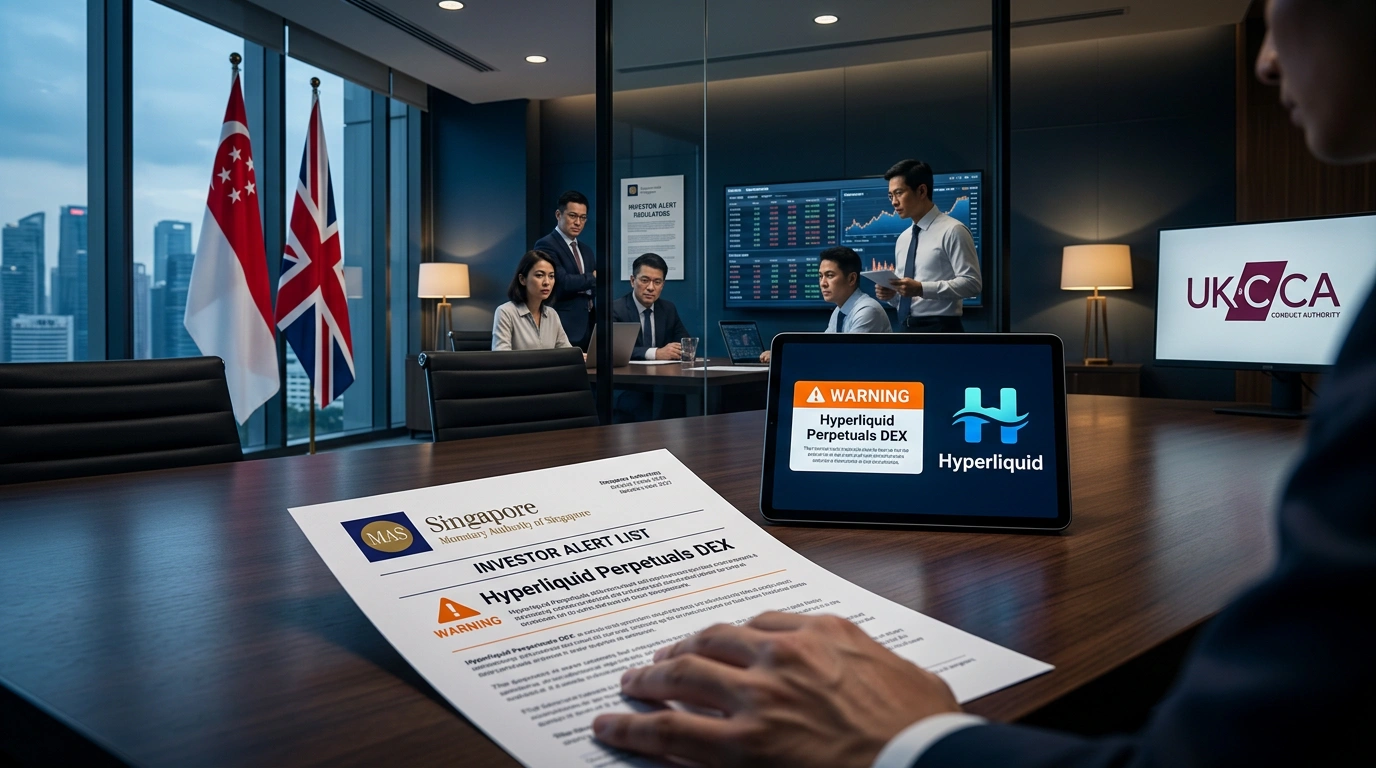
Singapore's Monetary Authority (MAS) has added Hyperliquid to its Investor Alert List, flagging the decentralized perpetuals exchange for operating without a local license. The move comes less than three weeks after the UK's Financial Conduct Authority (FCA) issued a similar warning about the platform. Within a single month, Hyperliquid has drawn official attention from regulators in two of the world's leading financial centers.
What the Investor Alert List Means for Traders
MAS maintains the Investor Alert List as a public register of entities providing financial services to Singapore residents without proper authorization. An IAL listing does not shut a platform down or ban it from operating globally. It does serve as an official warning: investors who suffer losses have no recourse under Singapore law and cannot file complaints with MAS.
The list has a long track record. Bybit appeared on it before obtaining its Singapore license, along with dozens of other centralized and decentralized platforms. Bybit has since become one of the few major exchanges with a full MAS license. Decentralized protocols have fewer examples of successful licensing, partly because the regulatory framework for entities without a legal person remains unresolved in Singapore. IAL inclusion can be a standalone warning or the first step in a longer regulatory sequence.
Scale and No-KYC Model Caught MAS Attention
Hyperliquid ranks among the top three decentralized platforms globally by perpetuals trading volume, processing tens of billions of dollars monthly. The exchange has attracted a large base of Asian traders, including significant participation from Singapore. That scale made it visible to MAS.
The exchange accepts USDT and other assets without identity verification. Under Singapore's Payment Services Act, licensed crypto service providers must conduct KYC for local customers. Hyperliquid's model does not meet that standard for Singapore residents. The no-KYC approach draws privacy-conscious traders but creates direct tension with licensing requirements across most regulated markets.
Market Reaction and Platform Silence
Hyperliquid's team has not commented on the MAS action. The HYPE token held above $63 on June 27, despite a broader crypto market pullback in late June 2026. Trading volumes on the platform continued to grow, with no visible signs of liquidity outflow following the announcement. Markets are treating the IAL listing as a compliance note rather than an operational threat.
The Bybit comparison is worth examining. Singapore's 2022 IAL listing did not stop that exchange from operating, but it did accelerate the path to obtaining a local license. Getting licensed is harder for a decentralized protocol with no single legal entity than for a centralized exchange. If Hyperliquid moves toward regulatory compliance, it will need to either establish a corporate structure or introduce identity checks, both of which conflict with the platform's permissionless design.
Regulators Are Watching Scaled DeFi Platforms
Both the FCA and MAS have reputations for pragmatic approaches to crypto regulation. Neither, however, is willing to let large unlicensed platforms serve local retail investors without intervention. Once a decentralized exchange reaches Hyperliquid's scale, it stops being invisible to financial authorities.
Hyperliquid faces a concrete decision: pursue licenses in key jurisdictions or remain an unlicensed global platform with the exposure that entails. The second path makes it harder to attract institutional capital, which increasingly demands regulatory compliance from its counterparties. The outcome matters beyond Hyperliquid itself. If the largest perps DEX moves toward licensing, it sets a new benchmark for the sector. For now, the platform has time to choose.



Comments
Your email address will not be published. Required fields are marked *