


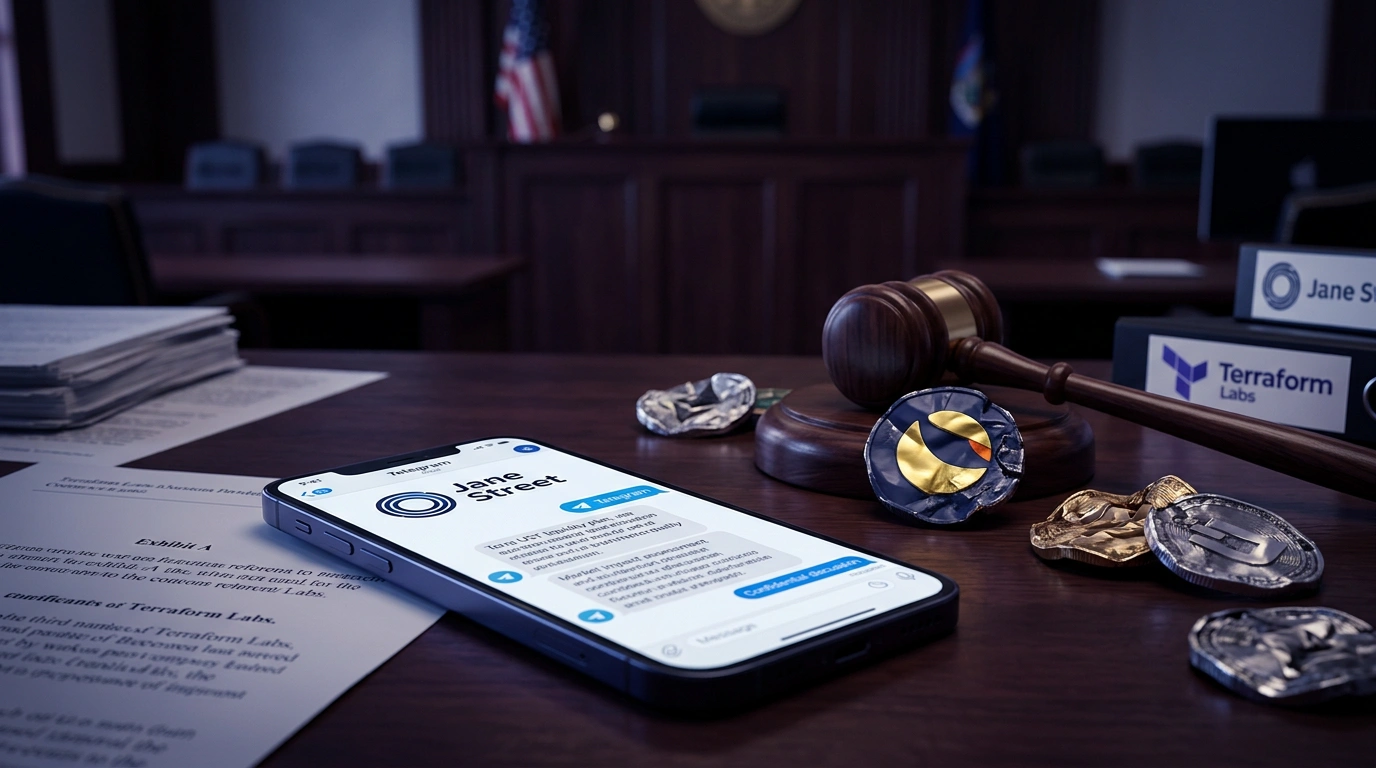
A newly unsealed court filing in the Terraform Labs bankruptcy case accuses Jane Street of using a private Telegram channel to obtain nonpublic information before the TerraUSD crash in May 2022. According to the plaintiff, the quantitative trading firm unwound hundreds of millions of dollars in UST positions just hours before the Terra market lost $40 billion in market capitalization.
The document was filed by Todd Snyder, the court-appointed administrator of Terraform Labs. Defendants named in the suit include Jane Street itself, firm co-founder Robert Granieri, and two employees: systems developer Bryce Pratt and Michael Huang.
The Bryce's Secret Channel: Source of the Allegations
Bryce Pratt interned at Terraform Labs before joining Jane Street as a systems developer. According to Snyder, he became the link between the trading firm and the Terraform team. Through a private Telegram chat called Bryce's Secret, Jane Street employees allegedly received confidential data unavailable to the broader market.
The court filing states directly: Jane Street used Bryce's Secret chat group and other backchannel sources of non-public information to front-run trading that hastened the collapse of Terraform. In other words, the plaintiff argues that Jane Street's trading decisions at the time drew on more than publicly available information. Co-founder Robert Granieri and Michael Huang are also named as participants in the alleged scheme.
Jane Street has long built its reputation on strict internal compliance procedures. A public accusation involving insider channels directly contradicts that image, which explains the firm's sharp public response.
May 7, 2022: The Minutes That Mattered
The central episode of the case dates to May 7, 2022, several days before Terra's full collapse. Terraform quietly withdrew about $150 million in TerraUSD from the Curve 3pool liquidity pool. The transaction carried no public announcement and outwardly resembled routine liquidity management.
Less than 10 minutes after that withdrawal, the same pool recorded its single largest swap ever: $85 million. That trade, according to Snyder, triggered the UST selloff that ultimately led to the collapse of the entire Terra space. Luna Foundation Guard held tens of thousands of Bitcoin as a stabilization reserve at the time, but even large-scale BTC sales failed to stop the LUNA and UST death spiral.
Who stood behind the $85 million swap remains redacted in the public version of the filing. The relevant sections are still under seal. The plaintiff argues, however, that only someone who knew about the planned $150 million withdrawal in advance could have positioned in time.
Case Timeline: From Bankruptcy to Manhattan Federal Court
Terraform Labs filed for bankruptcy in 2024 after an SEC ruling found some of its tokens to be securities. Court-appointed administrator Todd Snyder then began systematically recovering assets for creditors. On February 23, 2026, he filed suit in the U.S. District Court for the Southern District of New York, charging Jane Street and three individuals with misappropriating confidential information and manipulating market prices.
In April 2026, Jane Street filed a motion to dismiss, calling the lawsuit an attempt by Terraform to extract cash from Jane Street to foot the bill for a fraud that Terraform itself perpetrated on the market. A public statement to Cointelegraph was blunter.
The losses suffered by Terra and Luna holders were the result of a multi-billion dollar fraud perpetrated by the management of Terraform Labs.
- Jane Street spokesperson, from a statement to Cointelegraph
Jane Street: Who the Defendants Are
According to Reuters, Jane Street generated $39.6 billion in net trading revenue in 2025, making it the world's largest quantitative trading firm. The firm acts as a market maker across equity, options and crypto markets, processing trillions of dollars in volume daily.
In the crypto space, Jane Street was active in providing liquidity to the UST market and held significant positions across DeFi protocols. If the court accepts the plaintiff's theory, it would mean the world's largest market maker in 2022 was receiving confidential data from a project team where one of its employees previously interned. That kind of precedent is rare even in traditional finance.
Insider Trading in DeFi: Where the Gray Zone Ends
Classic insider trading doctrine applies to trading in securities. UST was not formally classified as a security at the time of its collapse, so standard securities law does not apply directly. Snyder is pursuing a different approach: common law and fraud doctrine.
The plaintiff's argument is that even without formal securities status, receiving private data from a token issuer through a former intern violates fiduciary duties and may constitute market manipulation. USDT and other centralized stablecoins came under heavier regulatory scrutiny after the Terra crash, but the question of insider schemes in DeFi had never before reached a public courtroom.
If the court agrees with the plaintiff, the ruling will set a precedent across a wide range of DeFi cases. Market makers who maintained informal ties with DeFi project teams will get a clear signal: that kind of communication can carry legal liability, even in decentralized markets.
What Comes Next: Creditors Await the Court
The New York federal court has yet to rule on Jane Street's motion to dismiss. Snyder seeks disgorgement of alleged wrongful profits plus compensation for creditors and investors who lost money in 2022. The exact scale of claims remains sealed. This case publicly names institutional actors alleged to have profited from one of crypto's largest failures and raises serious questions about the standards expected of market makers operating inside DeFi ecosystems.


Comments
Your email address will not be published. Required fields are marked *