


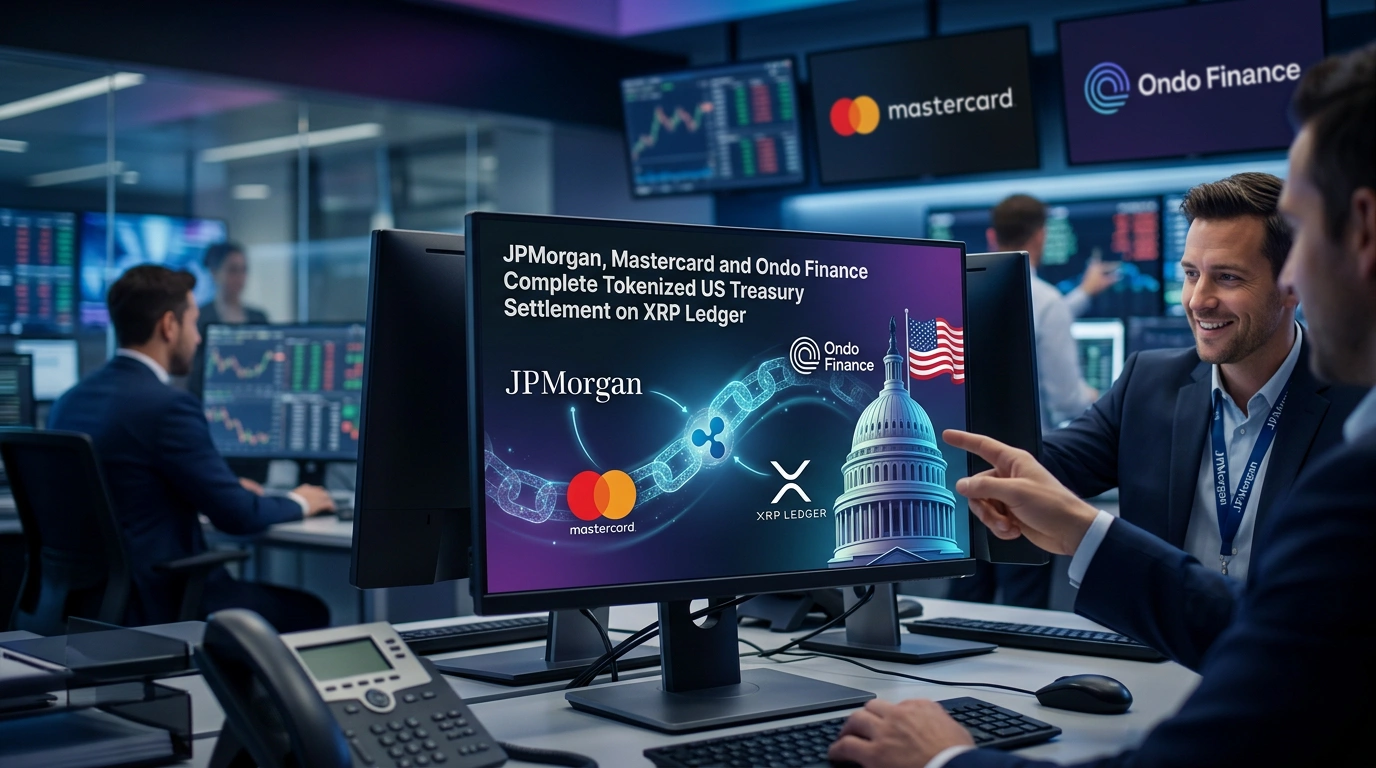
JPMorgan and Mastercard on May 7, 2026 completed the first cross-border settlement of a tokenized US Treasury fund using a public blockchain. The transaction ran on XRP Ledger with Ondo Finance and Ripple. For the real-world asset tokenization market, this is the first confirmed proof that a public blockchain and traditional banking infrastructure can close a deal together in real time.
How the settlement worked
Ondo Finance redeemed a share of its OUSG fund (US Ondo Short-Term US Government Treasuries) for Ripple directly on XRP Ledger. Mastercard's Multi-Token Network routed the settlement instructions to Kinexys, JPMorgan's blockchain banking platform. Kinexys then delivered US dollars to Ripple's Singapore bank account.
Three participants, three rails, one real-time settlement. Ondo Finance put it plainly. A public blockchain and global banking infrastructure closed a cross-border transaction together for the first time. Not through a shared gateway and not through an intermediary, but through a direct technical connection between the public blockchain and the banking rail.
The geographic element sets this apart too. JPMorgan is based in the US, and Ripple holds its account in Singapore. That cross-border component is what separates this from all earlier pilots. The deal builds on a May 2025 pilot, but that test had no cross-border leg.
XRP Ledger as the settlement rail
The public blockchain in this transaction took on the role typically held by a custodian or clearing house. The OUSG share was redeemed directly on XRP Ledger, then Mastercard's MTN bridged the public and banking rails. JPMorgan's Kinexys handled the fiat leg.
Each link in the chain solves a specific problem. XRP Ledger handles tokenization and redemption. Mastercard MTN carries the signal between the blockchain rail and the banking system. Kinexys settles in fiat. No participant needs to hold a counterparty in their own network.
For XRP this is more than a price story. It is a shift in how TradFi sees the network. Ripple has positioned XRP Ledger as a settlement platform for real-world assets for years. Now JPMorgan and Mastercard have placed their names next to that use case. The market received confirmation that a public blockchain is not just crypto infrastructure but a potential settlement rail for institutional capital.
$31 billion on-chain and projections to $16 trillion
More than $31.1 billion in real-world assets are currently tokenized on-chain, excluding stablecoins, according to RWA.xyz. Boston Consulting Group estimated the market could reach $16 trillion by 2030. McKinsey projects a more conservative $2 trillion over the same period.
OUSG is one of the largest tokenized short-term Treasury funds. It delivers the current US Treasury yield to holders and competes with stablecoins in the parked-capital segment. A stablecoin holds its dollar peg. OUSG also generates yield. That instrument can now travel across cross-border banking rails.
Among tokenized asset classes, Bitcoin holdings are growing too. Public companies and funds increasingly account for BTC as an on-chain reserve asset, moving away from traditional custody arrangements.
Others are moving in parallel. Intercontinental Exchange, NYSE's parent, announced in January a tokenized trading platform for stocks and ETFs with 24/7 settlement. DTCC is preparing a pilot in July, with full launch in October 2026.
Regulation: the condition for scale
The IMF flagged specific risks in its April report. Tokenization shifts failure responsibility from the banking system to smart contract code. In a crisis, intervention becomes harder than in a traditional banking scenario. Without legal clarity on ownership records and settlement finality, tokenized markets risk staying what the IMF called "fragmented and peripheral."
Shark Tank investor Kevin O'Leary said at Consensus Miami 2026:
"When that occurs, it's going to change everything."
- Kevin O'Leary, investor, Shark Tank, Consensus Miami 2026
He was referring to the passage of US crypto market structure legislation that would bring tokenized assets into compliance with SEC rules. Until that happens, he argued, significant institutional capital will stay on the sidelines.
- IMF warns about shifting system failure risk to smart contracts
- Without legal clarity, the market risks staying "fragmented and peripheral"
- NYSE/ICE plans a tokenized trading platform for 24/7 stock and ETF settlement
- DTCC tests tokenized securities in July 2026
From pilot to system: the pace is picking up
Weeks before this transaction, Samsung SDS won a contract to build South Korea's blockchain securities platform. Legal & General tokenized 50 billion pounds in liquid funds via Calastone. The list grows every month.
This deal stands apart from earlier pilots. Not one institution running its own sandbox network, but three major players settling on a public blockchain in a real cross-border transaction. That is a different level of readiness.
The participant list itself signals the pace. Not startups, but JPMorgan and Mastercard, two of the most conservative financial institutions in the world. Both put their names behind a public blockchain as a settlement rail.
Full deployment still depends on regulatory decisions. But the technical and corporate alignment behind tokenized settlement is forming faster than most expected two years ago.



Comments
Your email address will not be published. Required fields are marked *