


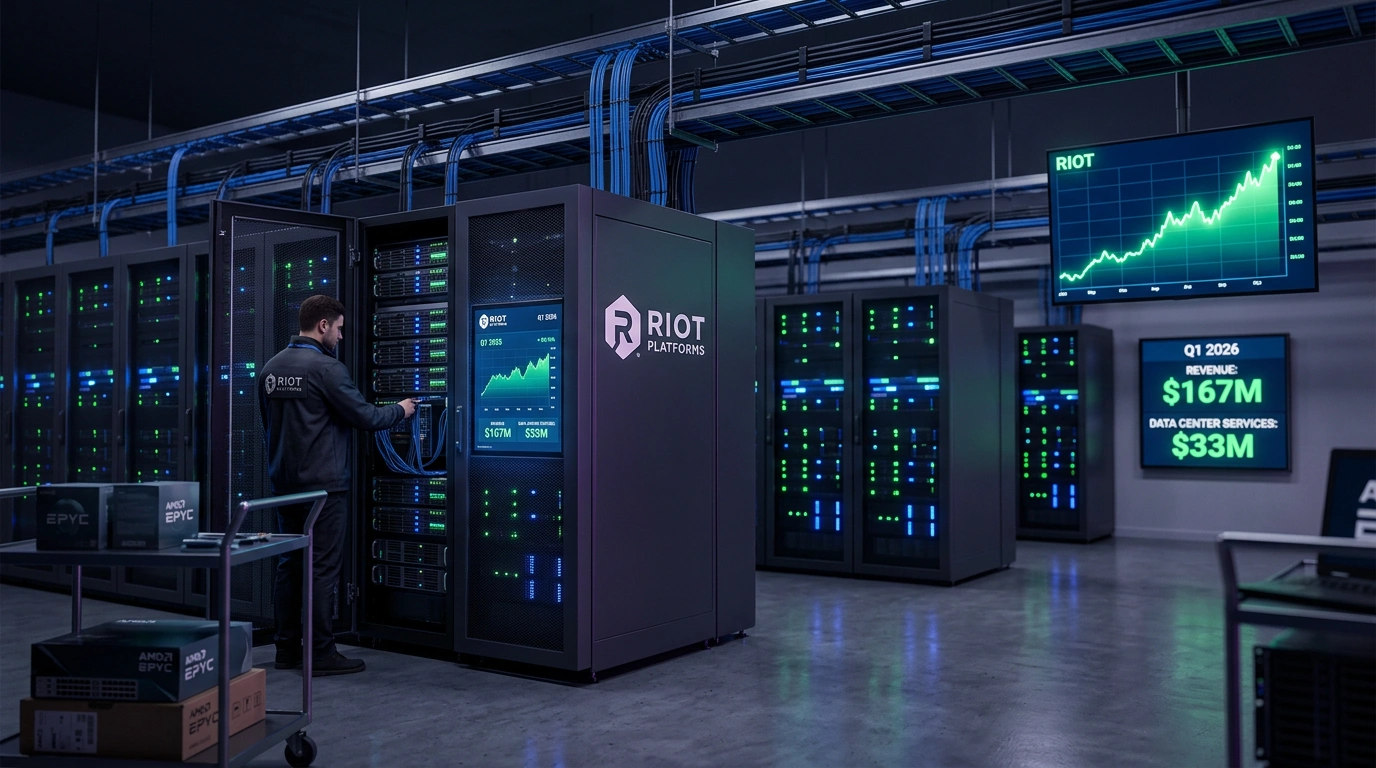
Riot Platforms posted $167.2 million in revenue for Q1 2026, with its new data center business contributing $33.2 million. This marks the company's first full quarter as an active data center operator alongside its Bitcoin mining operations. Shares jumped 7.31% to $18.50 on the day the results were released.
Data center revenue offset the mining decline
Bitcoin mining brought Riot $111.9 million in Q1, down from $142.9 million a year earlier. Two factors drove the decline: lower average Bitcoin prices through the quarter and a 24% year-over-year rise in the global network hash rate. The company produced 1,473 BTC during the period, slightly below 1,530 in Q1 2025. The average cost to mine one coin rose to $44,629 from $43,808.
The data center segment absorbed part of that drop. CEO Jason Les called the $33.2 million first-quarter result a "definitive inflection point" - Riot officially transitioned from a miner to a revenue-generating infrastructure operator. Engineering revenue, covering infrastructure services, added another $22.2 million, up from $13.9 million a year ago. The combined effect shows the diversification is already working.
Riot ended the quarter holding 15,679 BTC valued at roughly $1.1 billion based on a March 31 price of $68,222, with 5,802 coins held as collateral. Cash stood at $282.5 million, of which $76.9 million is restricted. The company sold more than $250 million worth of Bitcoin during the quarter.
AMD doubled contracted capacity to 50 MW
The biggest driver of the market reaction was the AMD contract update. AMD had initially contracted 25 megawatts of critical IT infrastructure in Riot's data center, then exercised an option to expand, bringing total contracted capacity to 50 MW. Les described AMD's decision to double its commitment as validation of Riot's ability to execute at institutional scale.
Fifty megawatts of contracted capacity is a strong result for a company in its first operational data center quarter. AMD is actively looking for reliable partners to deploy AI computing infrastructure in the US, and choosing Riot signals the company passed the test as a technical operator. For investors, that is not just one customer confirmation but a read on Riot's growth ceiling.
Miners are shifting to AI as margins tighten
Riot is not the first mining company moving toward AI infrastructure. MARA Holdings recently acquired Long Ridge Energy for $1.5 billion, positioning itself for data center operations. CoreWeave, which grew from an Ethereum miner into one of the leading AI cloud providers, remains the clearest example of where this trend can lead.
The underlying logic is similar across all cases. Bitcoin mining is getting squeezed by rising network difficulty and BTC price swings. Margins compress while fixed costs for power and maintenance remain constant. AI computing data centers offer long-term contracts with predictable revenue, which is attractive for companies with existing infrastructure and experience running high-power facilities.
For holders of Bitcoin watching the miner market, this trend has a direct price implication. Public miners that diversify into data centers rely less on selling BTC to cover operating costs. That reduces a structural source of selling pressure from the market.
How the market read the results
RIOT shares closed up 7.31% at $18.50 on the day of the earnings release, then slipped 0.57% to $18.40 in after-hours trading. The move looks like a measured positive: investors welcomed the diversification story but held back from a larger re-rating pending the full report review.
Running three revenue streams simultaneously (mining, data center, and engineering services) lowers Riot's exposure to Bitcoin price drops. When BTC declines, the data center revenue is locked in by contracts and does not move with the market. That structural advantage is starting to show up in how the company is valued.
What comes next for Riot and the sector
The next few quarters will show whether Riot can grow the data center share of its revenue mix. The AMD contract at 50 MW provides visibility for several quarters ahead, but adding new clients is necessary to shift the balance meaningfully. Les has already said he plans to expand the corporate AI client base.
For the Bitcoin mining sector as a whole, Riot's Q1 results show that companies with existing infrastructure have a real alternative to pure mining. Those who move early to monetize their capacity in new markets will be better positioned in the next cycle. Riot's quarterly numbers give concrete shape to a trend that is still accelerating.
Comments
Your email address will not be published. Required fields are marked *