


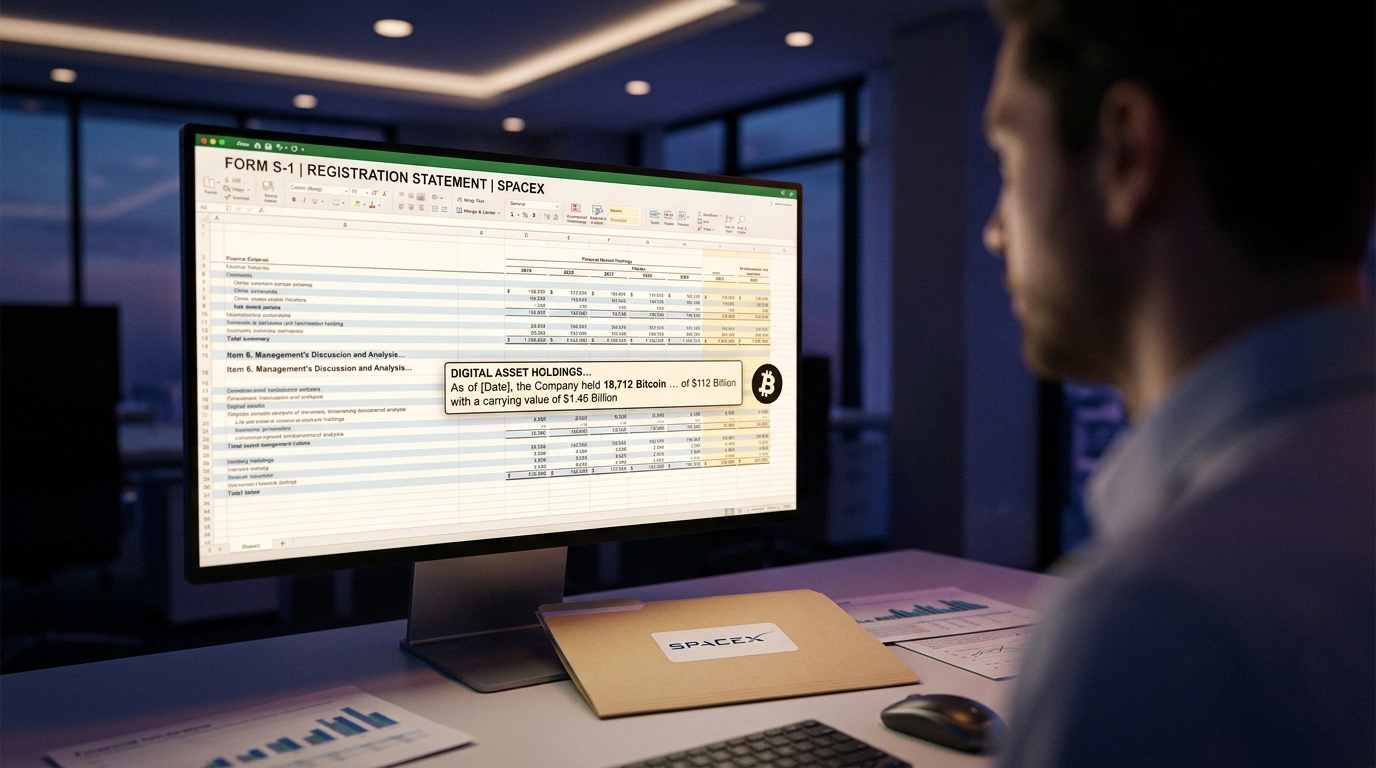
SpaceX filed for an IPO and instantly became one of the biggest corporate crypto stories of May. Elon Musk's company holds 18,712 Bitcoin worth $1.45 billion. That is twice as much as analysts had estimated before the filing appeared.
The Balance Sheet Nobody Knew: 18,712 Coins Instead of 8,000
Before the S-1 registration statement hit the SEC, analytics platforms BitcoinTreasuries.NET and Arkham put SpaceX's BTC holdings at only 8,285 coins. The real number turned out to be double. The company started buying BTC in early 2021 at an average price of $35,320 per coin. As a private company, it had no obligation to disclose any of this.
That is why the number was a surprise. SpaceX published no quarterly reports and had no duties to public investors. Analysts worked from on-chain signals and blockchain tracker data. It turned out a large share of the coins sat outside known addresses. The estimate was off by more than 10,000 BTC.
At the current Bitcoin to dollar rate, the company's unrealized gain on this position exceeds 120% of the original investment. That return makes SpaceX shares more attractive to institutional buyers seeking indirect BTC exposure through a regulated equity instrument.
A $75 Billion IPO as a New BTC Access Channel
SpaceX aims to raise around $75 billion at a valuation between $1.75 trillion and $2 trillion. If the IPO closes on June 12 as stated in the documents, it will be the largest in stock market history. The shares will automatically become a tool for indirect BTC exposure for millions of retail investors who cannot access crypto products directly due to brokerage and regulatory restrictions.
Buying a SpaceX share effectively gives an investor partial BTC coverage alongside the company's aerospace and AI business. A similar dynamic already played out with Tesla and Strategy, which changed how markets view public companies with crypto assets on the balance sheet. SpaceX could repeat that effect at a much larger scale, given the company's size and its founder's media reach.
There is already substantial institutional demand for the SpaceX IPO. If major funds buy shares partly because of the crypto component, that means indirect capital flowing into BTC without any direct spot market purchases. The mechanics are simple, but the scale of the IPO makes the potential effect significant.
How the BTC Market Responds to the Disclosure
SpaceX will be the first trillion-dollar company to go public with such a BTC position. Institutional funds tracking its shares will gain indirect Bitcoin exposure in their portfolios. For the market, this is not just another entry in the table of large holders.
There is another significant result here: the S-1 revealed 10,427 coins that no tracker had spotted before. That raises a natural question about how many other large private companies are sitting on similar undisclosed positions. Markets tend to respond to that kind of uncertainty with rising demand. Especially if future IPOs from other tech giants also show similar lines in their balance sheets.
The timing matters too. SpaceX was buying BTC in 2021, when the institutional wave was just getting started. The position now confirms that long-term accumulation paid off. For corporate treasurers still on the fence, that is a more convincing signal than any analyst report.
Risks for Future SpaceX Shareholders
A crypto balance brings profit but also carries risk. A 30% BTC drop would cut the position's value by roughly $435 million. For a company worth trillions that is a small number, but it will show up in quarterly reports and shape how new shareholders, especially those coming from traditional equity markets, read the risk profile. Key risks include:
- BTC price swings will directly hit balance sheet line items each quarter
- US regulatory changes on corporate crypto assets could force a rethink of the approach
- GAAP accounting rules for crypto make comparisons with traditional companies harder to draw
- growing SEC scrutiny of crypto positions at public issuers will add regulatory oversight
There is one more dimension. A public company must mark its crypto position to market every quarter and record gains or losses in its financial statements. Tesla went through this in 2022 when BTC fell 60% and the company booked a significant impairment charge on the asset.
Corporate Bitcoin Reserves: the Trend Is Picking Up Speed
Strategy holds more than 843,000 BTC and set the corporate standard in this space. Tesla entered in 2021, partially exited, and kept 11,509 coins. SpaceX now joins the list with 18,712 BTC and a private-phase accumulation playbook. All three companies bought BTC when they were not required to report it, and every time the disclosure caught the market off guard.
The SpaceX IPO will push other large private players to revisit their own strategies. If a trillion-dollar company holds BTC as part of its balance sheet, that lowers the institutional barrier for similar decisions elsewhere. For the Bitcoin market, each new large holder means a smaller free float and more sustained upward pressure on price over the long run. The trend was visible before. Now it is documented in the prospectus of the largest IPO in history.



Comments
Your email address will not be published. Required fields are marked *