


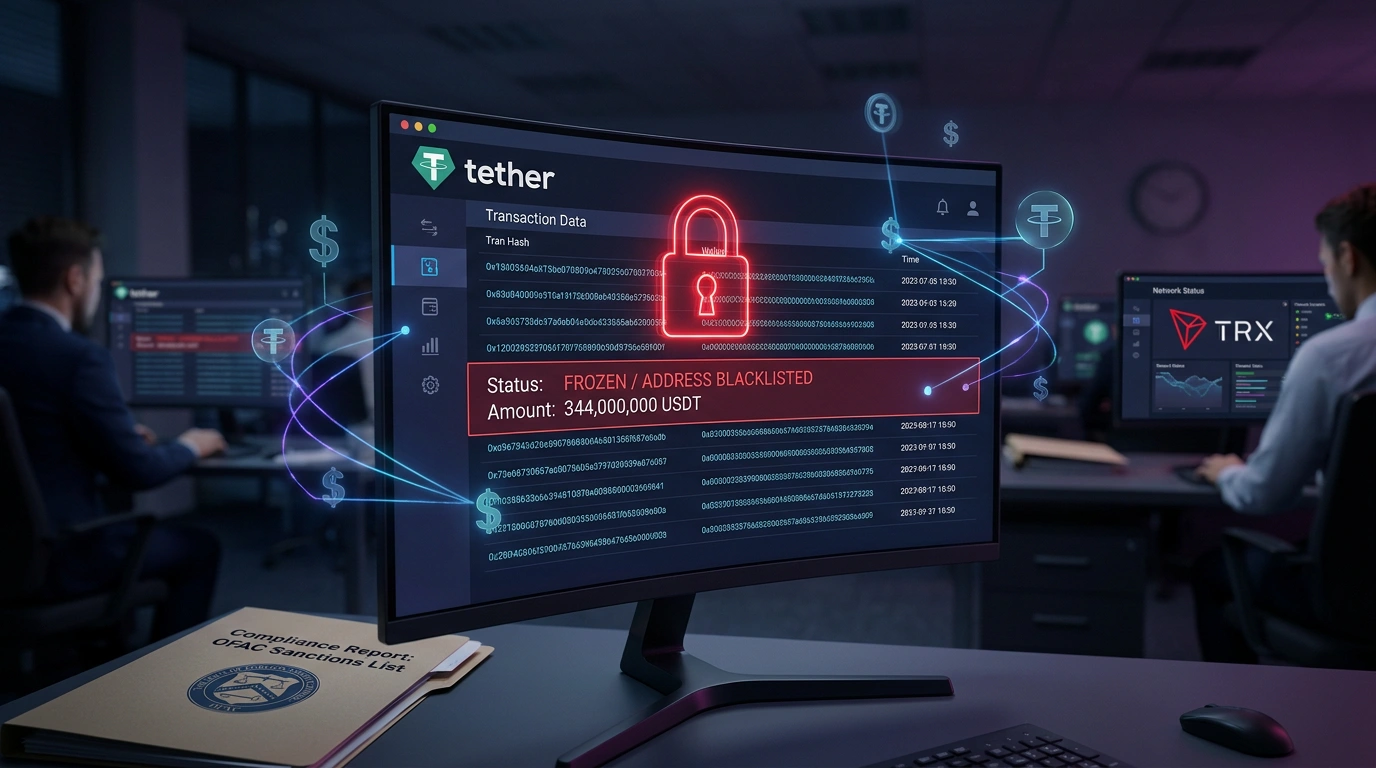
Tether froze $344 million in USDT across two addresses on the Tron network. This is the company's largest single compliance action on record, and part of its ongoing coordination with U.S. authorities to counter illicit stablecoin use.
What Exactly Was Frozen?
Blockchain security firm PeckShield identified the two blacklisted addresses. The first, TNiq9...QZH81, held roughly $213 million; the second, TTiDL...pjSr9, held $131 million. Tether did not officially confirm the network but did not dispute PeckShield's attribution to Tron.
The freeze followed confirmed ties to sanctions evasion and criminal networks. Tether declined to name the specific case. CEO Paolo Ardoino was direct in his statement: "USDT is not a safe haven for illicit activity. When credible links to sanctioned entities or criminal networks are identified, we act immediately and decisively."
How Does the Freezing Mechanism Work?
The freeze works through a blacklist function built into the USDT smart contract. The process has four stages:
- Request: a law enforcement agency notifies Tether about a suspicious address.
- The compliance team verifies ties to OFAC sanction lists or active criminal investigations.
- The address gets added to the smart contract's blacklist.
- The wallet owner loses the ability to transfer or sell their tokens. Funds remain on the address but become permanently inaccessible.
OFAC, the U.S. Treasury's Office of Foreign Assets Control, manages sanction registries and serves as Tether's primary federal partner in such actions. The company works with over 340 law enforcement agencies across 65 countries, has supported more than 2,300 cases globally, and has frozen over $4.4 billion in assets total, with $2.1 billion tied specifically to U.S. authorities.
Why Didn't Circle Freeze Funds After the Drift Hack?
The action renewed scrutiny of how stablecoin issuers handle illicit funds. Following the Drift Protocol hack in April, where attackers (investigators link them to North Korean hackers) drained $285 million, Circle did not freeze the USDC involved. The backlash was sharp.
Circle's Chief Strategy Officer Dante Disparte explained in a blog post: "When Circle freezes USDC, it is not because we have decided, unilaterally or arbitrarily, that someone's assets should be taken from them. It is because the law requires us to act." The company acts only under court orders or direct regulatory requests, not proactively. A class action lawsuit has since been filed against Circle over the Drift funds.
Tether takes a different stance. Ardoino said the company combines "blockchain transparency with real-time monitoring and direct coordination with law enforcement." The gap between these two approaches has become a central debate in the broader conversation about what compliance standards should look like for centralized stablecoin issuers.
Scale of Operations Has Grown Steadily
This freeze is the largest in Tether's history, but part of a longer series. In November 2023, the company blocked $225 million tied to a Southeast Asian human trafficking and pig-butchering scam. In January 2026, Tether froze $182 million across five Tron wallets.
The scale has grown with each action. In 2023, Tether froze $225 million. Early 2026 brought a $182 million freeze in a single operation. Now the total has reached $344 million. The growth reflects both rising USDT use in illicit transactions and the expanding analytical capabilities of Tether's compliance team. Chainalysis data shows stablecoins account for a growing share of criminal settlement volumes.
Implications for Regular USDT Holders
For anyone planning to sell USDT for Ukrainian hryvnia or using the stablecoin for everyday transactions, this freeze changes nothing. Tether's compliance team focuses on addresses identified in specific sanctions cases, not regular users.
There is one point to keep in mind, though. A centralized stablecoin does not give its holder absolute control over funds. If Tether receives a law enforcement request, it can apply a blacklist to any address. That has always been true, but the growing scale of these actions is bringing renewed attention to decentralized alternatives.



Comments
Your email address will not be published. Required fields are marked *