


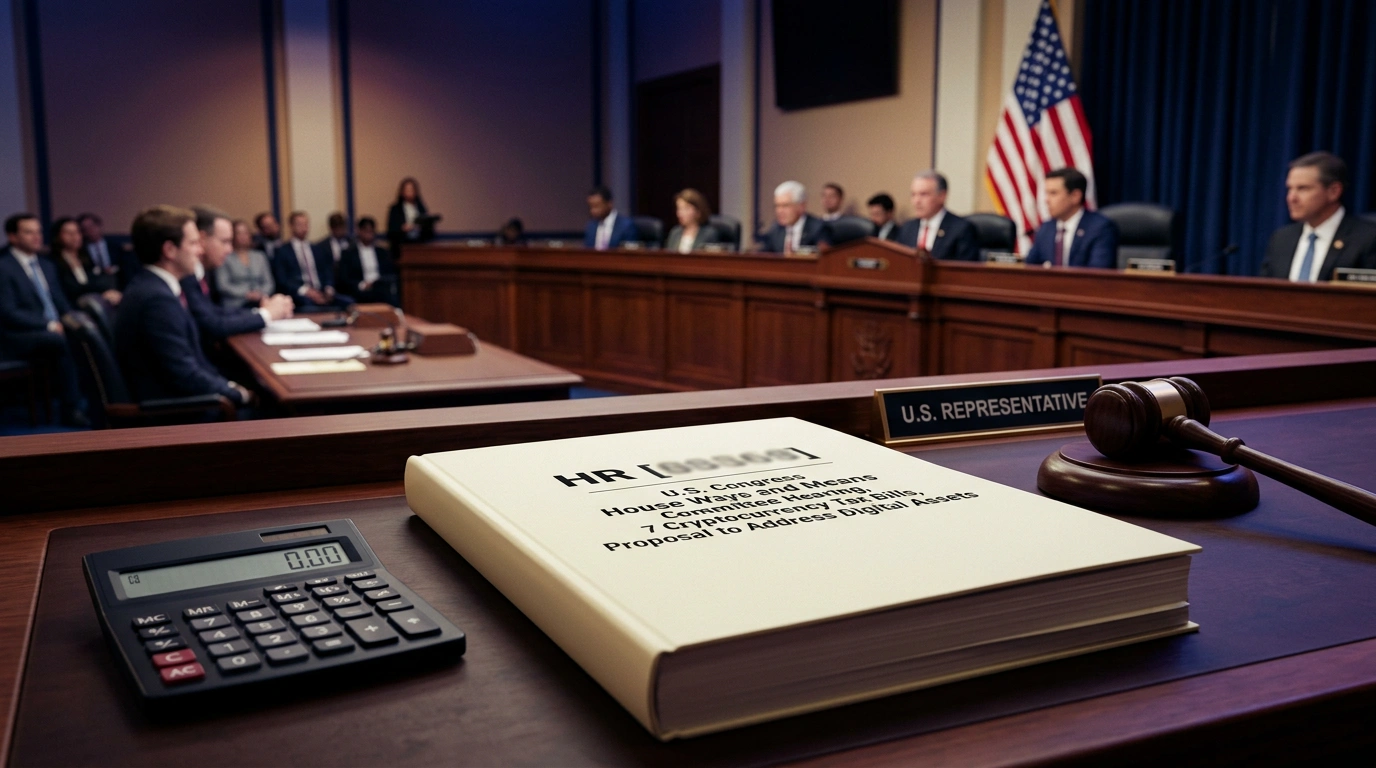
On Tuesday, June 9, the House Ways and Means Committee holds its first focused hearing on seven new crypto tax bills. The package covers a de minimis exemption for small transactions, new stablecoin reporting thresholds, and lighter requirements for miners and stakers. The industry has pushed for this review for years.
At the same time, Illinois has already passed a $56 billion state budget that includes a 0.2% transaction levy on crypto deals through registered brokers. The bill awaits Governor JB Pritzker's signature, and he has signaled publicly that he plans to sign. If he does, Illinois will become the first US state with this kind of per-transaction charge on digital assets.
Seven Bills, One Deadline
All seven proposals were submitted to Congress during 2025-2026, but none has cleared a final vote. The Ways and Means hearing will give the first clear signal about which parts of the package can actually move forward. Any federal tax legislation needs bipartisan backing in both chambers, so even scheduling the hearings counts as tangible progress from the industry's perspective.
The core problem lawmakers are trying to fix: in the US, every crypto transaction technically counts as a taxable event. Buy a coffee with a stablecoin for $3 and, strictly speaking, you are required to report it to the IRS. This rule has made everyday crypto payments impractical for most Americans, because the compliance burden is completely out of proportion for micro-transactions.
The package targets three gaps. First, a de minimis threshold for small transactions, which currently does not exist for crypto. Second, miners and stakers must report every block reward or staking payout, which for active network participants means hundreds of records per year. Third, there is no unified federal reporting standard for crypto brokers.
$300 Exemption: Lummis De Minimis Proposal
One of the package's central points applies to Bitcoin and the entire crypto market: transactions up to $300 would not be taxed or require reporting. Wyoming Senator Cynthia Lummis drafted the base version back in July 2025. The idea is now moving through both the Senate Finance Committee and Ways and Means in parallel.
A similar rule for foreign currencies has existed for decades. An American who travels to Canada, spends $50 in Canadian dollars, and returns home faces no reporting requirement on the small exchange gain or loss. Crypto advocates have sought the same treatment for years. The $300 threshold would cover the vast majority of retail point-of-sale transactions and small P2P deals.
The practical effect goes beyond simpler filing. Specialized crypto tax tracking software costs $50 to $300 per year even for low-activity traders. Removing the threshold for small amounts lowers that barrier and makes crypto payments more accessible to everyday users.
PARITY Act: Separate Rules for Stablecoins
The Digital Asset PARITY Act, drafted in March 2026 and formally introduced in May, sets a lower and separate threshold for stablecoins: transactions under $200 would not require mandatory reporting. For USDT, USDC, and other dollar-pegged assets commonly used in e-commerce and P2P transfers, this is a significant change.
The key distinction between the two proposals: the PARITY Act covers only stablecoins, while Lummis' de minimis applies to the whole market. They can advance separately. The Digital Chamber CEO Cody Carbone commented on the PARITY Act in a post on X:
"We need digital asset tax clarity or activity will never fully onshore."
- Cody Carbone, CEO of The Digital Chamber, from a post on X in response to the Digital Asset PARITY Act
Illinois: First State With a Transaction Levy
Senate Bill 3019 passed as part of Illinois' budget package along party lines and now awaits the governor's signature. The charge is formally called a "privilege tax" under the Digital Asset Privilege Tax Act. Any broker handling digital asset transactions in the state after January 1 must register. Operating without registration is classified as a Class 3 felony, carrying two to five years in prison and fines up to $25,000.
The expected $60 million in annual revenue equals less than 0.11% of the state's total budget. The Digital Chamber and Illinois Blockchain Association sent an open letter urging the state legislature to reject the measure. Their argument: no other US state has imposed a comparable transaction levy, and the industry had no opportunity to comment before the vote.
The precedent Illinois may set raises broader concerns. If the 0.2% charge proves profitable and does not trigger a visible business exodus, other states facing budget gaps may consider similar measures. Critics point out that brokers will likely absorb the levy into their spread, pushing the real cost onto end users.
The Senate Is Focused Elsewhere
While Ways and Means prepares for the hearings, the Senate is working on two other priorities: budget reconciliation and the CLARITY Act, a proposed market structure framework for digital assets. These processes compete for the attention of the same committees. The industry consensus is that passing all packages at once in 2026 is unlikely.
The practical result: Tuesday's outcome will likely take the form of a prioritized list. Congress will signal which two or three of the seven bills are ready for a real floor vote this year and which get pushed to the next legislative cycle. For the industry, that is the first clear marker after a long wait.
The First Clear Signal
If the $300 de minimis takes effect in 2026, everyday Bitcoin and stablecoin payments become legally simpler for millions of Americans. Crypto transactions currently avoided over compliance uncertainty would get a clear legal framework. Small businesses accepting digital assets would no longer need to log every minor payment in specialized accounting software.
The IRS last made significant updates to its crypto guidance in 2023. Since then, the market's size, user base, and asset variety have grown sharply. Similar de minimis bills failed in 2023 and 2024. The 2026 attempt is different in one way: both parties now openly support the idea. Tuesday's hearing will show whether that support is strong enough to translate into law.

Comments
Your email address will not be published. Required fields are marked *