


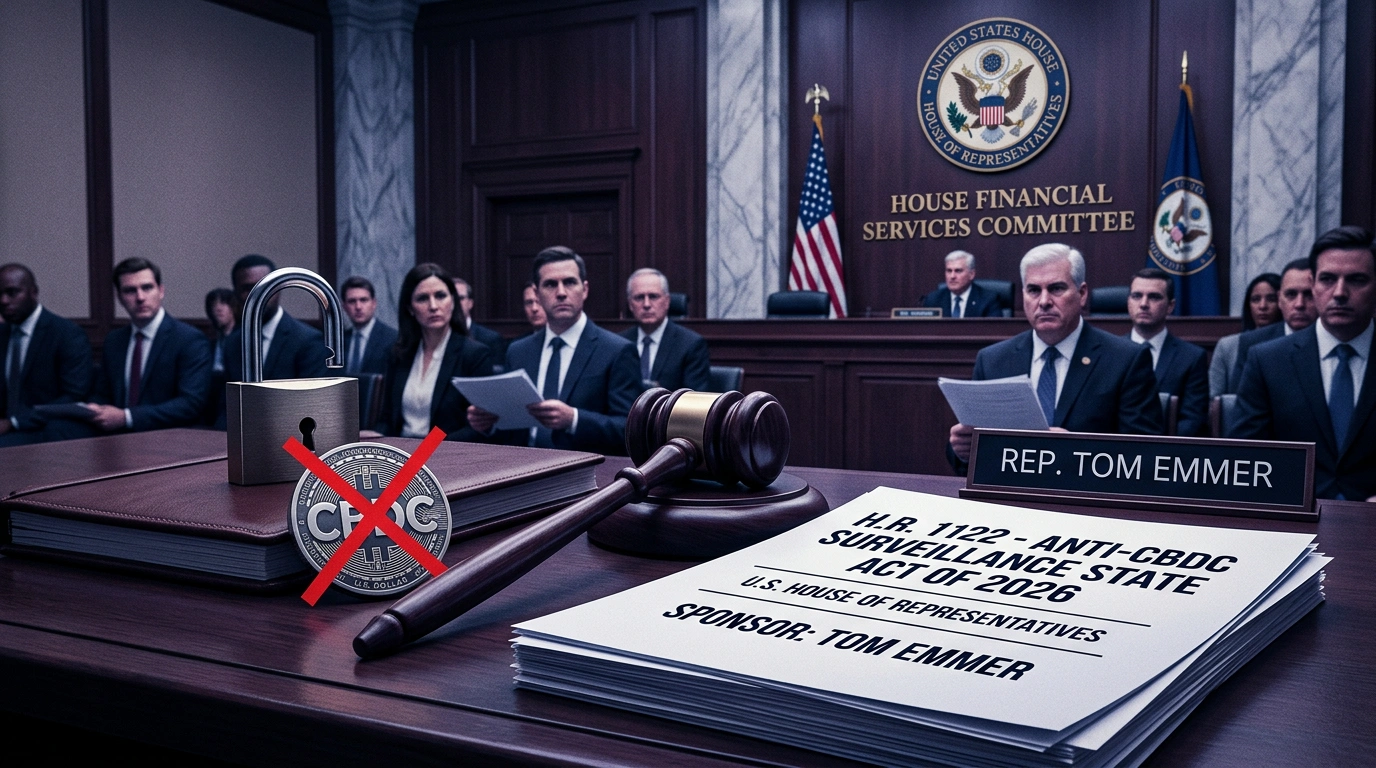
Republican lawmakers in the US House of Representatives are preparing to vote on a permanent ban on the digital dollar. House Majority Whip Tom Emmer embedded the Anti-CBDC Surveillance State Act inside the 21st Century ROAD to Housing Act. The vote is expected before the end of this week.
What is a CBDC and why ban it permanently?
A CBDC (Central Bank Digital Currency) is essentially a digital version of physical cash issued directly by a central bank. The Federal Reserve spent several years studying the concept through pilot programs and advisory reports. No official launch happened. The risk, however, remained real.
The core difference between a CBDC and a decentralized cryptocurrency lies in who controls the ledger. Bitcoin operates without a central authority, and no agency can freeze a wallet. With a CBDC the picture flips: the government tracks every payment and has technical capacity to restrict or block any account.
A CBDC could also carry programmable conditions. Funds might be restricted to certain categories of purchases or expire after a set period. That cannot happen with cash or Bitcoin. China already rolled out the digital yuan e-CNY and the Eurozone is testing a digital euro. The US stalled at the research phase. Emmer wants to keep it there permanently.
The bill's name says it plainly: Anti-CBDC Surveillance State Act. Critics of the digital dollar argue that such a system would turn the central bank into a tool of financial surveillance over every citizen.
How does the Anti-CBDC Surveillance State Act work?
Emmer first introduced this bill in 2023. Back then it did not reach a floor vote as a standalone measure. This time the approach changed: the provision is packaged inside a broader housing bill, raising its chances of passage.
Key provisions of the bill:
- Full development ban: The Federal Reserve cannot research, pilot, or launch a retail CBDC without explicit Congressional authorization.
- Pilot programs are banned too, even small-scale ones.
- The law targets retail CBDC only, the kind accessible to ordinary citizens. Wholesale digital settlement between banks falls outside its scope.
- Federal Reserve officials face personal liability for violations.
Emmer openly calls a CBDC a potential "financial weapon" in government hands. Private stablecoins, he argues, already meet the demand for convenient digital payments without handing authorities a control mechanism.
Why is this vote happening right now?
Several factors came together. The Senate recently advanced the GENIUS Act on stablecoin regulation, and lawmakers want to build a clear pro-private crypto framework while simultaneously closing the door on a state-issued alternative. A CBDC ban fits cleanly into that picture.
There is also a practical motive. Without a permanent legal barrier, a future Fed board or incoming administration could restart a CBDC research program. A statutory ban becomes a safeguard against that scenario. Some Democrats back the idea too, driven by concerns about financial privacy rather than market competition alone.
The current administration has leaned toward pro-market rhetoric, and the crypto sector is lobbying hard in Washington. The window is open. The timing is deliberate.
How does a CBDC differ from stablecoins and Bitcoin?
For anyone tracking the crypto market, the distinction matters. USDT is issued by a private company, Tether, and regulators only oversee reserves and licensing. Bitcoin is fully decentralized: neither government nor private company controls the network. A CBDC puts the state at the center. It becomes the issuer, the record-keeper, and the potential gatekeeper of every transaction.
Consider another angle. Stablecoins, despite their dollar peg, run on decentralized infrastructure. Someone can acquire USDT through a peer-to-peer deal and transfer it without any intermediary. A CBDC by design excludes that: every wallet is tied to a verified identity.
Supporters of decentralized assets broadly welcome a CBDC ban. Less government competition means more space for private solutions. That said, a CBDC ban alone does not guarantee market growth. It does signal where US regulatory direction is heading.
What happens if the bill passes?
For crypto markets, passage would be a modest positive. The US Congress would signal clearly that it backs private crypto over a state-run alternative.
The Senate path may be harder. Some senators are skeptical of a permanent ban with no room for future regulatory adjustment. Technology moves fast, and what seems impermissible today may require new rules tomorrow.
If the law takes effect, it could serve as a reference point for other nations debating their own CBDCs. The House is expected to vote before the end of this week. That result will shape the US crypto regulatory agenda for years ahead.

Comments
Your email address will not be published. Required fields are marked *