


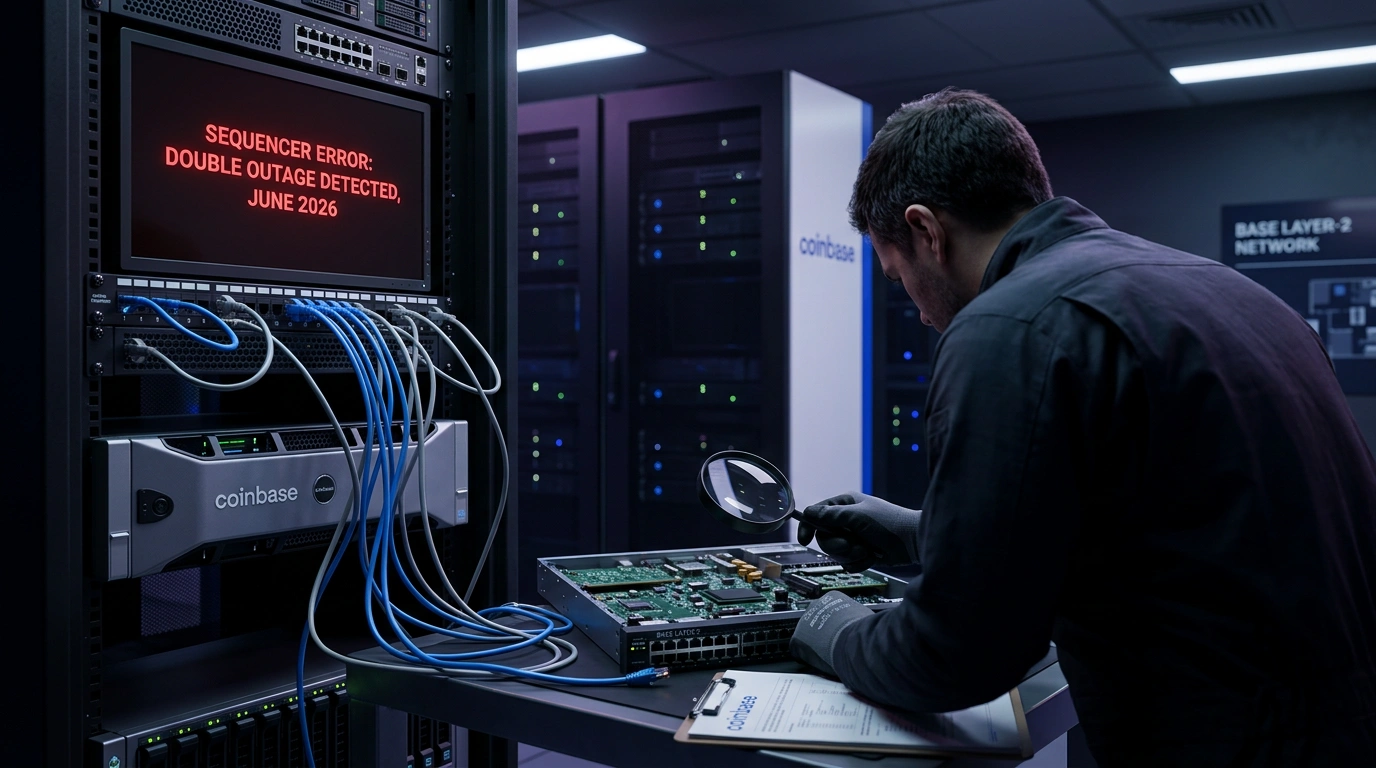
The Base network, Coinbase's layer-2 blockchain, went down twice last week: first for 116 minutes on Thursday, then for 20 minutes on Friday. On Saturday, the engineering team published a post-mortem and identified the root cause behind both incidents.
What Is a Sequencer and Why Does It Matter?
Most layer-2 networks delegate transaction ordering to a single component called a sequencer. It accepts user transactions, determines their order, and builds blocks. Base uses this model too.
The idea behind layer-2 is to process transactions outside the main blockchain and then post compressed summaries to Ethereum mainnet. This gives fast throughput and low fees. Base is an optimistic rollup: it assumes transactions are valid by default and allows them to be challenged within a set time window.
The downside is clear. One bug in the sequencer stops the whole network. There is no backup node, no failover. If it goes down, no new blocks are produced. That is exactly what happened. Similar outages have hit Arbitrum, OP Mainnet, and zkSync Era before.
From the user side, every sequencer failure looks the same: transactions are sent but confirmations never arrive. Funds are safe, but the network is frozen. In Base's case, the first freeze lasted over two hours.
Where the Bug Was Hiding
Every transaction the sequencer receives goes through validation before it can enter a block. Rejected transactions should trigger a cleanup of the internal "journal state," a record of which accounts and storage slots the transaction touched during execution.
The bug lived in that cleanup step. When a transaction was rejected, the journal was not cleared. Account and storage data stayed in memory. The next attempt to build a block ran into this leftover state and stalled. The sequencer could not move forward until someone manually restarted the process.
The rejection itself worked correctly. The invalid transaction did not make it into a block. But the cleanup step tied to that rejection simply did not fire. Two steps that should have been linked were effectively disconnected. The patch that fixed the first outage made sure the journal clears properly after every rejection. A small change in code, but one that only surfaces under a specific sequence of events, which is why it went undetected before.
"An invalid transaction was received by the block builder and failed during execution, as expected, but erroneously did not clear the journal state that contained the accounts and storage slots that had been accessed."
- Base Engineering team, from the post-mortem of June 28, 2026
How the Two Outages Unfolded
Both incidents happened within two days. The first struck on Thursday and lasted 116 minutes. The second hit on Friday and lasted 20 minutes, but for a different reason.
- Thursday, first outage: 116 minutes of downtime. The sequencer stalled because of stale journal state left by an invalid transaction.
- The team identified the issue, applied a patch, and restarted the sequencer. The network came back online.
- During recovery, a race condition emerged. After the system reset, validator nodes could not catch up with the sequencer fast enough.
- Friday, second outage: 20 minutes of downtime due to the race condition. Full recovery required a manual restart of validator nodes.
What Base Plans to Fix
The team announced two areas of work. The first is expanded "fuzz testing." The system is deliberately bombarded with large volumes of random, malformed, or unexpected inputs. This helps catch edge cases and bugs before they reach production. According to the team, the previous scope of testing was not broad enough to cover this particular scenario.
The second area is building "graceful recovery." Right now, after a sequencer failure, validator nodes require a manual restart from engineers. That is part of why the Friday outage dragged on. The new mechanism should allow nodes to recover on their own after unexpected states, without human intervention.
Are Layer-2 Networks Stuck With a Single Point of Failure?
Decentralizing the sequencer has been a stated goal of most L2 projects for years. In practice, none have fully achieved it. As long as a single centralized sequencer handles all transaction ordering, outages like this remain a possibility across any layer-2 network.
The industry has discussed "distributed sequencing": replacing one sequencer with a group of independent operators so that a single failure does not stop the chain. But the added complexity can reduce network speed, and no major L2 has shipped it yet.
For Base, this is not the first incident. The network went down for 17 minutes in September 2024 and for around 30 minutes in August 2025. Each time, the team patched the specific bug. But the structural issue (reliance on a single sequencer) has not been resolved.
Base ranks second among layer-2 networks by total value secured, at around $11 billion according to L2beat. At that scale, every interruption is felt. During the downtime, every protocol on Base was unable to process transactions, including Uniswap and other DeFi applications. Ethereum mainnet continued without disruption. A layer-2 outage does not cascade to the base layer.


Comments
Your email address will not be published. Required fields are marked *