


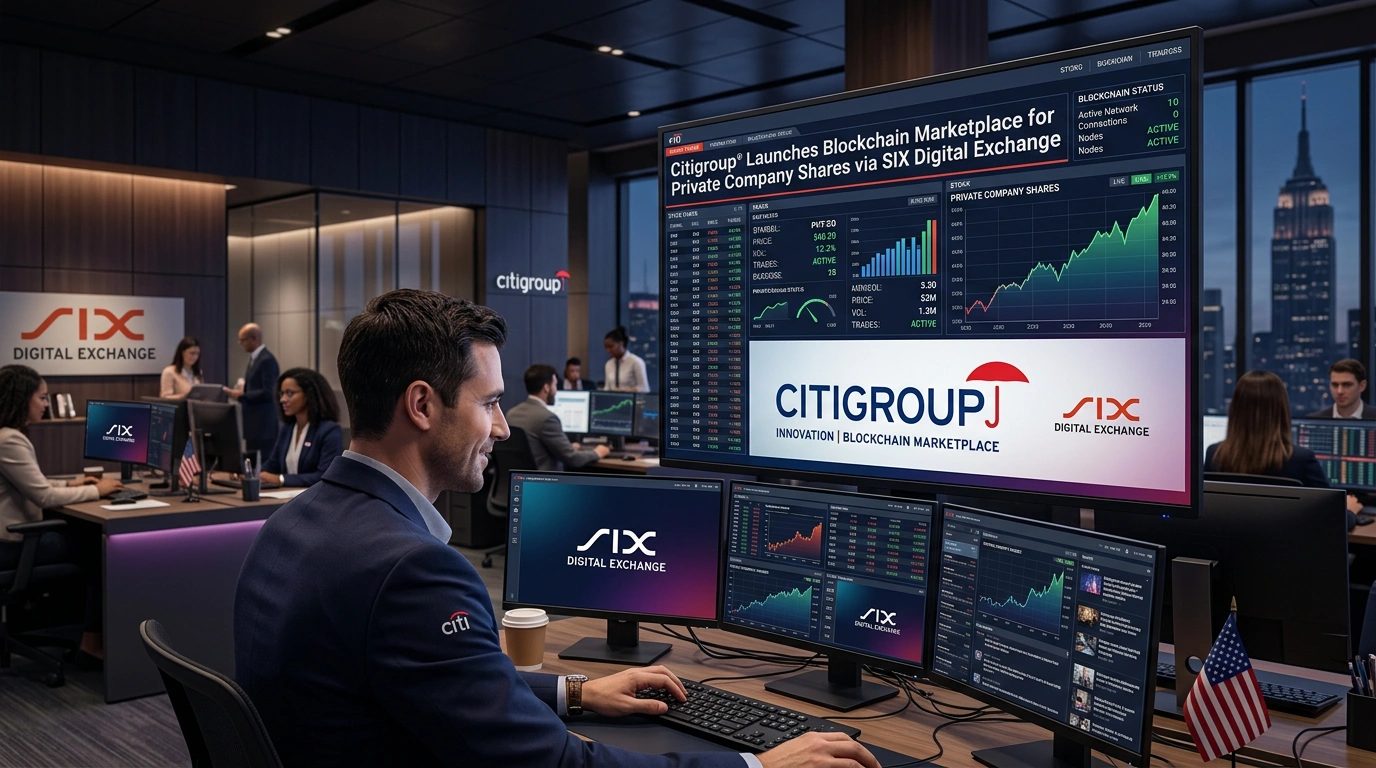
Citigroup launched a blockchain-based marketplace for shares of private companies, targeting wealthy and institutional investors. The platform opens access to the pre-IPO market through a new instrument called tokenized depositary receipts, which can be traded alongside public equities in one portfolio. Technical infrastructure is provided by SIX Digital Exchange, a subsidiary of Switzerland's SIX Group stock exchange operator.
How Does the Citi Platform Work?
The core instrument is a tokenized depositary receipt, or TDR. Citi will issue TDRs for each participating company, recording ownership rights directly on a blockchain. Trading happens through SIX Digital Exchange rather than NYSE or Nasdaq.
Artem Korenyuk, Citi's head of digital assets, described the concept simply. Investors will be able to buy a stake in a private company "right next to their Apple stock." One portfolio, no separate accounts or legal structures between the investor and the asset. That simplicity is what sets this apart from how private market access works today.
Initially the platform will be open only to non-US investors. Citi is already in talks with several large private companies about listing their shares. Names have not been disclosed. US access is planned for a later date.
What Makes TDRs Different From SPVs?
Until now, most investors accessed private companies through SPVs (special purpose vehicles), legal structures designed to hold assets on behalf of investors. SPVs are often opaque, with money going into a legal wrapper, and the actual composition, terms, and costs are not always visible. Fees are split among multiple intermediaries.
TDRs work differently. Ownership rights are recorded on a blockchain and can be verified at any time. Trading happens on a single platform. Citi frames this as a more transparent alternative for a market that has traditionally been hard to read.
- Transparency: SPVs often hide structural details from investors, while TDRs record ownership in an open blockchain ledger
- SPVs are difficult to resell without re-registration and legal steps, whereas TDRs trade freely on SIX Digital Exchange
- In an SPV structure, fees are distributed across multiple intermediaries, while Citi's platform consolidates them in one place
- SPVs are a familiar market structure, but Citi argues that TDR transparency lowers risk for the investor
Citi's TDRs still carry blockchain infrastructure risks and depend on the issuer's reputation. Not a perfect model, but a step toward a more readable market.
Why Is Pre-IPO Investing Getting So Much Attention?
Companies are going public later than ever. Amazon held its IPO just 3 years after founding. Today's startups wait an average of 12-15 years. During that time a large share of value creation happens in private markets, out of reach for most investors who lack access to private capital.
The American Investment Council published an analysis using PitchBook data showing that private equity outperforms the S&P 500 across 5-, 10-, 15-, and 20-year horizons. Long-term outperformance combined with limited access creates persistent demand.
The SpaceX IPO in June 2026 made that demand visible. Retail investors placed more than $70 billion in orders before the stock began trading, with the company targeting a $1.8 trillion valuation. That scale of appetite pushed Citi to move.
Who Else Is Entering This Market?
Citi is not the first mover. Robinhood offered tokenized access to OpenAI shares and other private companies earlier, but those products provided only indirect economic exposure without legal ownership. OpenAI issued a formal notice that these "tokenized stocks" are not equity in the company.
Exodus, a self-custody crypto wallet, partnered with Ondo Finance to launch a marketplace with 200+ tokenized stocks and ETFs on Solana. According to RWA.xyz, total tokenized equities have reached $3.5 billion, up 139% in 30 days. The xStocks platform backed by Kraken holds 69% of that market at $2.5 billion.
Citi's model differs from all of these. Rather than offering blockchain access to public equities, the bank is building a mechanism for the market that was previously inaccessible to most, namely shares in companies that have not yet gone public.
What Comes Next?
Major banks are pushing into blockchain infrastructure across a broad range of assets. JPMorgan is testing tokenized deposits. BNP Paribas and Franklin Templeton published research on tokenization efficiency for EU capital markets. Blackrock runs a tokenized fund called BUIDL with more than $2 billion in assets.
For most people, blockchain still brings to mind Bitcoin or speculative tokens. But Citi's TDRs, like dozens of other banking initiatives over the past two years, point to something else. The technology is becoming operational infrastructure for traditional finance, not just an asset class.
Retail investors are not part of this picture yet. But if Citi eventually extends access to American clients and beyond, the pre-IPO market could look quite different in a few years.



Comments
Your email address will not be published. Required fields are marked *