


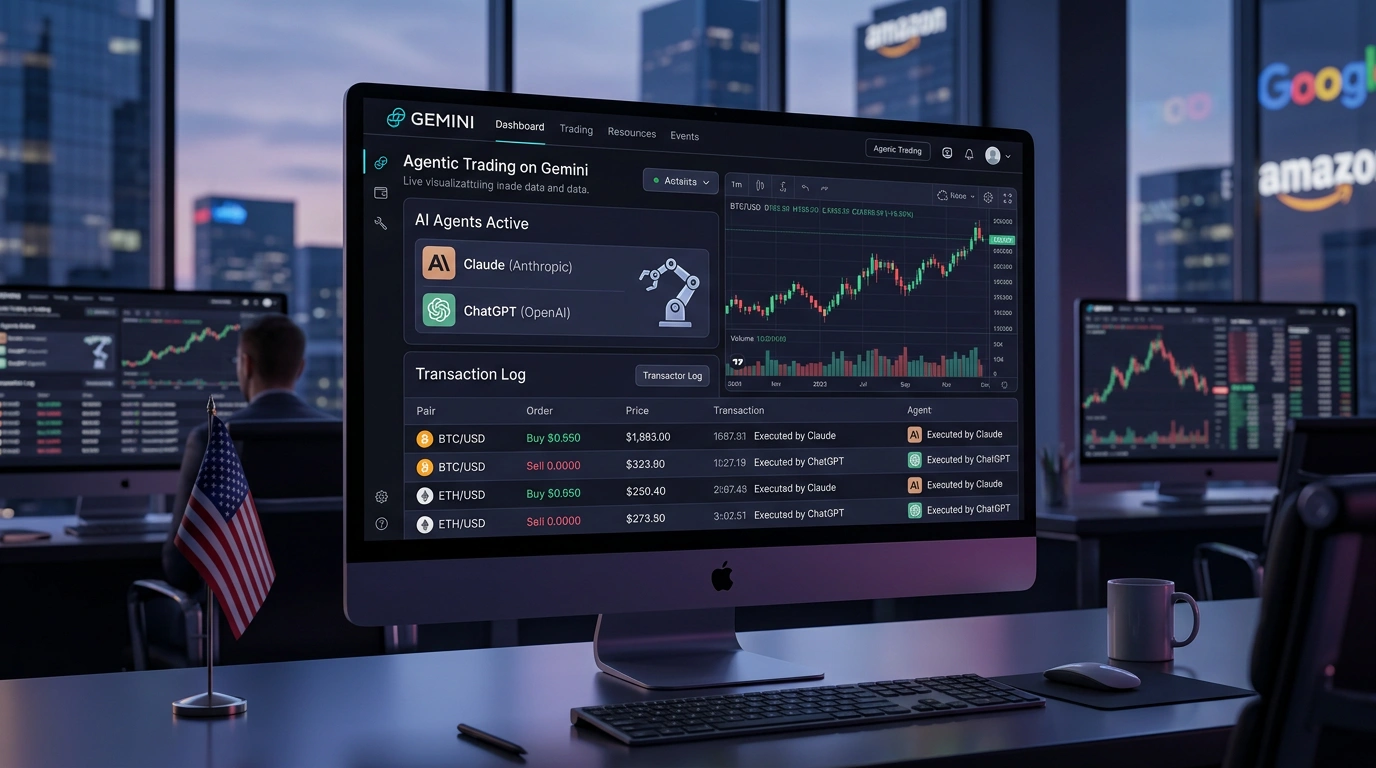
Crypto exchange Gemini launched Agentic Trading on April 27, 2026, giving AI agents direct control over user trading accounts. The Winklevoss brothers' firm called it the first tool of its kind available directly through a regulated US exchange. At launch, the platform supports two AI systems: Claude from Anthropic and ChatGPT from OpenAI, both connected through a shared open protocol. The new feature is available to Gemini clients in the United States immediately following an update to the platform's terms of service.
How Agentic Trading differs from ordinary trading bots
Until now, automated trading on centralized exchanges relied mainly on API keys with tightly restricted permissions. Bots executed pre-written scripts, and anything more complex required third-party platforms or custom server-side solutions. An AI agent within Agentic Trading works differently: it can place orders, close positions and react to market conditions in real time, with the same account-level access a human trader would have.
Users define the starting rules: risk limits, allowed assets, time windows. After that, the agent operates within those parameters without further input. Gemini describes the model as delegated trading, where the strategic choices stay with the human and the tactical execution goes to the AI. The approach is aimed primarily at active traders who want to automate routine decisions without losing sight of their broader strategy.
The core difference from traditional bots is adaptability. A script runs commands regardless of context. An AI agent reads the current situation and makes decisions based on continuously updated data. Previously, this level of autonomy was the one thing that separated a human trader from any automated system. Gemini is the first to give this logic a direct connection to a real trading account on a regulated platform.
Open protocol instead of closed integrations
The new feature runs on an open protocol through which AI models communicate with Gemini's trading system. This is a deliberate architectural choice: rather than locking into one AI system, the company built a shared connection standard. Third-party agent developers can use the same protocol as long as their system meets Gemini's technical requirements, and the list of supported AI models is not limited to the two current partners.
The protocol separates agent logic from order execution. The AI decides what to buy or sell; Gemini handles execution, compliance and platform-level risk controls. This split lets the exchange keep full oversight of regulatory requirements while the agent handles trading decisions. It sets Agentic Trading apart from solutions where AI connects to exchanges through unofficial or unregulated channels.
The open design means Gemini can add compatible models later without reworking core infrastructure. For AI agent developers, it is also a signal: Gemini is opening the platform as a regulated environment for testing trading strategies, not just a tool for individual users.
Claude and ChatGPT step into live markets
At launch, Gemini confirmed partnerships with two companies: Anthropic (Claude) and OpenAI (ChatGPT). Both AI systems can now trade Bitcoin, Ethereum and other cryptocurrencies on a licensed US platform in automated mode. For both models, this is the first entry into a regulated crypto market with real trading authority rather than a test environment.
Gemini did not share details on which strategies are supported at launch. The open protocol could allow agents to read market data, react to signals and run complex multi-step strategies. Previously, that kind of capability was mostly limited to unregulated DeFi protocols or enterprise-grade tools with restricted access. Gemini puts AI trading into a regulated, transparent setting for the first time while keeping all of the platform's protective mechanisms required under US law.
For end users, this means the option to run an AI agent that trades around the clock without manually reviewing each order. The question is not whether AI agents can outperform human traders. The question is how long it takes the market to find out, now that there is a regulated venue to test it.
Gemini's choice of Claude and ChatGPT for the initial launch reflects a practical decision: both systems are already widely used by developers, have public APIs and are backed by active communities. Other major regulated US exchanges, including Coinbase and Kraken, have not announced comparable products yet. If Agentic Trading finds demand among Gemini's clients, that will give competitors a concrete reason to accelerate their own efforts.
The liability question Washington has not answered yet
The launch raises an immediate question American law has not fully resolved: who is responsible for losses caused by an AI agent's decision? In its updated terms of service, Gemini states that financial responsibility stays with the user who granted the agent its permissions. That clarifies the exchange-client relationship, but it does not settle the legal status of the trades themselves.
The SEC and CFTC have not issued formal guidance on trades executed by AI agents on behalf of humans at registered platforms. Gemini is the first to move this question from theory into live practice. The market has seen something similar before: in the 2010s, algorithmic trading entered regulated venues before regulators had clear rules in place. A series of high-profile market disruptions in that period eventually pushed regulators to act.
The capabilities involved this time go well beyond anything a previous-generation algorithm could do, and the volume of delegated decisions is potentially far greater. How quickly regulators respond will become clear in the months ahead.



Comments
Your email address will not be published. Required fields are marked *