


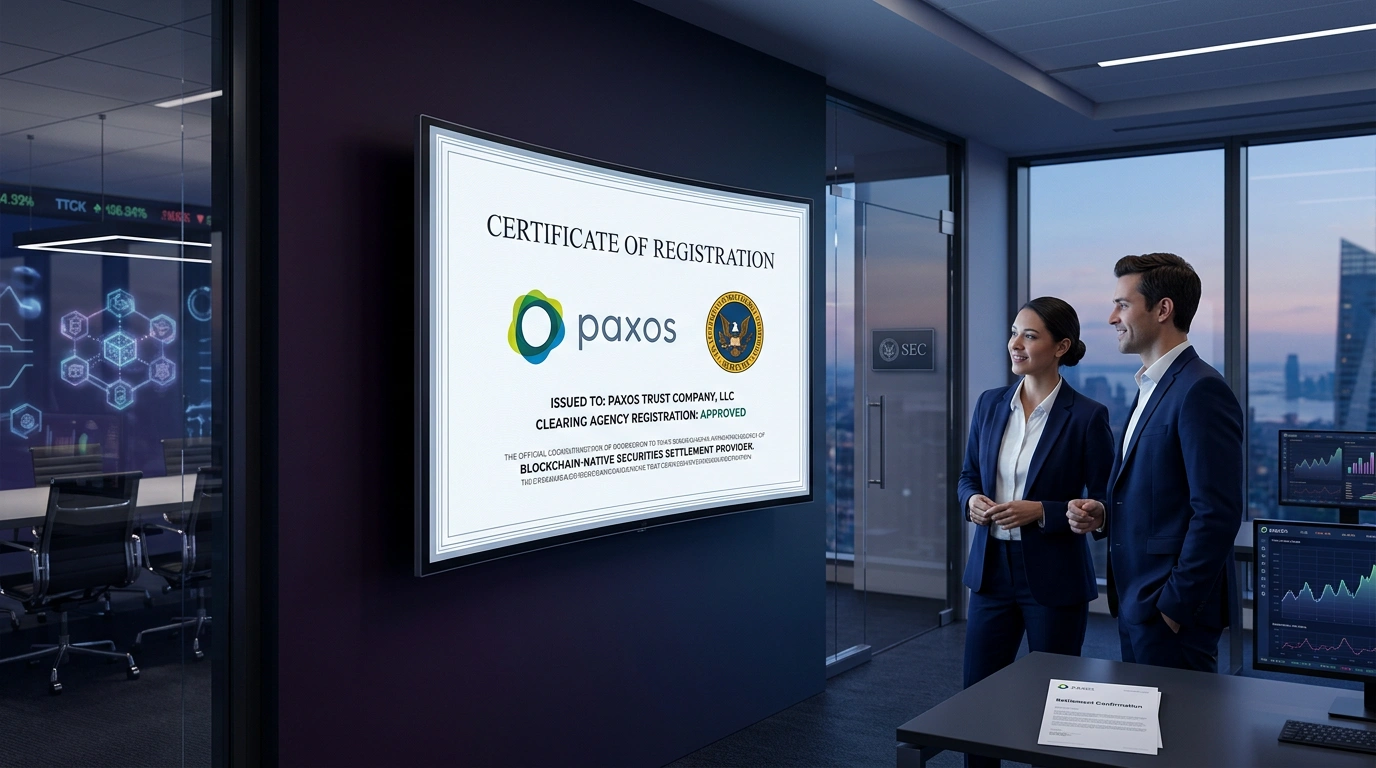
The US Securities and Exchange Commission has registered Paxos Securities Settlement Company as a clearing agency, making it the first "blockchain-native" settlement provider with such a status in the United States. The registration removes a legal barrier that prevented banks and brokers from building blockchain settlement infrastructure under federal securities law. The announcement came on May 29, 2026, after more than seven years of negotiations between Paxos and the regulator.
What a clearing agency does and why this registration matters
A clearing agency acts as an intermediary between buyers and sellers of securities. The two sides of a trade do not settle directly: a clearing provider stands between them, verifying trade details, matching counterparties, and guaranteeing the physical transfer of money and securities. Most US settlement currently runs through the DTCC, which operates on traditional centralized systems. The standard T+2 cycle means assets actually change hands two days after a trade is agreed, not at the moment of execution.
Blockchain clearing replaces part of that chain with an automated protocol. Settlement moves to same-day. Before Paxos received its registration, banks had no legal foundation for this model under US securities law. Now they do. For the Bitcoin and Ethereum markets, this raises the prospect of digital assets being processed by the same regulated infrastructure as traditional securities. Banks no longer have to choose between regulatory safety and blockchain efficiency.
Seven years from pilot to official status
In October 2019, the SEC issued Paxos a no-action letter, allowing the company to launch a blockchain settlement pilot for US equities. The service started in February 2020. The pilot ran for more than five years and produced measurable results: same-day settlement, lower operational costs, and fewer errors compared to traditional systems. Some of the world's largest financial institutions participated as partners and tested the system at industrial scale.
"Our clearing agency registration is the result of seven years of work with the SEC, beginning with our No-Action Letter in 2019 and the settlement pilot we operated with some of the world's largest and most sophisticated financial institutions."
- Charles Cascarilla, co-founder and CEO of Paxos, Paxos press release, May 29, 2026
Cascarilla also described the registration as "a critical piece of financial market infrastructure," pointing to the convergence of blockchain technology and traditional capital markets. Paxos described its new status as the "only blockchain-native firm" the SEC approved to provide clearing and settlement services as a central securities depository in the US. The pilot showed that blockchain settlement can deliver operational efficiency inside a fully regulated framework.
BUSD, Wells Notice, and the path to a clean record
Before this approval, Paxos faced significant regulatory pressure. In 2023, the SEC sent the company a Wells Notice, planning to recommend enforcement action over the Binance USD (BUSD) stablecoin. The regulator considered BUSD an unregistered security. At the same time, the New York Department of Financial Services (NYDFS) ordered Paxos to stop minting new BUSD. Both agencies acted independently, but the effect was the same: the company faced regulatory pressure from two directions at once.
In 2024, the SEC closed its investigation without filing suit and issued a formal notice of no action. In August 2025, Paxos reached a $48.5 million settlement with NYDFS over compliance failures related to Binance and BUSD. By the time the clearing agency registration arrived, all open disputes with regulators had been resolved. The earlier conflict with the SEC did not block the company's long-term regulatory plan.
Who gets a direct benefit
Banks and brokers feel the most direct effect. A registered SEC provider lets them route trades through Paxos's blockchain infrastructure without needing their own regulatory registration. Large financial institutions that already took part in the pilot can now move from testing to production scale.
- Same-day settlement instead of the standard T+1 or T+2 cycle
- Lower operational costs through automation at the blockchain protocol level
- Legal basis for clearing tokenized Treasuries, corporate bonds, and equities
- Banks build crypto settlement on top of already-regulated Paxos infrastructure, without their own licensing
Paxos also remains the issuer of several stablecoins: PayPal USD (PYUSD), Global Dollar (USDG), and Pax Gold (PAXG). The clearing agency registration adds another regulated layer to that product portfolio. The company now combines stablecoin issuance with operating a regulated settlement layer for securities. The US tokenized asset market already runs into the hundreds of billions of dollars, and a regulated clearing provider removes a key legal risk for that segment.
What it means for the broader crypto market
The Paxos registration closes another regulatory gap in US crypto infrastructure. After spot Bitcoin ETF approvals and the arrival of tokenized Treasuries on blockchain platforms, a blockchain clearing agency was the next structural piece. Three years ago this outcome looked unlikely: the same regulator sent Paxos a Wells Notice in 2023. Now the same SEC issued the registration.
The precedent may push competitors to file similar applications with the SEC. If a handful of providers gain comparable registrations over the next two to three years, blockchain clearing becomes a standard piece of US financial infrastructure rather than a single exception. For crypto investors, this is another sign that digital assets are entering the core of traditional markets, not sitting on the edges.

Comments
Your email address will not be published. Required fields are marked *