


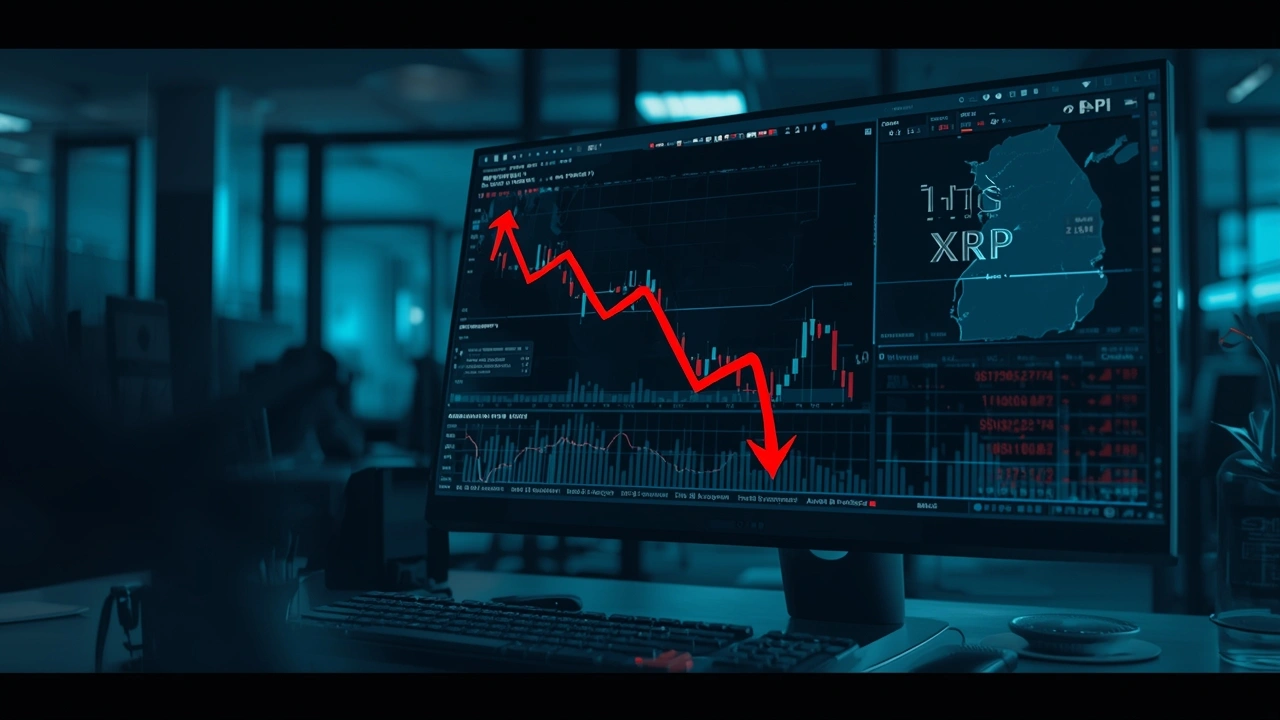
XRP slipped below $1 on the same day Ripple announced its third partnership deal in South Korea this year. The gap between the company's activity and the token's price shows that Ripple's institutional deals do not always translate into demand for XRP itself.
What happened to XRP's price
The token fell below the psychological $1 mark on Tuesday, losing more than 1% on the day and over 2% on the week. On both measures, XRP was the weakest of the major cryptocurrencies. That is a sharp contrast to a year ago, when the token traded above $3.
The drop came right after news of Ripple's business expansion, not because of any separate negative trigger. The market is clearly pricing Ripple the company apart from XRP the token it once issued.
The same pattern has been playing out for months. XRP has steadily lost ground through the summer while Ripple kept signing new institutional clients one after another. The correlation between the two has essentially disappeared.
For traders working XRP on spot markets or in hryvnia pairs on crypto exchangers, that split adds an extra layer of difficulty. Partnership news usually gets read as a buy signal, but this time the market moved the other way, and that break from the usual script is what analysts are focused on.
Ripple expands its partnerships in Korea
Jeonbuk Bank became the first regional bank in South Korea to deploy Ripple Payments for cross-border transfers. Founded in 1969 in the city of Jeonju, the bank dominates the financial market in the country's southwestern province.
This marks Ripple's third Korean deal of 2026. The company previously arranged custody and wallet infrastructure with insurer Kyobo Life Insurance and digital bank Kbank. Now the partner list includes a regional bank with a real customer base among small and mid-sized businesses.
Ripple Payments promises settlement in seconds to minutes instead of the days a transfer can take over SWIFT, and it runs around the clock, seven days a week. The bank plans to offer it to business clients including importers, exporters, IT startups and online content creators, the exact groups that usually feel cross-border payment delays the most.
In a release shared with the press, Ripple did not specify which asset would move the funds under the Jeonbuk deal. It could be XRP or the company's own dollar-pegged stablecoin RLUSD, and that ambiguity is exactly what traders have been debating.
South Korea is not a random pick here. Local regulators have spent the past couple of years steadily loosening rules around digital assets, and Korean retail traders have long accounted for some of the heaviest XRP trading volume worldwide. For Ripple, that combination of regulatory openness and a ready audience makes it unlikely this will be the year's last Korean deal.
"This deal reflects growing momentum across Korea's institutional financial sector, with banks building digital asset capability and looking for long-term infrastructure partners. Regional banks remain a core part of the real economy."
- Fiona Murray, Ripple's managing director for Asia Pacific, from a Ripple press release, August 2026
Why RLUSD is pulling attention away from XRP
Over the past year Ripple has been pushing RLUSD, not XRP, as the primary settlement asset for institutional clients. That strategy partly explains why a steady run of bank and financial partnerships has not translated into token gains.
The numbers on Ripple's own ledger back up the trend. Tokenized real-world assets on the XRP Ledger are worth roughly $1.38 billion, and more than three-fifths of that, or $845 million, sits in RLUSD. XRP remains the network's namesake, but not the asset actually carrying the money.
For banks and financial firms, that setup makes sense: RLUSD is pegged to the dollar and carries none of the price risk that comes with XRP. It is simply easier to sell clients a predictable settlement tool than to convince them to work with a volatile asset.
How traders are reading the outlook
Despite the weak price action, trader positioning looks decidedly more optimistic. Open interest in XRP futures reached roughly $2.78 billion this week.
- On Binance, long positions outnumber shorts by more than three to one.
- A similar ratio shows up on OKX, where traders are also betting on a rebound.
- Social media sentiment around XRP has turned its most negative in three months during that same stretch.
- That gap between futures positioning and public commentary is usually read as a sign of uncertainty rather than a confident trend.
For XRP holders and exchangers trading the pair, the takeaway is straightforward. A growing roster of Ripple's institutional clients does not by itself guarantee a higher token price as long as the company keeps routing its core settlements through RLUSD instead of XRP.
What it means for the market from here
Ripple's payments business keeps growing regardless of where XRP trades. The company is signing up new banks and insurers, expanding across Asia and processing more volume through its own stablecoin. For investors, that means treating two separate stories on their own terms: Ripple's success as a business and XRP's prospects as an asset, which no longer move in step.
Worth watching next is whether the company discloses the settlement asset for the Jeonbuk deal. If the flows turn out to run through XRP rather than RLUSD, that would be the first direct evidence in a long while linking Ripple's partnerships to actual demand for the token. So far, the market has not gotten that confirmation.
Until then, market participants are better off tracking hard numbers rather than partnership headlines: the volume actually moving through the XRP Ledger, and XRP's share among the assets settled on it. Those figures, not the count of signed deals, will show whether the token is moving back toward the center of Ripple's business.


Comments
Your email address will not be published. Required fields are marked *