


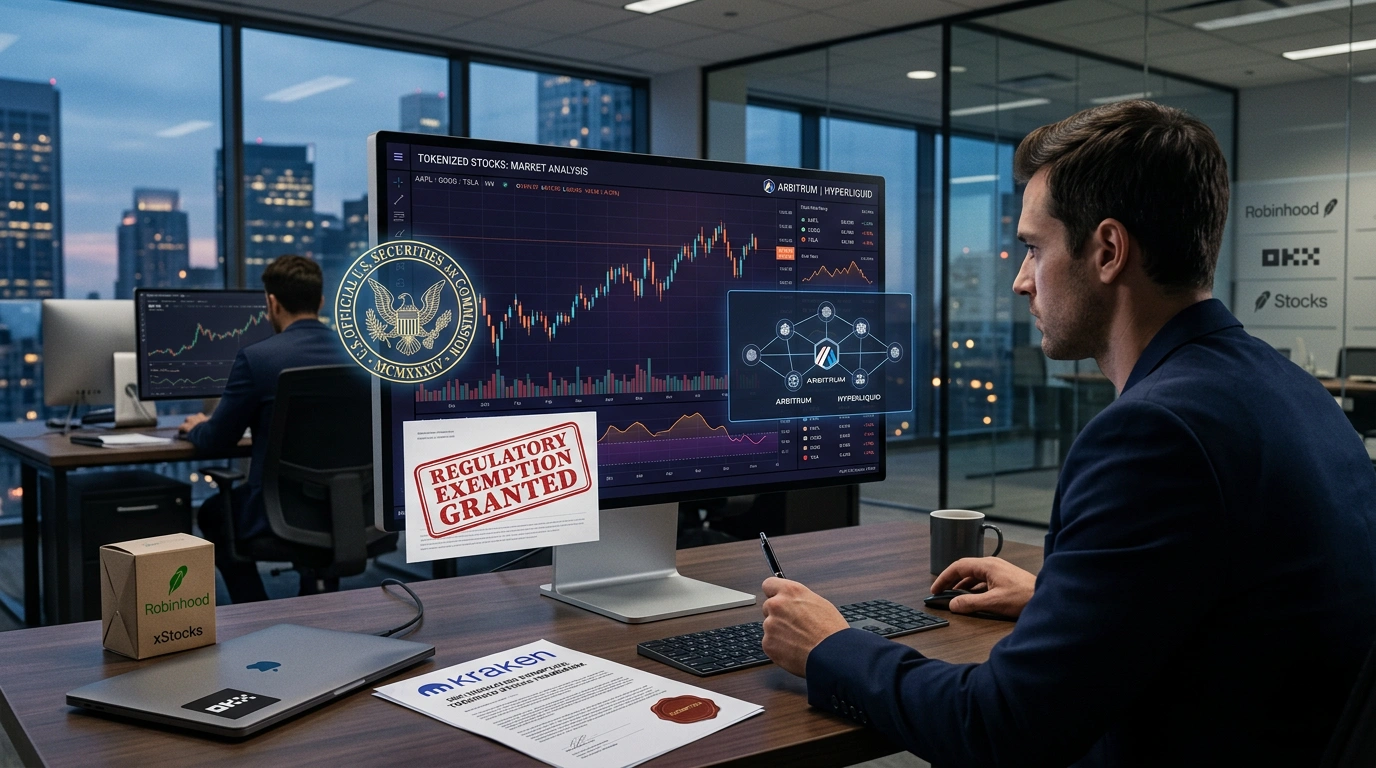
The US Securities and Exchange Commission is moving toward allowing third-party platforms to tokenize shares in public companies without the companies' consent. Bloomberg Law reported on May 19, 2026, citing people familiar with the matter, that the SEC is preparing an 'advancement exemption' that could be announced as early as this week. This directly reverses the agency's January guidance, which had effectively blocked the third-party tokenization segment.
What Is the SEC's 'Breakthrough Exemption'?
In January 2026, the SEC drew a sharp line between two types of tokenized stocks. The first type covers 'true' tokenization, where the company itself integrates blockchain into its official shareholder records. The second covers third-party products, where a platform issues tokens tracking a company's share price without the company's involvement. The January guidance treated the second type as synthetic exposure rather than real equity ownership, effectively closing off an entire segment of the market.
The 'advancement exemption' removes that line. Third-party platforms would be allowed to tokenize shares as long as those tokens carry the same rights as traditional shareholders: voting rights and dividends. Tokens without those features could face delisting. SEC Commissioner Hester Peirce led the push for this approach.
Before finalizing, the SEC reportedly spoke with hundreds of market participants. That said, not everyone inside the agency agrees. Bloomberg Law cites sources pointing to several officials remain opposed to the shift.
Which Platforms Were in Legal Limbo Until Now?
After the January guidance, several major products were operating with regulatory uncertainty overhead. Kraken launched xStocks, third-party tokens tracking public company shares. Robinhood rolled out tokenized equity positions on Arbitrum, an Ethereum layer-2 network. OKX offered perpetual contracts on private company shares. All of these products existed in a gray zone.
Hyperliquid moved fastest on the news: HYPE climbed to $48 and set a new local high. The market is pricing in that the SEC's new posture opens the door specifically for tokenized assets on decentralized platforms.
- Kraken xStocks: third-party tokens on public company shares, the broadest product in this category by coverage
- Robinhood: tokenized equity positions on Arbitrum, accessible to customers outside the US
- OKX: perpetual contracts on private company shares, including pre-IPO names
- Hyperliquid: fastest-reacting market beneficiary based on HYPE price response
Who Is Raising Concerns About This Approach?
Pushback is coming from two directions. Brett Redfearn, president of Securitize (one of the largest crypto-native tokenization platforms), warned that allowing third parties to tokenize shares 'without an issuer at the table' could lead to fragmentation. If multiple versions of tokenized shares from the same issuer exist, investors lose clarity about what each product is actually worth.
Some public companies are also unhappy. OpenAI and Anthropic previously opposed unauthorized tokens tracking their pre-IPO valuations. The SEC's new posture does not require companies to consent to tokenization, but it also gives them no tool to block it.
In other words, the 'development exemption' solves the regulatory problem for platforms but creates a new one: how to keep a market coherent when authorized and unauthorized tokenization of the same company exist in parallel.
$30 Billion in Two Years: Why the Market Needed These Rules
The tokenized securities market grew 200% year-over-year and crossed $30 billion. During April and May 2026 alone, several institutional players made concrete moves: Intercontinental Exchange (NYSE's parent) announced a tokenization platform for 24/7 trading and settlement, DTCC is preparing a July launch, and BlackRock, JPMorgan and Franklin Templeton have all filed or launched tokenized products.
The practical case for tokenization is straightforward. Blockchain-based trading and settlement can be faster and cheaper than traditional exchange infrastructure. Beyond that, a person without access to US markets or a standard brokerage account would be able to buy tokens in Nvidia or Apple through a crypto platform. That financial access argument is central to how tokenization advocates are pitching their case in Washington.
When Will the Official Decision Come?
Details are not yet finalized and could change before announcement. Bloomberg Law reports the exemption could come as early as this week. The SEC did not respond to requests for comment at time of publication.
The CLARITY Act is also moving through the Senate, having cleared committee. Several market participants have said publicly that Wall Street will not fully commit to tokenization without a unified legal framework and clear answers on ownership. The SEC may give the market a tactical green light through the exemption. The strategic regulatory foundation, though, still sits with Congress.
Comments
Your email address will not be published. Required fields are marked *