


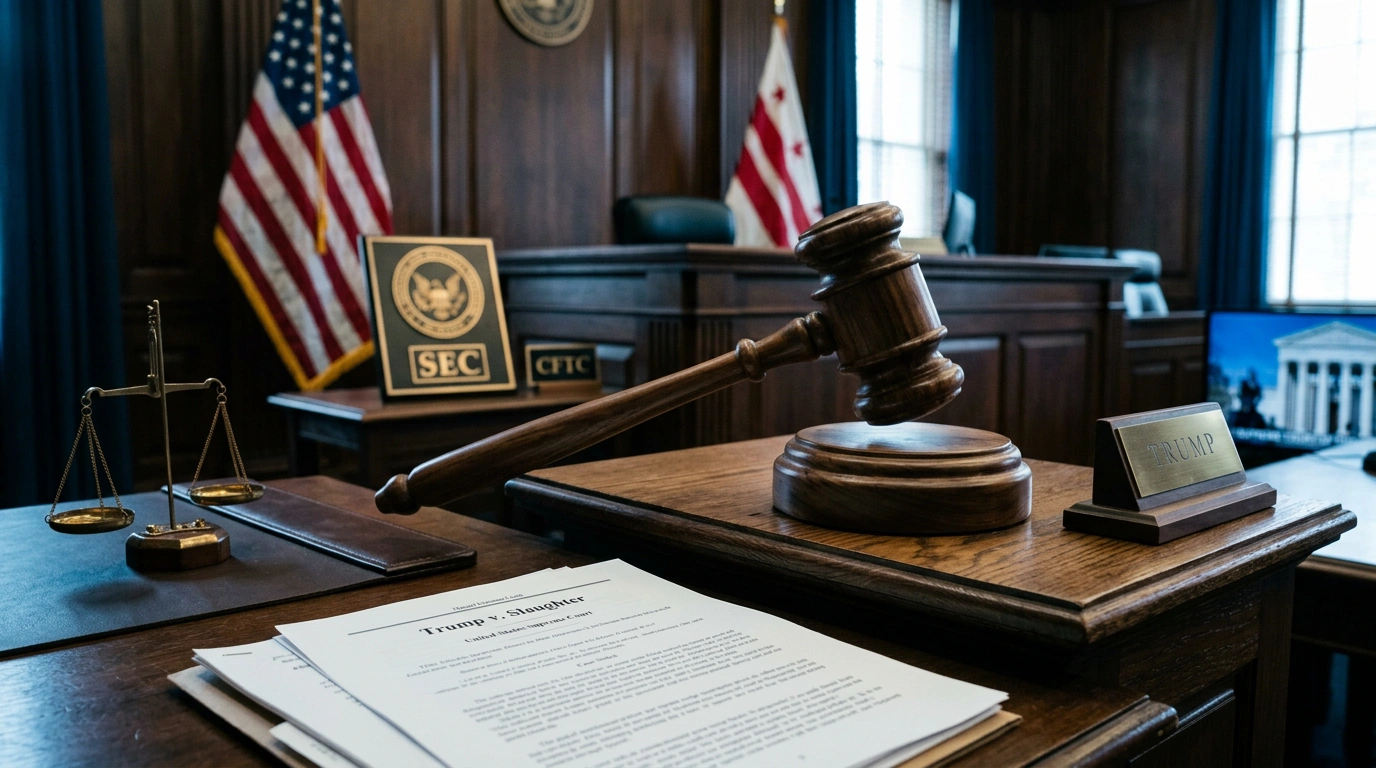
The US Supreme Court voted 6-3 to give the president authority to fire leaders of independent regulatory agencies at any time and without explanation. The ruling in Trump v. Slaughter overturns a 91-year precedent from the Franklin Roosevelt era. For the crypto industry, the decision hits closest at the SEC and CFTC, two agencies that hold legal authority over most digital assets in the United States.
What Did the Supreme Court Actually Decide?
Rebecca Slaughter served as a commissioner at the Federal Trade Commission (FTC), a consumer protection body. Trump moved to fire her. Slaughter challenged that in court, and the case reached the highest court in the country. Her husband serves as vice president of policy at Paradigm, one of the largest venture funds in the crypto space. That connection gave the couple the resources to take the case all the way.
The ruling overturns Humphrey's Executor v. United States, a 1935 precedent that shielded independent agencies from White House interference for more than nine decades. Under the old rule, a president could only remove an independent agency commissioner for gross neglect of duty or clear legal violations. That limit is now gone. The only carve-out that survived applies to Federal Reserve governors.
The decision reaches beyond the FTC. It extends to all independent US agencies, including the SEC, CFTC, FCC, NLRB, and others. The court's conservative majority backed the view that independent agencies violate the separation of powers by holding executive authority answerable to Congress but not to the president.
Why Does This Matter for the Crypto Market?
The SEC decides whether a token qualifies as a security and whether a crypto ETF can trade publicly. It approved spot Bitcoin and Ethereum ETFs and brought enforcement cases against Ripple and Coinbase. The CFTC oversees futures and derivatives markets, including Bitcoin futures on CME. Who sits on these bodies directly shapes how they read the law in contested situations.
Trump had already acted before the ruling by refusing to appoint Democrats to either agency. The SEC currently has three Republican commissioners and no Democrats. The CFTC has a single Republican chairman. By longstanding convention, both agencies were supposed to include members from both parties.
"Today's historic Slaughter decision by the Supreme Court is the greatest increase in presidential power in the last 100 years. Such a monumental ruling at such an important time!"
- Donald Trump, 47th President of the United States, social media post, June 29, 2026
What Happens to the CLARITY Act?
The ruling landed in the middle of the fight over the CLARITY Act, a bill that would formally legalize most types of crypto activity in the US and draw clear lines between SEC and CFTC authority. Right now both agencies claim overlapping jurisdiction over the same assets in many cases. The CLARITY Act aims to fix that and give the market legal certainty for the first time in years.
Senate Democrats had set a condition: they would back the bill only if Trump committed to appointing Democrats to both agencies, ensuring bipartisan oversight. In December 2025, the president said he was "open" to the idea. No appointments followed. Now Trump could theoretically appoint a Democrat and fire that person the day after a key vote.
Galaxy Research cut its odds for CLARITY Act passage in 2026 to 50%. The clock is running: the bill needs to pass before early August, before November midterm elections push the issue off the calendar. Senate Republicans said they plan to force a floor vote next month regardless of where Democrats stand.
What Changes in Practice?
- Faster approval of crypto products is possible if Republican SEC commissioners keep pushing an industry-friendly agenda without internal opposition.
- Every agency decision now carries built-in expiration risk. The next administration could swap in a new team and reverse established rules just as easily.
- For Ethereum ETFs, staking services, and stablecoin issuers, the ruling creates room for faster approvals under the current administration.
- Markets prefer stability. If the regulatory setup shifts with every election cycle, institutional players find it harder to commit to long-term US operations.
- EU regulators operating under MiCA gain a stability edge in the eyes of firms looking for a predictable legal environment.
Two Scenarios, Equal Odds
Bitcoin prices and most altcoins showed little movement in direct response to the ruling. Regulatory precedents rarely move the market within hours. But for funds and companies planning a long US presence, the decision shifts the risk picture. Independent agencies are no longer a buffer between the president and the market.
If the CLARITY Act passes in August, the industry gets legal clarity after more than a decade of debate. If it fails, the market stays in a position where each new president can rewrite the rules from scratch. Both outcomes carry equal weight right now.



Comments
Your email address will not be published. Required fields are marked *