


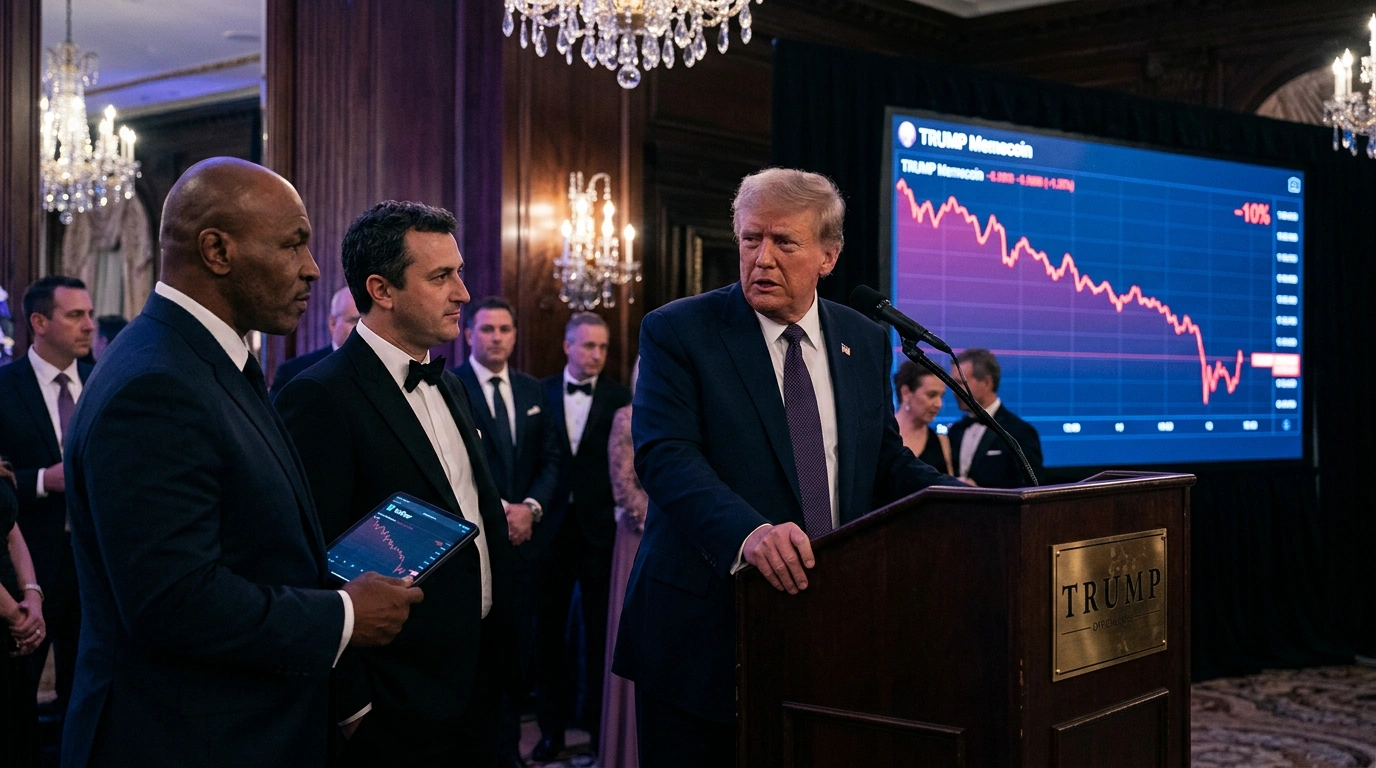
President Trump gathered several hundred top $TRUMP memecoin holders for a private Mar-a-Lago event on April 25. Among the guests were Tether CEO Paolo Ardoino, ARK Invest CEO Cathie Wood, and boxer Mike Tyson. Despite all the hype around the "most exclusive conference in the world," the token fell nearly 10% in 24 hours.
What Happened in Palm Beach on April 25
The Mar-a-Lago event drew several hundred top $TRUMP holders. Trump personally pledged to stop banks from derailing the Clarity Act and reaffirmed his support for the crypto industry. "We are the leader in crypto. It's now mainstream," he told the crowd.
Paolo Ardoino, Cathie Wood, Anchorage Digital CEO Nathan McCauley, and Mike Tyson all took the stage. The event touched on geopolitics too. Trump called NATO a "paper tiger" and raised the topics of Iran and Venezuela. But the main message was clear: White House backing for the crypto market.
The gathering was marketed as a reward for the token's top holders. A similar dinner last year triggered a wave of Democratic criticism and street protests. The reaction this time is more muted, but the conflict-of-interest question has not gone away.
Why the Token Fell Despite a Meeting with the President
In the 24 hours since the event started, $TRUMP dropped nearly 10%. Since the token's launch in January 2025, it has lost more than 96% from its peak. This fits a familiar pattern: price ran up in anticipation of the event, then buyers sold once the moment arrived.
Token distribution structure is also at play. The bulk of $TRUMP supply stays in the hands of the team and affiliated entities. Each price spike triggers selling pressure from these holdings, keeping the token from sustaining any rally. For retail holders, this means fighting a constant internal seller.
Broader market conditions add weight. Altcoins in April have been trailing Bitcoin, which holds above $78,000. Most speculative assets, including branded memecoins, have not recovered from the Q1 2026 drawdown. Any $TRUMP rally faces an uphill battle against the broader market trend.
The Clarity Act and Why Banks Are Blocking It
The Clarity Act aims to separate digital assets into two categories: securities and commodities. The bill has been stuck in the Senate because of a standoff between banking lobbyists and the crypto industry. Banks worry that interest-bearing stablecoin programs could pull deposits away from traditional financial institutions.
At the event, Trump confirmed the White House will not let banks stop the legislation. Recent negotiations suggest a compromise is possible. There are signs the process could resume before the end of this year's legislative calendar.
For the crypto market, passing the Clarity Act would mean more than regulatory clarity. Formally categorizing tokens would open the door to new products on U.S. platforms and potentially draw more institutional capital into the sector. Until the law passes, major players are staying cautious about investing in tokens that sit in regulatory gray areas.
The Conflict of Interest Slowing the Law Through Congress
Democrats want the Clarity Act to include a direct ban on senior officials profiting from the crypto industry. Trump is personally connected to several crypto projects ($TRUMP, World Liberty Financial, and others), and these ties have become one of the stated arguments against fast-tracking the bill.
This is not new territory. Last year, a similar event for memecoin holders sparked a wave of Democratic criticism and protests. The industry largely backs Trump, betting on favorable regulation. But every dinner like this one fuels those calling for stricter rules on officials with crypto holdings.
The more memecoin money buys access to the president, the harder it gets to separate Trump's personal business interests from federal regulatory policy. For some senators, this is an additional reason to vote against the Clarity Act in its current form.
What This Signals for the Altcoin Market in April
$TRUMP's drop after a high-profile event shows again that a branded memecoin runs by its own rules, largely disconnected from real market signals. The Mar-a-Lago gathering raised the token's profile but did not change its underlying supply-demand structure. After a 96% drop from peak, recovery requires genuinely new buyers and new reasons to enter.
Solana, the blockchain on which $TRUMP runs, is under pressure too. The SOL futures market shows some pickup, but the memecoin space on Solana is still far from late-2024 levels. Any lasting rally for $TRUMP will need a broader turn in the altcoin segment first.
Real upside for $TRUMP would need to come from Clarity Act progress, not another celebrity dinner. If the law passes, it would potentially legitimize new token categories and reduce uncertainty for U.S.-based issuers. Until then, $TRUMP remains a purely speculative asset with no regulatory foundation to stand on.


Comments
Your email address will not be published. Required fields are marked *