


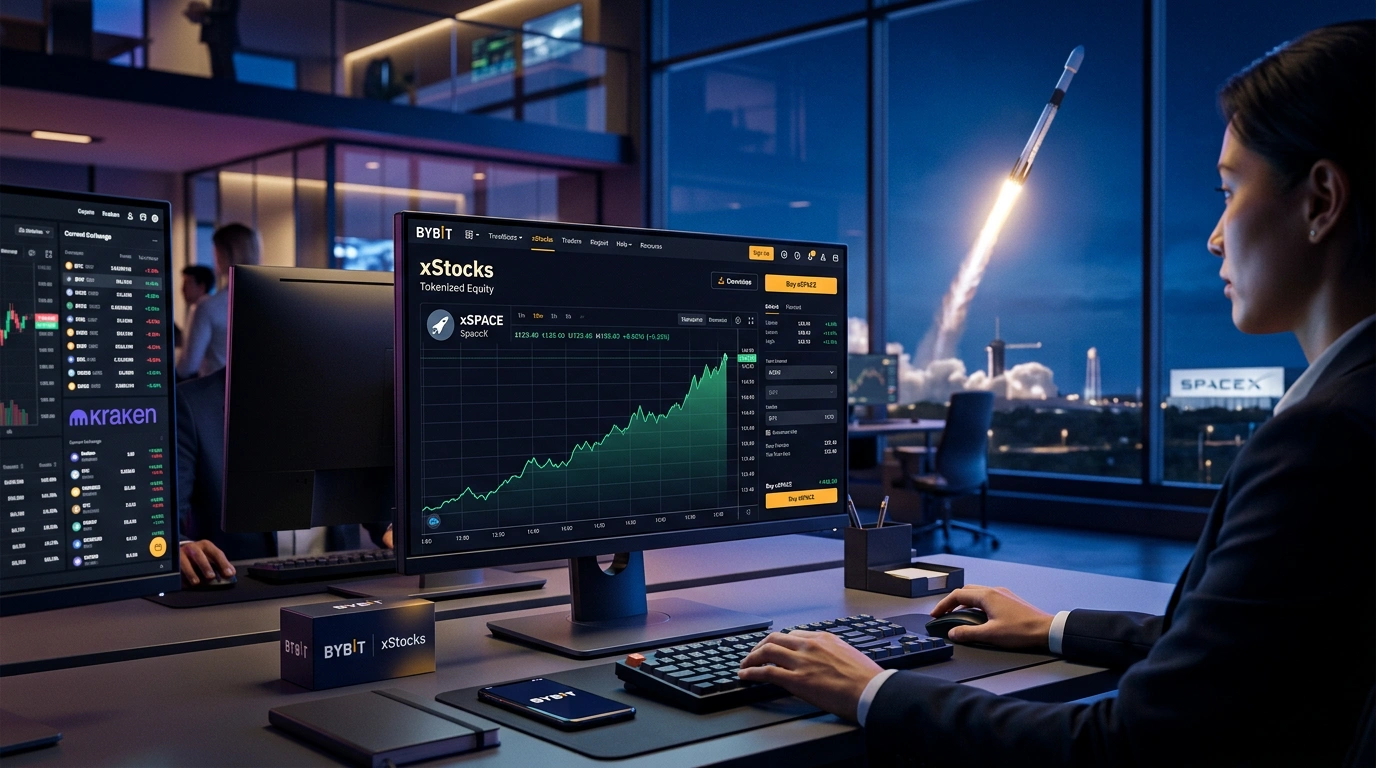
SpaceX is set to list on June 12, 2026. The company plans to raise roughly $75 billion at a valuation of at least $1.8 trillion, which would surpass Saudi Aramco's $29.4 billion IPO record from 2019 and become the largest public offering in corporate history. According to Bloomberg, demand has already exceeded the available share supply ahead of the listing date.
On June 7, Bybit joined the platforms offering tokenized access to the offering. Two days earlier, Kraken became the first to launch xStocks IPO Access. Both platforms issue clients the SPCXx token, backed 1:1 by actual SpaceX shares, with round-the-clock trading outside NYSE or NASDAQ session limits.
SpaceX IPO by the Numbers: How It Compares to the Biggest Listings in History
The planned $75 billion raise puts SpaceX at a level the public market has not seen before. Saudi Aramco raised $29.4 billion in 2019 and held the record for seven years. Alibaba ($25 billion, 2014), SoftBank ($23.5 billion, 2018) and Facebook ($16 billion, 2012) combined fall short of half what SpaceX is targeting.
The $1.8 trillion valuation rests primarily on Starlink, the satellite internet service already generating steady profit and scaling to new markets. The rocket development and research segments remain loss-making: launches, Starship and orbital constellation deployments require heavy capital spending. SpaceX also disclosed more than 18,000 Bitcoin on its balance sheet in IPO filings, an unusual line for a prospectus of this scale that sets the company apart from typical corporate debutants.
The public market gets its first look at the tradeoff between profitable Starlink and capital-intensive space programs. Whether the post-listing price holds the $1.8 trillion thesis or corrects lower in the first weeks of trading remains an open question.
xStocks: How the Platform Converts Shares into Tokens
xStocks was built by Backed Finance, a company Kraken acquired in late 2025. The product logic is straightforward. Each SpaceX share gets a blockchain counterpart fully backed by the underlying asset. SPCXx trades continuously, without weekend breaks and without NYSE or NASDAQ session limits. For investors outside the US, time zone differences stop being a constraint.
Participation requires a verified account. On Kraken, applications are accepted only through the mobile app: Kraken Pro and the desktop version do not support this feature. On Bybit, the standard interface works. Once an allocation is confirmed, the investor receives SPCXx and can trade before the official NYSE listing on June 12.
A core technical distinction of xStocks from earlier tokenized-equity models is cross-platform compatibility. SPCXx bought through Kraken and through Bybit is the same asset in a single registry. The liquidity of both platforms merges into one market, which in theory tightens spreads compared to a model where each platform runs its own separate token.
Bybit Joins in 48 Hours: What the Speed of Integration Signals
Kraken announced xStocks IPO Access on June 5. Bybit followed on June 7. Less than 48 hours passed between the two announcements. In traditional brokerage, connecting a new platform to an IPO takes months of negotiations, underwriter agreements and separate licenses for each jurisdiction. xStocks as an open protocol removes most of those barriers: a platform does not need its own SpaceX securities license for every individual country.
Access is closed to residents of the US, Canada, Australia and the UK due to regulatory constraints in those jurisdictions. For most EEA markets and more than 110 other countries, participation is open today, five days before the public listing. US investors who normally receive IPO allocations through domestic brokers are fully excluded from this product.
Bybit ranks among the three largest exchanges by spot volume. Its addition to xStocks does not only expand geographic reach - it substantially increases the baseline liquidity of the platform for all future tokens in the xStocks catalog.
Risks to Know Before June 12
Demand exceeded the available share count. Most applicants will receive less than they requested or a full decline. For heavily oversubscribed offerings, that outcome is common. A second set of risks is specific to tokenized equities and relates to the legal standing of SPCXx after the public listing.
- Allocation below the requested amount: more applications came in than shares in the offering. Underwriters decide each participant's allocation, and it may differ significantly from what was submitted.
- SPCXx liquidity after June 12 will depend on spread widths on xStocks relative to NYSE. A large price gap opens arbitrage between venues and temporarily raises token volatility.
- Corporate rights through SPCXx, shareholder voting and dividends, are not yet standardized in most jurisdictions where the tokens trade.
- Some regulators may reclassify SPCXx as a local security after the listing, changing trading conditions for participants in those markets.
After June 12: The First Major Test for Tokenized Equities
The SpaceX IPO will be the first large-scale public test of tokenized stocks as an asset class. If the offering goes through without technical failures, SPCXx spreads remain reasonable and no regulatory challenges emerge, future major IPOs will come to market with an xStocks catalog slot as a standard option rather than an exception.
For the crypto industry, this model is direct competition for the traditional brokerage business. Kraken and Bybit entered the IPO market without underwriter agreements in each country, without session-based trading limits and without conventional securities licenses. If SpaceX confirms the $1.8 trillion valuation and trading runs smoothly, this approach may become the template for dozens of future large listings, and that shift could happen much faster than traditional investment banks expect.



Comments
Your email address will not be published. Required fields are marked *