


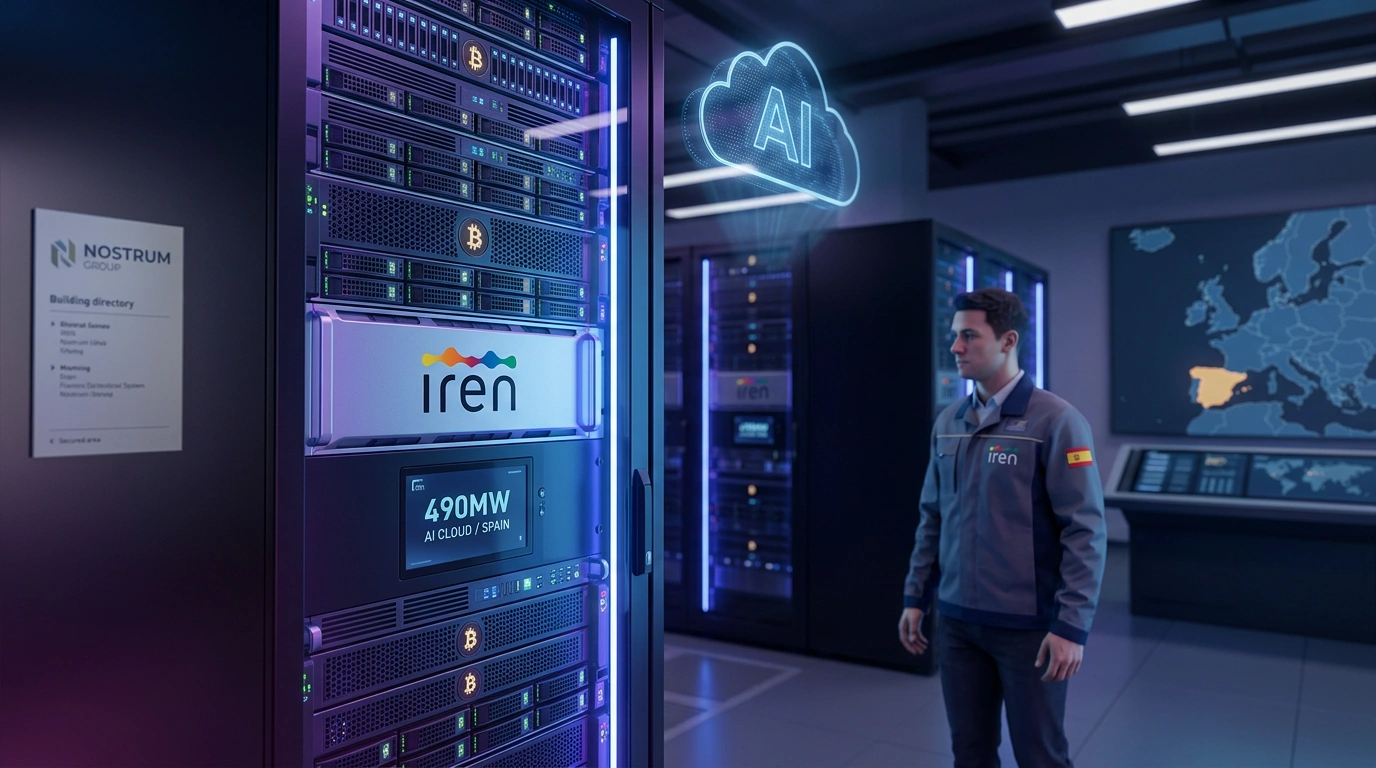
Bitcoin miner IREN completed its acquisition of Spanish data center developer Nostrum Group, officially entering the European Union market with an AI cloud strategy. The deal brought IREN's global power portfolio to approximately 5 gigawatts and sharpens a question growing louder across the public miner sector: how much longer will Bitcoin mining hold up as the core business model?
Nostrum Group and 490 MW in Spain: What IREN Actually Got
IREN added approximately 490 MW of grid-connected power in Spain, a development-ready site, and more than 50 engineers, construction professionals, and operations staff. The deal pushed the company's total global power portfolio to roughly 5 GW, with the Spanish asset making up about 10% of the total. Spain is IREN's third region after Australia and North America.
The location choice is deliberate. Spain offers competitive prices for industrial power from renewable sources and a well-developed fiber network. Its regulatory environment for new data centers remains more accommodating than the Netherlands or Ireland, where authorities have already restricted new construction due to grid strain. For an AI cloud platform serving clients across the EU, Middle East, and Africa, the Spanish footprint also gives latency advantages.
Nostrum's team stays with IREN. That cuts the timeline from deal close to first launch of the European AI Cloud Platform from several years to several quarters. A greenfield project at the same scale would take 3-4 years; Nostrum delivers the engineering base and people who already know Spanish regulators and grid operators.
"Europe is one of the largest and fastest-growing markets for AI infrastructure, and Spain is among its most compelling entry points."
- Daniel Roberts, co-founder and co-CEO of IREN, from the company press release, June 16, 2026
AI Cloud Revenue Nearly Doubled, Mining Revenue Fell
IREN's quarterly results for the three months ended March 31 show two parallel trends. AI cloud service revenue rose from $17.3 million to $33.6 million in a single quarter. Nearly doubled. Bitcoin mining revenue dropped from $167.4 million to $111.2 million, due to lower average BTC prices and partial decommissioning of mining hardware.
Mining is still the largest revenue source in absolute terms, but not by growth rate. As of March 31, IREN had approximately 150,000 GPUs installed or on order. The company estimates a potential annual revenue run rate of $3.7 billion at full GPU utilization. For context, its cloud revenue for the entire last quarter was $33.6 million. If the cloud unit holds its current growth pace, it will pass $100 million annually before the end of 2026.
Bernstein analysts have said IREN could eventually phase out most of its mining fleet, retrofitting existing sites for GPU infrastructure. If the revenue shift holds through two more quarters, the market will start repricing IREN not as a miner with an AI unit, but as a cloud operator with a mining legacy.
Where the Risks Hide for Shareholders
The pivot from ASIC to GPU looks logical on paper. In practice, there are four risk areas the market has not fully priced in.
- GPU supply is controlled by Nvidia. Queues for H100 and H200 are set by the vendor, and delivery timelines shift regardless of the buyer's plans.
- AI cloud clients have to be won. Mining revenue arrives automatically from the network, but every cloud contract must be signed separately.
- Retrofitting a data center for GPU costs considerably more than an ASIC installation. Different cooling, different power delivery, separate network infrastructure.
- If ASIC profitability rebounds as BTC rises past $100K, the GPU pivot will look premature in hindsight.
Each of these scenarios has already played out at some competitor to IREN over the past 18 months. That is not an argument against the transition. It is an argument that market projections may be too optimistic in the near term.
Why the EU and Not the US
The US AI infrastructure market is already crowded. Microsoft, Google, and Amazon have announced hundreds of billions in US capital spending. For a company IREN's size, competing there means going up against players with capital budgets an order of magnitude larger.
In the EU the picture is different. Demand for independent regional infrastructure exists; supply is lagging. The AI Act pushes companies to keep compute inside the EU rather than relying on US cloud services. Spain gained an edge over the Netherlands and Ireland, where restrictions on new data centers are already in place.
HIVE Digital is converting its Swedish facility for AI compute. Bitdeer is building capacity in Norway. But neither entered the region through a single acquisition at 490 MW. The Nostrum deal sets a new scale benchmark for miners moving into AI in the EU. Competition will still be stiff: Equinix and Digital Realty hold long-standing contracts with major corporate clients across the region.
Where the Mining Sector Goes After Nostrum
The IREN deal may become the reference point that accelerates AI transition plans at other public miners. Those who have announced intentions only will now face pressure to show specific megawatts and headcount. Smaller announcements without those details will get a skeptical read from the market.
For the Bitcoin network, a shift of major public miners into AI means a structural change in hashrate distribution. If several players reduce their ASIC fleets at the same time, mining difficulty may continue falling after its 10% drop in June. Private operators who stay in mining will capture a larger share of block rewards.
The metrics that will confirm whether the transition is real: AI cloud share of total revenue and average GPU utilization in upcoming IREN quarterly filings. Nostrum opens the door. The actual test comes when the company shows its first cloud contracts from the Spanish site, with real timelines and pricing.


Comments
Your email address will not be published. Required fields are marked *