


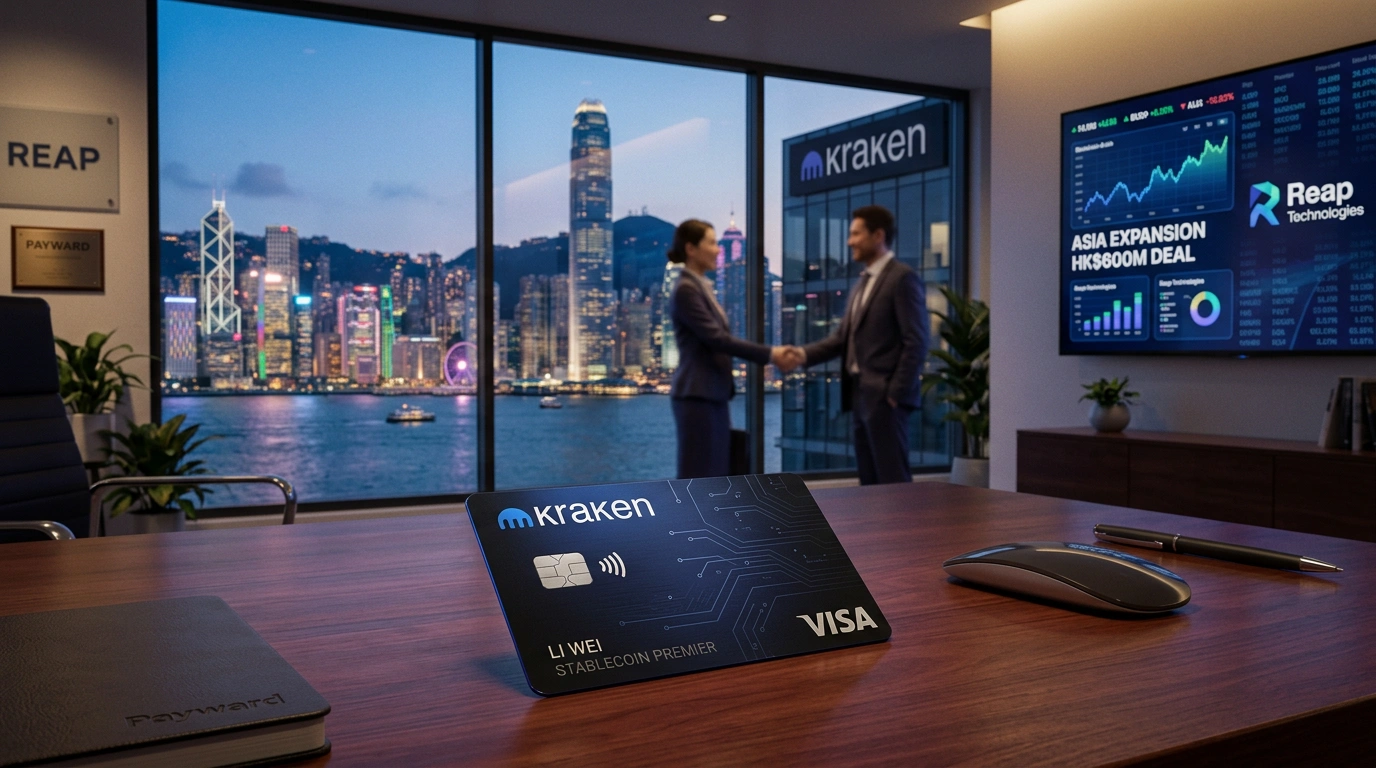
Kraken parent Payward has agreed to acquire Hong Kong-based Reap Technologies for up to $600 million. The deal marks Kraken's largest acquisition in its history. Reap brings card issuance, cross-border payments, and stablecoin settlement to Payward's B2B platform.
Deal Terms: $600M and a $20B Payward Valuation
Payward announced the deal on May 7, 2026. The purchase price will be paid in a mix of cash and Payward stock. The company did not disclose the exact split. The transaction values Payward at $20 billion.
The deal is expected to close in the second half of 2026, subject to regulatory approvals. Reap is based in Hong Kong, where the Hong Kong Monetary Authority governs payment businesses. Getting sign-offs across multiple jurisdictions may take months.
Reap will continue operating as a standalone platform. Co-founders Daren Guo and Kevin Kang remain with the company. Guo previously led Stripe's Asia Pacific business. Kang came from investment banking. They founded Reap together in 2018.
This is Payward's fourth major acquisition in quick succession. Earlier deals brought in derivatives exchange Bitnomial, futures broker NinjaTrader, and xStocks issuer Backed. Each purchase filled a specific gap in Payward's financial stack.
What Reap Does and Why Asia
Reap builds B2B payment infrastructure. Its platform connects Visa and Mastercard card networks, banking rails, and blockchain through a single API. Corporate clients can issue employee cards, run cross-border transfers, and hold liquidity in stablecoins.
Asia is the right market for this product. Cross-border transfers between Hong Kong, Singapore, Japan, and South Korea over legacy banking rails carry fees of 3-5% and settlement delays of up to several days. Stablecoins like USDT cut those costs and bring settlement time down to minutes.
Arjun Sethi, co-CEO of Payward and Kraken, put it plainly: "Card networks, banking rails, and blockchains on a single API, settling in stablecoins." That is what Reap sells.
Reap's clients are fintechs, payment aggregators, and corporate treasuries. They already know what the old banking infrastructure costs. They are looking for something better.
Where Stablecoins Meet Corporate Payments
Stablecoin payments have moved well beyond crypto exchanges. This year Meta started paying creators in USDC through Stripe, Visa extended stablecoin settlement to nine blockchain networks, and DoorDash switched to stablecoin payouts for couriers in 40 countries. Corporate demand is real.
For Payward, the Reap deal offers direct access to this market. Stripe paid $1.1 billion for Bridge in 2024 to build its own stablecoin rails. Kraken is entering the same field through Reap, adding payments on top of existing trading and derivatives services.
A Payward corporate client now gets one stack instead of several: trading on Kraken, derivatives via Bitnomial and NinjaTrader, digital equities via Backed, and cross-border payments through Reap. For a fintech needing a single vendor, that is a strong offer.
Competitive Environment
In the B2B stablecoin payments space, Payward faces Stripe (via Bridge), Coinbase (via Base), and traditional payment providers. None of them offers spot trading, derivatives, and stablecoin payments together in one stack.
A $20 billion valuation makes Payward one of the most valuable private crypto companies. Staying private gives it flexibility: no quarterly earnings pressure and fewer constraints on future deals.
Retail traders on Kraken will notice nothing. Bitcoin and other assets trade the same as always. Reap is aimed at corporate clients and fintechs, not individual investors.
What Happens After Closing
Once Reap is integrated, Payward Services will offer a full corporate stack through a single API. Kraken's trading platform, derivatives via Bitnomial and NinjaTrader, digital equities from Backed, and cross-border stablecoin payments from Reap all become available in one place. For a fintech replacing four separate vendor contracts, that means simpler architecture and lower operational costs.
Reap's existing clients will keep working without disruption. The platform stays independent after the deal closes.
Payward's strategy reads clearly after its fourth acquisition in a year. Trading exchange to full financial stack, one targeted deal at a time. Crypto companies are growing past their original roles, and Kraken is doing it more consistently than most.



Comments
Your email address will not be published. Required fields are marked *