


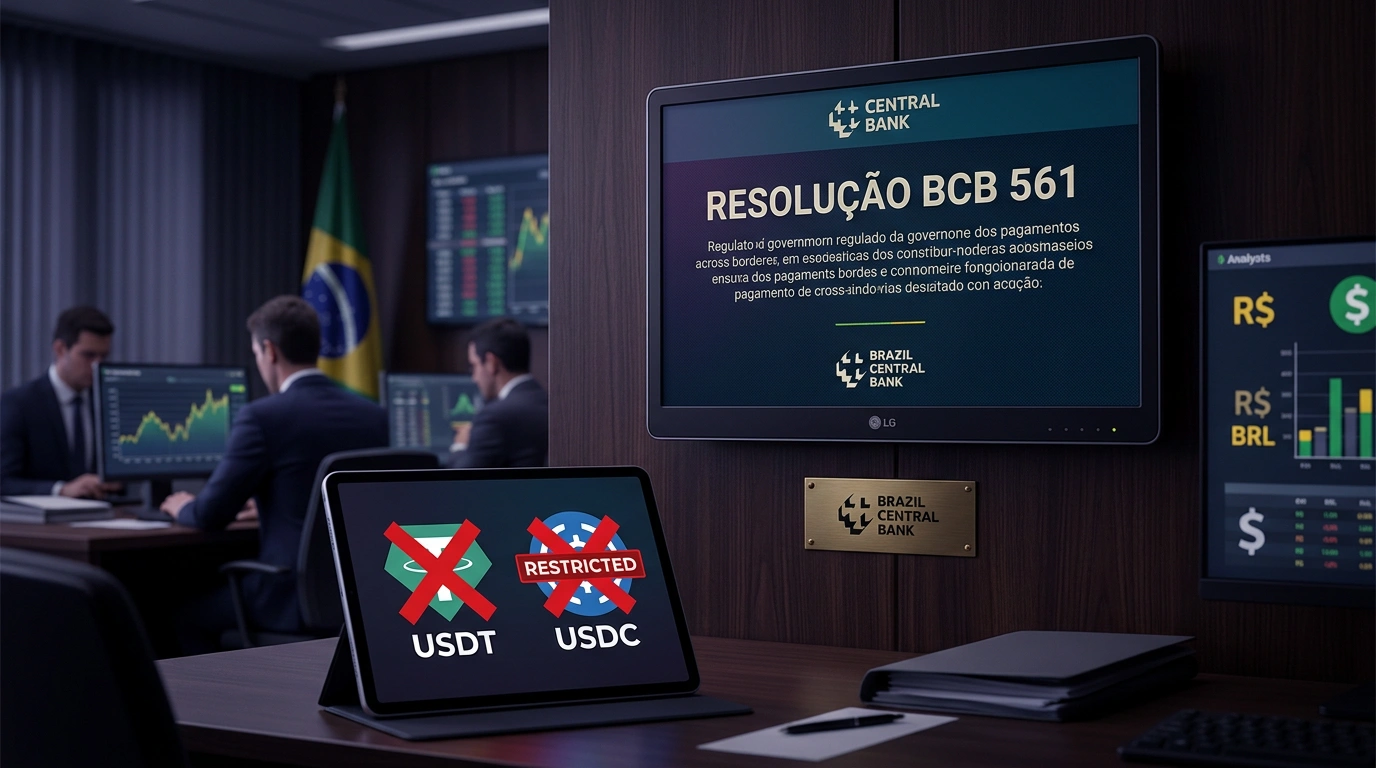
Brazil's central bank (BCB) published Resolution No. 561, barring crypto assets and stablecoins from settlements within the regulated eFX cross-border payment system. The restriction applies to fintech companies and payment operators. Individual investors who buy or hold crypto are not affected.
What Resolution No. 561 Prohibits
eFX is a regulated category in Brazil covering international payments and transfers. BCB set it up as a supervised channel for cross-border flows, requiring all participants to obtain authorization and report to the regulator. The system serves a broad range of participants: banks, payment startups, and money transfer providers. Resolution No. 561 now requires all settlements between an eFX provider and its foreign counterparty to go through standard foreign exchange transactions or non-resident accounts in Brazilian reais.
"Payments or receipts between an eFX provider and its foreign counterparty must be carried out exclusively through a foreign exchange transaction or movement in a non-resident Brazilian real account. The use of virtual assets is prohibited."
- BCB Resolution No. 561, Banco Central do Brasil, May 2026
In practice, this cuts off USDT and USDC from use in settlements between a payment operator and its foreign partner under an eFX license. One key point: the ban does not extend to buying or holding crypto. The retail market stays open.
This follows earlier BCB action. In November 2025, the central bank detailed new rules for virtual asset service providers, including authorization requirements for operating in the foreign exchange market. Resolution No. 561 is a stricter continuation of that direction.
Why BCB Acted Now
In early 2026, BCB Governor Gabriel Galipolo told Reuters that crypto activity in Brazil had surged sharply over the previous two to three years. About 90% of those flows were tied to stablecoins. The regulator flagged several problems at once: weak oversight of transaction taxation, money laundering exposure, and no guarantees around real asset backing.
BCB determined that stablecoin flows outside regulated channels are effectively invisible to fiscal and supervisory authorities. The scale of the situation required a direct response. The eFX segment, where the regulator has full oversight access, became the first point of enforcement.
Transition Period and What It Means for the Market
Providers not yet listed among approved eFX categories received a grace period. They may continue operating through May 31, 2027, if they apply for BCB authorization. But the ban on crypto settlements took effect immediately. Even during the transition, payments must go through traditional foreign exchange mechanisms.
The market received a deadline, not an exemption. Companies that want to stay in the regulated eFX segment must rebuild their payment infrastructure and obtain authorization. The other path means moving to unregulated space with all the legal exposure that brings. This decision gives providers a clear choice: file for authorization and stay in the licensed channel, or leave it.
Next Front: Unlicensed and Foreign-Currency Stablecoins
Resolution No. 561 is not BCB's last step. In a technical note to Brazil's Congress, the regulator warned that stablecoins issued outside banking supervision could face an outright ban or strict operating conditions in the domestic market. BCB identified two separate risk categories.
- Real-denominated stablecoins issued without a BCB license distort competition with regulated market participants.
- Foreign-currency stablecoins (USDT, USDC) complicate capital flow monitoring and break up the payments system into disconnected pieces.
- Both types could face additional restrictions across the entire domestic market.
Brazil is not the first country moving in this direction. Similar debates are running in the EU (MiCA), the US (GENIUS Act), and several Asian markets. The precision of BCB's actions and the scale of the Brazilian crypto market make this a meaningful reference point. Central banks are steadily pulling stablecoins out of the gray zone and into regulated space, where they face the same requirements as traditional financial players.



Comments
Your email address will not be published. Required fields are marked *