


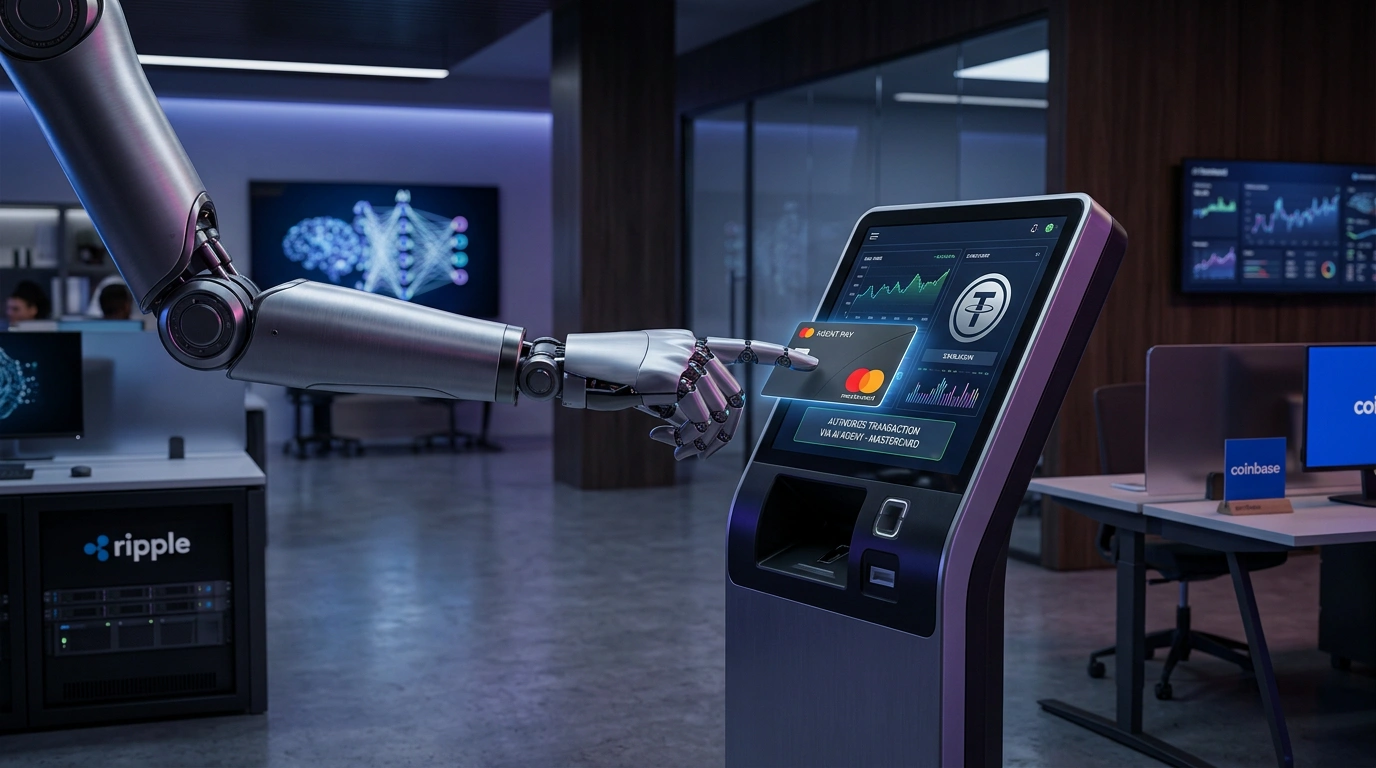
Mastercard launched Agent Pay for Machines, a platform for autonomous payments between AI agents without human involvement. More than 30 companies have already joined, including Coinbase, OKX, Ripple, Stripe, and Solana Foundation.
What is Agent Pay for Machines?
Mastercard already had a service called Agent Pay. The original version let AI agents make payments on behalf of specific users, but each transaction was still tied to a human account. The new platform cuts that dependency: it is designed for machine-to-machine settlements.
The platform supports three payment rails: bank cards, bank accounts, and stablecoins. Stablecoins allow the system to process micropayments worth fractions of a cent, while cards are unsuitable for this because of fixed processing fees. Mastercard supports USDC from Circle and RLUSD from Ripple. Both assets are already integrated into the company's production payment rails.
Mastercard already processes trillions of dollars in card transactions annually. Now the company wants machines, not just people, to use those same rails. The key difference is that machines can handle billions of tiny transactions per second, and cards were simply not built for that.
How does it work in practice?
To understand the mechanics, picture an AI assistant managing a company's cloud workloads. It orders computing capacity from a provider, pays for API calls to external services, coordinates auxiliary models. Each of these actions requires a payment. Before, either a human approved every operation, or the agent stopped. Now the agent acts on its own.
- Micropayments: fractions of a cent via stablecoins for scenarios where cards are impractical due to fixed fees
- Settlements across dozens of parallel agents without queues or delays
- Support for fiat instruments alongside crypto in one payment system
- Integration with the Mastercard network without replacing existing banking infrastructure
There is one more aspect worth understanding. In the system, each agent receives its own payment credentials, not tied to any human account. This opens up business models where one machine provides a service, another pays for it, and the human only sees the operation in a final summary report.
"Machine payments can make it possible for services to be bought and sold among agents at essentially different scales than payments today: very high volumes, very small values, very fast, and at extremely low latency."
- Jorn Lambert, Chief Product Officer, Mastercard, company press release, June 10, 2026
Who has already joined?
More than 30 companies from different sectors signed on at launch. Coinbase and Anchorage Digital cover the exchange and custody side. Polygon and Solana Foundation cover blockchain layers. Aave Labs and Alchemy joined from the DeFi and infrastructure side. Stripe and Cloudflare came from traditional payments and cloud infrastructure.
MoonPay and BVNK connect fiat with crypto. Mastercard acquired BVNK for up to $1.8 billion in March this year. The deal gave the company stablecoin infrastructure in its own portfolio. That infrastructure now becomes part of Agent Pay for Machines.
A partner list like this signals something beyond a pilot. Mastercard is not testing an idea. It is building infrastructure. When Coinbase and OKX sign onto the same project as Stripe and Cloudflare, no one wants to miss the payment layer for the machine economy.
Mastercard's crypto push in 2026
Agent Pay for Machines fits into a broader pattern. In March, Mastercard launched a Crypto Partner Program with more than 85 companies, including Binance and PayPal. Program participants are building products that combine digital assets with Mastercard's card network.
Around the same time, Mastercard joined Solana's enterprise blockchain environment to support stablecoin settlement. In early June, the company expanded its stablecoin settlement program by bringing USDC and RLUSD into production transactions. Three major moves in three months.
Mastercard is pragmatic about crypto. Stablecoins are useful to the company not for ideological reasons but for a practical task. Handling tiny sums fast and cheaply, where traditional processing costs more than the transaction itself.
Today, stablecoins handle settlements between people. The next step puts them between machines.
What comes next?
Mastercard is betting that its network will remain the central hub even in a machine economy. Rivals are already moving. Stripe is expanding its API for AI agents, and Coinbase is building its own autonomous payment infrastructure. The question is who sets the standard first.
Stablecoins play a purely practical role here. If an agent buys 10 seconds of compute time for $0.0003, a card does not work. USDC or RLUSD do. That is the niche where crypto beats traditional processing without any debate. Mastercard, it seems, sees this more clearly than most.
For the end user, all of this stays hidden for now. The market is clearly moving toward AI agents as a standard business tool. When that happens, an agent's ability to pay on its own will be as basic as internet access. Mastercard, OKX, Coinbase, and Ripple are already building that layer.



Comments
Your email address will not be published. Required fields are marked *