


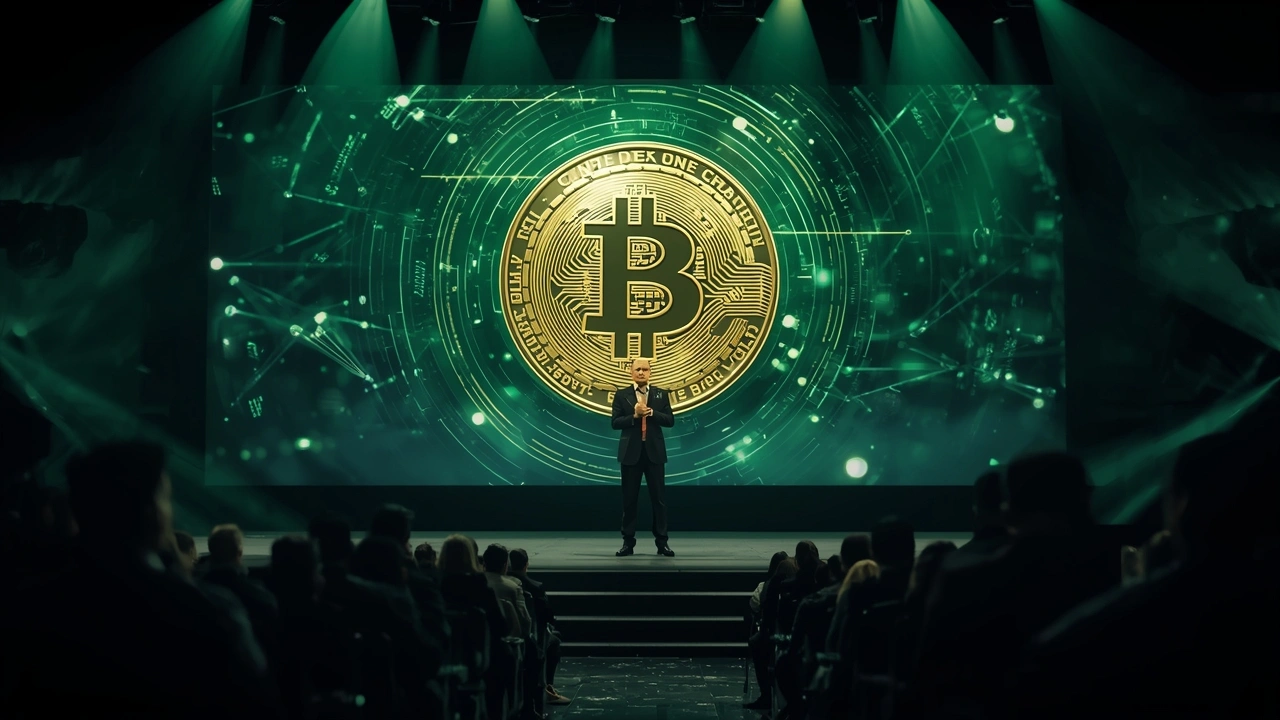
Kevin O'Leary put a $1 million target on Bitcoin. There is a catch: the industry has to deal with the quantum threat. Whether big funds move into Bitcoin depends on it.
What O'Leary Said About the Quantum Risk
The conversation took place at the Avalanche Summit in New York, on The Rollup podcast. O'Leary faced the camera with a Shohei Ohtani card around his neck. His collecting group bought the one-of-a-kind piece this year for $11 million, and it sits in a Tiffany holder with 110 carats of diamonds. The prop turned out to be apt. It was the basis of his argument that assets like this should live on a blockchain.
On Bitcoin he was direct. A million is possible if doubts around quantum computing go away. He means a scenario where a powerful enough quantum computer forges the signatures that protect wallets, a moment the industry calls Q-Day. No such computer exists today. Estimates of when one might arrive range from the early 2030s to never. A Google research paper this year argued that the date could come sooner than the industry expects.
For scale, Bitcoin trades around $80,000 now. A million is a 12.5x move, and it will not happen without big money.
That fear already affects money. Big funds, O'Leary says, keep Bitcoin within about 3% of a portfolio and treat it as a sliver of gold rather than a core holding.
Why Ethereum Fell Out of His Thesis
A year and a half ago the thesis was simple. Buy Bitcoin and Ethereum and you capture 97% of the industry's volatility, because everyone else would sooner or later standardize on Ethereum. It did not happen. "People aren't happy," O'Leary says, and now he asks which chain gets adopted next.
According to The Block, O'Leary is buying crypto again. He treats a major stock exchange moving onto a blockchain network as the signal to watch and calls it a watershed moment.
The new bet is different. Each industry will pick its own blockchain, not each investor. Collectibles, for example, could settle on Avalanche, while stock exchanges land on another network. Remember that he spoke at Avalanche's own summit. He did not name it the winner for exchange-listed stocks, though. The chain that a major exchange picks first for tokenization will, in his forecast, see its token "go through the roof", because every later trade runs through it.
"I don't think it's going to be Ethereum anymore. I don't think it's fast enough. I don't think it's secure enough. That's an opinion, my own opinion."
Kevin O'Leary, investor, from an interview with The Rollup podcast at Avalanche Summit
The remarks landed the same week as an SEC decision. The regulator introduced an "Innovation Exemption" that lets approved platforms trade tokenized stocks. For O'Leary, that is the same story as the card around his neck. Crypto, he says, will become the 12th sector of the S&P because it serves the other eleven. By the way, the president of Ava Labs said, according to The Block, that NYSE spent a year testing Avalanche technology for its tokenization plans.
A Bet on Electricity for AI
O'Leary does not want to repeat the Ethereum mistake with artificial intelligence. He does not guess the winner among models and puts money into the electricity none of them can run without. "You can't do AI without power," he says.
So far the portfolio holds three such positions.
- BitZero, a former Bitcoin miner turned Nasdaq-listed power company with land, fiber and permits in Norway and Finland.
- Private power projects in Alberta and Utah.
- Uranium, for the first time in his investing career.
He needs uranium for small modular reactors. These compact plants, he says, are headed for US data centers, and none of them run without nuclear fuel. "You might as well buy the picks and shovels of that strategy," O'Leary says. An AI slowdown, in his view, is not happening at all. Asked whether he sides with AI doom or an AI utopia, he answered without a pause. He is in the camp that believes AI will cure cancer. And letting China take the lead, O'Leary says, is never going to happen.
Clarity Act: Delayed, Not Dead
O'Leary was not surprised when the Senate blocked the Clarity Act. The bill got 49 of the 60 votes it needed, so it fell 11 short. "The chances of Clarity passing, in my view, were zero, and that's what happened," he said. But he sees it as a delay only.
His argument is straightforward. The House tax committee advanced the Digital Asset Tax Certainty Act, which lays out taxes for staking, mining and small transactions, plus broker requirements. When a government plans to tax something, it also needs rules for it. "We're going to tax staking," O'Leary said. "Once you tax, you've got to have policy," he added.
He expects Congress to return to the bill in the first or second quarter after the midterms, whichever party controls it. Until then, regulators are the ones writing the rules, not lawmakers. Congress, by O'Leary's read, will not hand the current administration a partisan win on this before the elections, and a bipartisan version comes back after them. The market took the pause calmly, and Bitcoin held above $80,000 after the failed vote.
How to Check O'Leary's Claims
O'Leary is an investor with a loud name, and his words are not a forecast. But his money is real. He caps his portfolio at 5% per stock and 20% per sector, yet over seven years crypto reached 23%. Checking the bet is easy, because it is enough to wait and see which network the first major exchange names for tokenized stocks.
Comments
Your email address will not be published. Required fields are marked *